
Last letters from the living dead man
David Patterson (Spirit) Hatch
THE CLASSIC COLLECTION · 1759
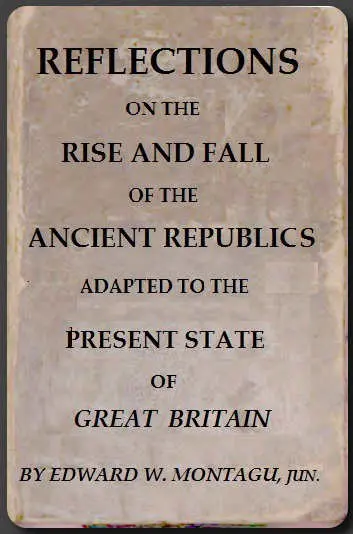
"Reflections on the Rise and Fall of the Ancient Republicks" by Edward W. Montagu is a historical account written in the early 19th century. The work examines the ancient republics such as Sparta, Athens, and Rome, drawing lessons that relate to the political climate of Great Britain at the time. Montagu aims to explore the factors that contributed to the rise and decline of these states, suggesting that contemporary issues in Britain resonate with those of the past. The opening portion of the book sets the stage for Montagu's exploration by introducing the historical context of various republics, particularly focusing on the governance of Sparta under Lycurgus. It discusses how Lycurgus addressed the deep-rooted issues of civil strife and inequality in Spartan society, ultimately leading to his significant reforms that promoted equality and a strong sense of civic duty among citizens. Montagu emphasizes the importance of unity and public virtue to maintain a free state, warning against the disunity that plagued ancient republics as a precursor to their downfall. The narrative establishes a foundation for Montagu's reflections, highlighting the dangers of neglecting the lessons of history in the face of contemporary political turmoil.
Introduction adapted from the source catalogue; source summaries may be automatically generated.
Free to read · English · 84,030 words · No account needed
MAKE TIME FOR A GOOD BOOK
On by default. Untick to stop anonymous reading totals. Each page counts after 10 seconds in view. How this works.
Anonymous counting is on unless you have switched it off.
Could we raise the venerable philosopher from the grave to take a short survey of the present manners of our own countrymen, would he not find them an amazingly exact copy of those of the Athenians, in the times immediately preceding their subjection to Macedon? Would he not see the same series of daily and nightly diversions, adapted to the taste of every class of people, from the publick breakfasting (that bane to the time and industry of the tradesman) up to our modern orgies, the midnight-revels of the masquerade? If he censured the Athenians for throwing away so much time and attention upon the chaste and manly scenes of Sophocles and Euripides, what must he have thought of that strange Shakespearomania (as I may term it) which prevailed so lately, and so universally amongst all ranks and all ages? Had he inquired of those multitudes who so long crowded both theatres at the representation of Romeo and Juliet, what were the striking beauties which so strongly and so repeatedly engaged their attention, could a tenth part of the affected admirers of that pathetick poet, have given him a more satisfactory answer than, “that it was the fashion?” would he not be convinced that fashion was the only motive, when he saw the same people thronging with the same eagerness, and swallowing the ribaldry of modern farce, and the buffoonery of pantomime with the same fury of applause? must he not have pronounced, that they as much exceeded the Athenians in thoughtless levity and folly, as they sunk beneath them in taste and judgment? For Plutarch does not find fault with the fine taste of the Athenians for the noble compositions of those incomparable poets; but for that excess of passion for the theatre, which, by setting up a new object of applause, had almost extinguished that publick virtue, for which they had been so greatly eminent; and made them more solicitous about the fate of a new tragedy, or the decision of the pretensions of two rival players, than about the fate of their country. But what idea must he have of the higher class of our people, when he saw those who should be foremost in a time of distress and danger, to animate the drooping spirit of their countrymen by the lustre of their example, attentive only to the unmanning trills of an opera; a degree of effeminacy which would have disgraced even the women of Greece, in times of greatest degeneracy. If he was informed that this species of diversion was so little natural to the rougher genius, as well as climate of Britain, that we were obliged to purchase and fetch over the worst performers of Italy at the expense of vast sums; what opinion must he form of our understanding? but if he was to see the insolence of these hirelings, and the servile prostration of their paymasters to these idols of their own making, how must such egregious folly excite his contempt and indignation! In the midst of these scenes of dissipation, this varying round of unceasing diversions, how must he be astonished at the complaint of poverty, taxes, the decay of trade, and the great difficulty of raising the necessary supplies for the publick service, which would strike his ear from every quarter! would not his censure upon our inconsistent conduct be just the same which the honest Spartan passed upon the infatuated Athenians? when a national militia of sixty thousand men only was asked for, would he not have blushed for those who opposed a measure (once the support and glory of every free state in Greece) and whittled it down to half the number from a pretended principle of economy? but could his philosophick gravity refrain a smile, when he saw the same people lavishing their thousands in subscriptions to balls, concerts, operas, and a long train of expensive et cætera’s, yet so wonderous frugal in pounds, shillings, and pence, in a measure so essential to the very safety of the nation? If therefore he saw a people bending under an accumulating load of debt, almost to bankruptcy, yet sinking more and more into a luxury, known in his time only to the effeminate Persians, and which required the wealth of Persia to support it: involved in a war, unsuccessful until measures were changed with ministers; yet indulging in all the pleasures of pomp and triumph, in the midst of national losses and national dishonour: ... contracting daily fresh debts of millions, to carry on that war, yet idly consuming more wealth in the useless pageantry of equipage, dress, table, and the almost innumerable articles of expensive luxury, than would support their fleets and armies; he could not help pronouncing such a people mad past the cure of Hellebore, and self-devoted to destruction.
Your reading position is saved on this browser. Take it to another device with a library code. Reading pages adapt to text, rather than matching a printed edition.
BEHIND THE BOOK
This eBook is for the use of anyone anywhere in the United States and most other parts of the world at no cost and with almost no restrictions whatsoever. You may copy it, give it away or re-use it under the terms of the Project Gutenberg License included with this eBook or online at www.gutenberg.org. If you are not located in the United States, you will have to check the laws of the country where you are located before using this eBook. Read the source licence.
The original source file, including credits and licence, is retained by this library. Request an original-format copy at no charge. Please include the book title and Project Gutenberg identifier #45592.
KEEP YOUR CURIOSITY GOING
David Patterson (Spirit) Hatch
Cécile Tormay

Moritz Busch
Coulson Kernahan
John L. Ransom

Ralph Waldo Emerson