
Last letters from the living dead man
David Patterson (Spirit) Hatch
THE CLASSIC COLLECTION · 1759
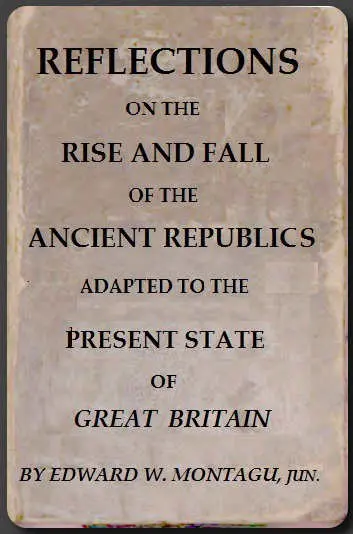
"Reflections on the Rise and Fall of the Ancient Republicks" by Edward W. Montagu is a historical account written in the early 19th century. The work examines the ancient republics such as Sparta, Athens, and Rome, drawing lessons that relate to the political climate of Great Britain at the time. Montagu aims to explore the factors that contributed to the rise and decline of these states, suggesting that contemporary issues in Britain resonate with those of the past. The opening portion of the book sets the stage for Montagu's exploration by introducing the historical context of various republics, particularly focusing on the governance of Sparta under Lycurgus. It discusses how Lycurgus addressed the deep-rooted issues of civil strife and inequality in Spartan society, ultimately leading to his significant reforms that promoted equality and a strong sense of civic duty among citizens. Montagu emphasizes the importance of unity and public virtue to maintain a free state, warning against the disunity that plagued ancient republics as a precursor to their downfall. The narrative establishes a foundation for Montagu's reflections, highlighting the dangers of neglecting the lessons of history in the face of contemporary political turmoil.
Introduction adapted from the source catalogue; source summaries may be automatically generated.
Free to read · English · 84,030 words · No account needed
MAKE TIME FOR A GOOD BOOK
On by default. Untick to stop anonymous reading totals. Each page counts after 10 seconds in view. How this works.
Anonymous counting is on unless you have switched it off.
Of all human passions, ambition may prove the most useful, or the most destructive to a people. The ...
... Digito ... monstrari et dicier hic est;[154]
the fondness for admiration and applause seems coeval with man, and accompanies us from the cradle to the grave. Every man pants after distinction, and even in this world affects a kind of immortality. When this love of admiration and applause is the only end proposed by ambition, it then becomes a primary passion; all the other passions are compelled to be subservient, and will be wholly employed on the means conducive to that end. But whether this passion for fame, this eagerness after that imaginary life, which exists only in the breath of other people, be laudable or criminal, useful or frivolous, must be determined by the means employed, which will always be directed to whatever happens to be the reigning object of applause. Upon this principle, however the means may differ, the end will be still the same; from the hero down to the boxer in the bear-garden; from the legislator who new-models a state, down to the humbler genius who strikes out the newest cut for a coat-sleeve. For it was the same principle directing to the same end, which impelled Erostratus to set fire to the temple of Diana, and Alexander to set the world in a flame so quickly after.
There is no mark which so surely indicates the reigning manners of a people at different periods, as that quality or turn of mind, which happens to be the reigning object of publick applause. For as the reigning object of applause will necessarily constitute the leading fashion, and as the leading fashion always takes rise among the great or leading people; if the object of applause be praiseworthy, the example of the great will have a due influence upon the inferior classes; if frivolous or vicious, the whole body of the people will take the same cast, and be quickly infected by the contagion. There cannot, therefore, be a more certain criterion, by which we may form our judgment of the national virtue or national degeneracy of any people, in any period of their existence, than from those characters, which are the most distinguished in every period of their respective histories. To analyze these remarkable characters, to investigate the end proposed by all their actions, which opens to us all their secret springs; and to develop the means employed for the acquisition of that end, is not only the most entertaining, but, in my opinion, by much the most useful, part of history. For as the reigning object of applause arises from the prevailing manners of a people, it will necessarily be the reigning object of desire, and continue to influence the manners of succeeding generations, until it is opposed, and gradually gives way to some new object. Consequently the prevailing manners of any people may be investigated without much difficulty, in my opinion, if we attend to the increase or decrease of good or bad characters, as recorded in any period of their history; because the greater number will generally endeavour to distinguish themselves by whatever happens at that time to be the reigning object of applause. Hence too we may observe the progressive order, in which the manners of any people prepared the way for every remarkable mutation in their government. For no essential mutation can ever be effected in any government (unless by the violence of external force) until the prevailing manners of the people are ripe for such a change. Consequently, as like causes will ever produce like effects; when we observe the same similarity of manners prevailing amongst our own people, with that which preceded the last fatal mutation of government in any other free nation; we may, at such a time, give a shrewd guess at the approaching fate of our constitution and country. Thus in the infancy and rise of the Grecian republicks, when necessity of self-defence had given a manly and warlike turn to the temper of the people, and the continuance of the same necessity had fixed it into a habit, the love of their country soon became the reigning object of publick applause. As this reigning object consequently became the chief object of desire to every one who was ambitious of publick applause, it quickly grew to be the fashion. The whole people in those states glowed with the generous principle of publick virtue to the highest degree of enthusiasm. Wealth had then no charms, and all the bewitching pleasures of luxury were unknown, or despised. And those brave people courted and embraced toils, danger, and even death itself, with the greatest ardour, in pursuit of this darling object of their universal wishes. Every man planned, toiled, and bled, not for himself, but for his country. Hence the produce of those ages was a race of patriot statesmen and real heroes. This generous principle gave rise to those seminaries of manly bravery and heroick emulation, the Olympick, Isthmian, and other publick games. To obtain the victory at those scenes of publick glory was esteemed the utmost summit of human felicity, a wreath of wild olive, laurel or parsley (the victor’s prize) that palma nobilis, as Horace terms it, which
Your reading position is saved on this browser. Take it to another device with a library code. Reading pages adapt to text, rather than matching a printed edition.
BEHIND THE BOOK
This eBook is for the use of anyone anywhere in the United States and most other parts of the world at no cost and with almost no restrictions whatsoever. You may copy it, give it away or re-use it under the terms of the Project Gutenberg License included with this eBook or online at www.gutenberg.org. If you are not located in the United States, you will have to check the laws of the country where you are located before using this eBook. Read the source licence.
The original source file, including credits and licence, is retained by this library. Request an original-format copy at no charge. Please include the book title and Project Gutenberg identifier #45592.
KEEP YOUR CURIOSITY GOING
David Patterson (Spirit) Hatch
Cécile Tormay

Moritz Busch
Coulson Kernahan
John L. Ransom

Ralph Waldo Emerson