
Last letters from the living dead man
David Patterson (Spirit) Hatch
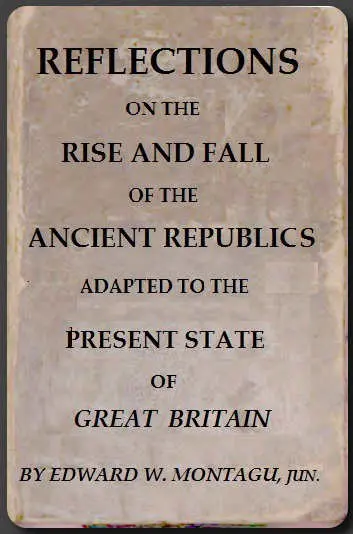
THE CLASSIC COLLECTION · 1759
"Reflections on the Rise and Fall of the Ancient Republicks" by Edward W. Montagu is a historical account written in the early 19th century. The work examines the ancient republics such as Sparta, Athens, and Rome, drawing lessons that relate to the political climate of Great Britain at the time. Montagu aims to explore the factors that contributed to the rise and decline of these states, suggesting that contemporary issues in Britain resonate with those of the past. The opening portion of the book sets the stage for Montagu's exploration by introducing the historical context of various republics, particularly focusing on the governance of Sparta under Lycurgus. It discusses how Lycurgus addressed the deep-rooted issues of civil strife and inequality in Spartan society, ultimately leading to his significant reforms that promoted equality and a strong sense of civic duty among citizens. Montagu emphasizes the importance of unity and public virtue to maintain a free state, warning against the disunity that plagued ancient republics as a precursor to their downfall. The narrative establishes a foundation for Montagu's reflections, highlighting the dangers of neglecting the lessons of history in the face of contemporary political turmoil.
Introduction adapted from the source catalogue; source summaries may be automatically generated.
Free to read · English · 84,030 words · No account needed
MAKE TIME FOR A GOOD BOOK
On by default. Untick to stop anonymous reading totals. Each page counts after 10 seconds in view. How this works.
Anonymous counting is on unless you have switched it off.
The late revolution of government in Sweden, though arising from the same principles, took a very different turn. Charles the twelfth, brave even to enthusiasm, and as insatiably fond of glory as the ambitious Alexander, had quite tired out and exhausted his people, by his destructive expeditions. But when that fortunate shot from the town of Frederickshal gave repose to his own country as well as to a great part of Europe, the states of Sweden, no longer awed by a warlike monarch (who had usurped a despotick power) and a veteran army, again resumed the exercise of their own inherent powers. Stimulated by a desire of vengeance for the evils they had already suffered, and the fear of smarting again under the same evils, they beheaded Gortz, the minister of their late monarch’s oppressions, and left the crown no more than the bare shadow of authority. For though they continued the monarchy for life and hereditary, yet they imposed such rigid terms upon their succeeding kings, as reduced them to a state of dependance and impotence nearly equal to a doge of Genoa or Venice. We see, in both these instances, the revolution in government effected by the union of two powers of the government against the third. The catastrophe indeed in both nations was different, because that third power which was obnoxious to the other two, was different in each nation. In the former of these instances, the people, fired with resentment against the nobility, and instigated by secret emissaries of the crown, blindly gave up their whole power to the king, which enabled him to deprive the nobility (the second estate) of their share of power, and bring the whole to centre in the crown. Thus the government in Denmark was changed into absolute monarchy. In the latter, the senate took the lead during the interregnum, which followed the death of Charles, and changed the government into aristocracy. For though the outward form of government indeed is preserved, yet the essence no longer remains. The monarchy is merely titular, but the whole power is absorbed by the senate, consequently the government is strictly aristocratick. For the people were by no means gainers by the change, but remain in the same state of servitude, which they so much complained of before. Thus in all revolutions in mixed governments, where the union of two injured powers is animated by the spirit of patriotism, and directed by that salutary rule before laid down, which forbids us to destroy, and only enjoins us to reduce the third offending power within its proper bounds, the balance of government will be restored upon its first principles, and the change will be for the better. Thus when the arbitrary and insupportable encroachments of the crown under James the second, aimed so visibly at the subversion of our constitution, and the introduction of absolute monarchy; necessity authorized the lords and commons (the other two powers) to have recourse to the joint exercise of that restraining power, which is the inherent resource of all mixed governments. But as the exercise of this power was conducted by patriotism, and regulated by the above-mentioned rule, the event was the late happy revolution; by which the power of the crown was restrained within its proper limits, and the government resettled upon its true basis, as nearly as the genius of the times would admit of. But if the passions prevail, and ambition lurks beneath the mask of patriotism, the change will inevitably be for the worse. Because the restitution of the balance of government, which alone can authorize the exercise of the two joint powers against the third, will be only the pretext, whilst the whole weight and fury of the incensed people will be directed solely to the ends of ambition. Thus if the regal power should be enabled to take the lead by gaining over the whole weight of the people, the change will terminate in absolute monarchy; which so lately happened in Denmark, as it had happened before in almost all the old Gothick governments. If the aristocratick power, actuated by that ambition, which (an extreme few instances excepted) seems inseparable from the regal, should be able to direct the joint force of the people against the crown, the change will be to an aristocratick government, like the present state of Sweden, or the government of Holland, from the death of William the third, to the late revolution in favour of the stadtholder. If the power of the people impelled to action by any cause, either real or imaginary, should be able to subvert the other two, the consequence will be, that anarchy, which Polybius terms, the ferine and savage dominion of the people.[363] This will continue until some able and daring spirit, whose low birth or fortune precluded him from rising to the chief dignities of the state by any other means, puts himself at the head of the populace inured to live by plunder and rapine, and drawing the whole power to himself, erects a tyranny upon the ruins of the former government; or until the community, tired out and impatient under their distracted situation, bring back the government into its old channel. This is what Polybius terms the circumvolution of governments;[364] or the rotation of governments within themselves until they return to the same point. The fate of the Grecian and Roman republicks terminated in the former of these events. The distracted state of government in this nation, from 1648, to the restoration of Charles the second, ended happily in the latter, though the nation for some years experienced the former of these catastrophes under the government of Cromwell.
Your reading position is saved on this browser. Take it to another device with a library code. Reading pages adapt to text, rather than matching a printed edition.
BEHIND THE BOOK
This eBook is for the use of anyone anywhere in the United States and most other parts of the world at no cost and with almost no restrictions whatsoever. You may copy it, give it away or re-use it under the terms of the Project Gutenberg License included with this eBook or online at www.gutenberg.org. If you are not located in the United States, you will have to check the laws of the country where you are located before using this eBook. Read the source licence.
The original source file, including credits and licence, is retained by this library. Request an original-format copy at no charge. Please include the book title and Project Gutenberg identifier #45592.
KEEP YOUR CURIOSITY GOING
David Patterson (Spirit) Hatch
Cécile Tormay

Moritz Busch
Coulson Kernahan
John L. Ransom

Ralph Waldo Emerson