
Last letters from the living dead man
David Patterson (Spirit) Hatch
THE CLASSIC COLLECTION · 1759
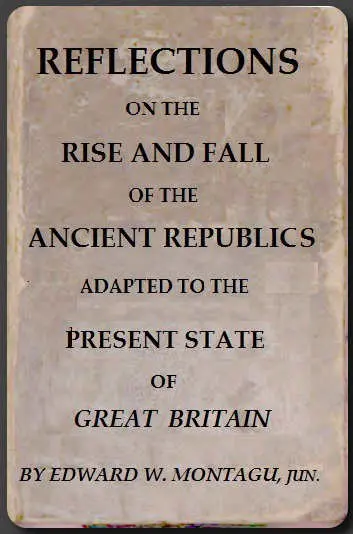
"Reflections on the Rise and Fall of the Ancient Republicks" by Edward W. Montagu is a historical account written in the early 19th century. The work examines the ancient republics such as Sparta, Athens, and Rome, drawing lessons that relate to the political climate of Great Britain at the time. Montagu aims to explore the factors that contributed to the rise and decline of these states, suggesting that contemporary issues in Britain resonate with those of the past. The opening portion of the book sets the stage for Montagu's exploration by introducing the historical context of various republics, particularly focusing on the governance of Sparta under Lycurgus. It discusses how Lycurgus addressed the deep-rooted issues of civil strife and inequality in Spartan society, ultimately leading to his significant reforms that promoted equality and a strong sense of civic duty among citizens. Montagu emphasizes the importance of unity and public virtue to maintain a free state, warning against the disunity that plagued ancient republics as a precursor to their downfall. The narrative establishes a foundation for Montagu's reflections, highlighting the dangers of neglecting the lessons of history in the face of contemporary political turmoil.
Introduction adapted from the source catalogue; source summaries may be automatically generated.
Free to read · English · 84,030 words · No account needed
MAKE TIME FOR A GOOD BOOK
On by default. Untick to stop anonymous reading totals. Each page counts after 10 seconds in view. How this works.
Anonymous counting is on unless you have switched it off.
It is evident from the course of this inquiry, that the ruin of the Roman republick arose wholly from internal causes. The ruin of Carthage was owing remotely to internal, but immediately to external. The Plebeian faction reduced Rome to the verge of ruin at the battle of Cannæ, and a complication of factions completed the subversion of that republick under the two triumvirates. The envy and jealousy of the Hannonian faction deprived Carthage of all the fruits of Hannibal’s amazing victories and progress, and paved the way for the utter excision of their very name and nation by the Roman arms. Such are the direful effects of faction, when suffered to run its natural lengths without control, in the most flourishing and best constituted government!...
[330] Justin. lib. 18. c. 5.
[331] Termed consuls by the Romans, susetes by the
Carthaginians.
[332] Οὐ γὰρ μόνον ἀριστίνδην, ἀλλὰ καὶ πλουτίνδην οἴονται δεῖν αἱρεῖσθαι τοὺς ἄρχοντας. Arist. de Repub. lib. 2. p. 234. c. 11.
[333] Αἱροῦνται γὰρ εἰς δύο ταῦτα βλέποντες (τὸν πλοῦτον, scil. καὶ τὴν ἀρετὴν) καὶ μάλιστα τὰς μεγίστας, τούς τε Βασιλεῖς καὶ τοὺς στρατηγοὺς. Ibid. p. 335.
[334] Ἔχει δὲ πολιτεία τῶν Καρχηδονίων παραπλήσια τῇ Λακωνικῇ πολιτείᾳ τὰ μὲν συσσίτια τῶν ἑταιριῶν τοῖς φιδιτίοις· τὴν δὲ τῶν ἑκατὸν καὶ τεττάρων ἀρχὴν, τοῖς Ἐφόροις, πλὴν οὐ χεῖρον. Οἱ μὲν γὰρ, ἐκ τῶν τυχόντων εἰσὶ. Ταύτην δ’ αἱροῦνται τὴν ἀρχὴν ἀριστίνδην. Ibid. p. 334.
[335] Τὸ δ’ ἀμίσθους καὶ μὴ κληρωτὰς ἀριστοκρατικὸν θετέον, καὶ εἴτε τοιοῦτον ἕτερον. Ibid.
[336] Τὸ δὲ τὰς πενταρχίας κυρίας οὔσας πολλῶν καὶ μεγάλων, ὑφ’ αὑτῶν αἱρετὰς εἶναι, καὶ τὴν τῶν ἑκατὸν ταύτας αἱρεῖσθαι τὴν μεγίστην ἀρχήν. ἔτι δὲ ταύτας πλείονα ἄρχειν χρόνον τῶν ἄλλων (καὶ γὰρ ἐξεληλυθότες ἄρχουσι, καὶ μέλλοντες) ὀλιγαρχικὸν. Ibid.
[337] Σημεῖον δὲ πολιτείας συντεταγμένης, τὸ τὸν δῆμον ἔχουσαν, διαμένειν ἐν τῇ τάξει τῆς πολιτεῖας, καὶ μήτε στάσιν, ὅτι γὰρ ἄξιον εἰπεῖν, γεγενῆσθαι, μήτε Τύραννον. Ibid.
[338] Τὸ μὲν προσάγειν, τὸ δὲ μὴ προσάγειν πρὸς τὸν δῆμον, οἱ Βασιλεῖς κύριοι μετὰ τῶν γερόντων, ἂν ὁμογνωμονῶσι πάντες. εἰ δὲ μή, καὶ τούτων ὁ δῆμος. Ἃ δὲ ἂν εἰσφέρωσιν οὗτοι οὐ διακοῦσαι μόνον ἀποδιδόασι τῷ δήμῳ τὰ δόξαντα τοῖς ἄρχουσιν, ἀλλὰ κύριοι κρίνειν εἰσὶ· καὶ τῷ βουλομένῳ τοῖς εἰσφερομένοις ἀντειπεῖν ἔξεστιν. Ὅπερ ἐν ταῖς ἑτέραις πολιτείαις οὐκ ἔστι. Ibid. pag. 334.
[339] The idol to whom the Carthaginians sacrificed their children was the Molock of the Canaanites, from whom they were lineally descended. This idol was the Chronos of the Greeks, and Saturn of the Latins.
[340] Plut. de Superstit. p. 171.
[341] Diodor. Sicul. lib. 20. p. 739.
[342] Id. ibid.
[343] This institution has been adopted since, by the Greek and Latin churches. The only difference in the punishment is, that the ancient vestals were buried alive, the modern vestals are immured between four walls.
[344] Polybius informs us, that when the Romans took a city by storm, they not only put all the men to the sword, but even quartered the dogs, and hewed off the limbs of every other living creature they found in the place.
Πολλάκις ἰδεῖν ἐστιν ἐν ταῖς τῶν Ῥωμαίων καταλήψεσι τῶν πόλεων, οὐ μόνους τοὺς ἀνθρώπους πεφονευμένους, ἀλλὰ τοὺς κύνας δεδιχοτομένους, καὶ τῶν ἄλλων ζώων μέλη παρακεκομμένα. Polyb. lib. 10. p. 820.
[345] Sallust. de Bell. Jugurth. p. 126....27.
[346] Grandeur des Romains, p. 68, &c.
[347] In fidem populi Romani sese dedere. Vide Polyb. Exerpt.
Legat. p. 1114, 15.
[348] Ibid. p. 1349, 50.
[349] Appian. de Bell. Pun. p. 82.
[350] Grandeur des Romains, p. 34.
[351] When the Roman ambassadours, soon after the loss of Saguntum, solicited an alliance with the Volsicani, a people of Spain, that people seemed astonished at the effrontery of the Romans, and bid them go and seek for allies amongst those nations who had never heard of the destruction of Saguntum, which, as they assured them, would be a melancholy and striking warning to the Spaniards how they ever placed any confidence in the good faith and friendship of the Romans. Liv. lib. 21. c. 19. p. 144.
[352] Polyb. lib. 3. p. 270. et seq.
Your reading position is saved on this browser. Take it to another device with a library code. Reading pages adapt to text, rather than matching a printed edition.
BEHIND THE BOOK
This eBook is for the use of anyone anywhere in the United States and most other parts of the world at no cost and with almost no restrictions whatsoever. You may copy it, give it away or re-use it under the terms of the Project Gutenberg License included with this eBook or online at www.gutenberg.org. If you are not located in the United States, you will have to check the laws of the country where you are located before using this eBook. Read the source licence.
The original source file, including credits and licence, is retained by this library. Request an original-format copy at no charge. Please include the book title and Project Gutenberg identifier #45592.
KEEP YOUR CURIOSITY GOING
David Patterson (Spirit) Hatch
Cécile Tormay

Moritz Busch
Coulson Kernahan
John L. Ransom

Ralph Waldo Emerson