
Last letters from the living dead man
David Patterson (Spirit) Hatch
THE CLASSIC COLLECTION · 1759
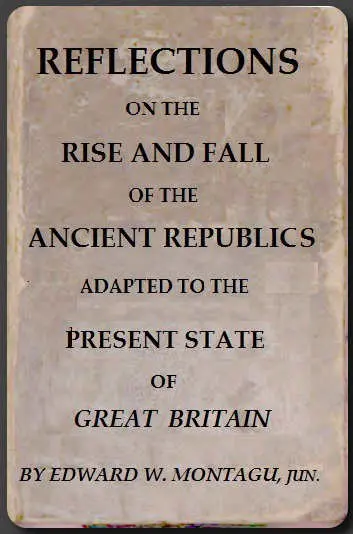
"Reflections on the Rise and Fall of the Ancient Republicks" by Edward W. Montagu is a historical account written in the early 19th century. The work examines the ancient republics such as Sparta, Athens, and Rome, drawing lessons that relate to the political climate of Great Britain at the time. Montagu aims to explore the factors that contributed to the rise and decline of these states, suggesting that contemporary issues in Britain resonate with those of the past. The opening portion of the book sets the stage for Montagu's exploration by introducing the historical context of various republics, particularly focusing on the governance of Sparta under Lycurgus. It discusses how Lycurgus addressed the deep-rooted issues of civil strife and inequality in Spartan society, ultimately leading to his significant reforms that promoted equality and a strong sense of civic duty among citizens. Montagu emphasizes the importance of unity and public virtue to maintain a free state, warning against the disunity that plagued ancient republics as a precursor to their downfall. The narrative establishes a foundation for Montagu's reflections, highlighting the dangers of neglecting the lessons of history in the face of contemporary political turmoil.
Introduction adapted from the source catalogue; source summaries may be automatically generated.
Free to read · English · 84,030 words · No account needed
MAKE TIME FOR A GOOD BOOK
On by default. Untick to stop anonymous reading totals. Each page counts after 10 seconds in view. How this works.
Anonymous counting is on unless you have switched it off.
The Spartans, as Plutarch asserts, held the first rank in Greece for discipline and reputation full five hundred years, by strictly adhering to the laws of Lycurgus; which not one of their kings ever infringed for fourteen successions quite down to the reign of the first Agis. For he will not allow the creation of those magistrates called the ephori, to be any innovation in the constitution, since he affirms it to have been, “not a relaxation, but an extension, of the civil polity.”[11] But notwithstanding the gloss thrown over the institution of the ephori by this nice distinction of Plutarch’s, it certainly induced as fatal a change into the Spartan constitution, as the tribuneship of the people, which was formed upon that model, did afterwards into the Roman. For instead of enlarging and strengthening the aristocratical power, as Plutarch asserts, they gradually usurped the whole government, and formed themselves into a most tyrannical oligarchy.
The ephori (a Greek word signifying inspectors or overseers) were five in number, and elected annually by the people out of their own body. The exact time of the origin of this institution and of the authority annexed to their office, is quite uncertain. Herodotus ascribes it to Lycurgus; Xenophon to Lycurgus jointly with the principal citizens of Sparta. Aristotle and Plutarch fix it under the reign of Theopompus and Polydorus, and attribute the institution expressly to the former of those princes about one hundred and thirty years after the death of Lycurgus. I cannot but subscribe to this opinion as the most probable, because the first political contest we meet with at Sparta happened under the reign of those princes, when the people endeavoured to extend their privileges beyond the limits prescribed by Lycurgus. But as the joint opposition of the kings and senate was equally warm, the creation of this magistracy out of the body of the people, seems to have been the step taken at that time to compromise the affair, and restore the publick tranquility: a measure which the Roman senate copied afterwards, in the erection of the tribuneship, when their people mutinied, and made that memorable secession to the mons sacer. I am confirmed in this opinion by the relation which Aristotle gives us of a remarkable dispute between Theopompus and his wife upon that occasion.[12] The queen much dissatisfied with the institution of the ephori, reproached her husband greatly for submitting to such a diminution of the regal authority, and asked him if he was not ashamed to transmit the crown to his posterity so much weaker and worse circumstanced, than he received it from his father. His answer, which is recorded amongst the laconick bons mots, was, “no, for I transmit it more lasting.”[13] But the event showed that the lady was a better politician, as well as truer prophet, than her husband. Indeed the nature of their office, the circumstances of their election, and the authority they assumed, are convincing proofs that their office was first extorted, and their power afterwards gradually extended, by the violence of the people, irritated too probably by the oppressive behaviour of the kings and senate. For whether their power extended no farther than to decide, when the two kings differed in opinion, and to overrule in favour of him whose sentiments should be most conducive to the publick interest, as we are told by Plutarch in the life of Agis; or whether they were at first only select friends, whom the kings appointed as deputies in their absence, when they were both compelled to take the field together in their long wars with the Messenians, as the same author tells us by the mouth of his hero Cleomenes, is a point, which history does not afford us light enough to determine. This however is certain, from the concurrent voice of all the ancient historians, that at last they not only seized upon every branch of the administration, but assumed the power of imprisoning, deposing, and even putting their kings to death by their own authority. The kings too, in return, sometimes bribed, sometimes deposed or murdered the ephori, and employed their whole interest to procure such persons to be elected, as they judged would be most tractable. I look therefore on the creation of the ephori as a breach in the Spartan constitution, which proved the first inlet to faction and corruption. For that these evils took rise from the institution of the ephori is evident from the testimony of Aristotle, “who thought it extremely impolitick to elect magistrates, vested with the supreme power in the state, out of the body of the people;[14] because it often happened, that men extremely indigent were raised in this manner to the helm, whom their very poverty tempted to become venal. For the ephori, as he affirms, had not only been frequently guilty of bribery before his time, but, even at the very time he wrote, some of those magistrates, corrupted by money, used their utmost endeavours, at the publick repasts, to accomplish the destruction of the whole city. He adds too, that as their power was so great as to amount to a perfect tyranny, the kings themselves were necessitated to court their favour by such methods as greatly hurt the constitution, which from an aristocracy degenerated into an absolute democracy. For that magistracy alone had engrossed the whole government.”
Your reading position is saved on this browser. Take it to another device with a library code. Reading pages adapt to text, rather than matching a printed edition.
BEHIND THE BOOK
This eBook is for the use of anyone anywhere in the United States and most other parts of the world at no cost and with almost no restrictions whatsoever. You may copy it, give it away or re-use it under the terms of the Project Gutenberg License included with this eBook or online at www.gutenberg.org. If you are not located in the United States, you will have to check the laws of the country where you are located before using this eBook. Read the source licence.
The original source file, including credits and licence, is retained by this library. Request an original-format copy at no charge. Please include the book title and Project Gutenberg identifier #45592.
KEEP YOUR CURIOSITY GOING
David Patterson (Spirit) Hatch
Cécile Tormay

Moritz Busch
Coulson Kernahan
John L. Ransom

Ralph Waldo Emerson