
Last letters from the living dead man
David Patterson (Spirit) Hatch
THE CLASSIC COLLECTION · 1759
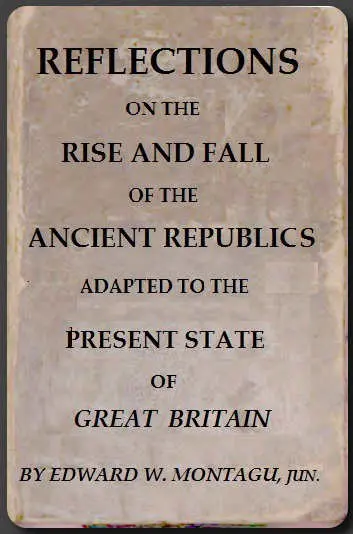
"Reflections on the Rise and Fall of the Ancient Republicks" by Edward W. Montagu is a historical account written in the early 19th century. The work examines the ancient republics such as Sparta, Athens, and Rome, drawing lessons that relate to the political climate of Great Britain at the time. Montagu aims to explore the factors that contributed to the rise and decline of these states, suggesting that contemporary issues in Britain resonate with those of the past. The opening portion of the book sets the stage for Montagu's exploration by introducing the historical context of various republics, particularly focusing on the governance of Sparta under Lycurgus. It discusses how Lycurgus addressed the deep-rooted issues of civil strife and inequality in Spartan society, ultimately leading to his significant reforms that promoted equality and a strong sense of civic duty among citizens. Montagu emphasizes the importance of unity and public virtue to maintain a free state, warning against the disunity that plagued ancient republics as a precursor to their downfall. The narrative establishes a foundation for Montagu's reflections, highlighting the dangers of neglecting the lessons of history in the face of contemporary political turmoil.
Introduction adapted from the source catalogue; source summaries may be automatically generated.
Free to read · English · 84,030 words · No account needed
MAKE TIME FOR A GOOD BOOK
On by default. Untick to stop anonymous reading totals. Each page counts after 10 seconds in view. How this works.
Anonymous counting is on unless you have switched it off.
In our researches back into the remote times of antiquity, we must lay hold of whatever helps we are able to meet with. If Justin therefore is to be credited, Dido not only received considerable assistance from a colony of Tyrians which she found settled in Utica, but admitted great numbers of the natives who settled with her in the new city, and consequently became Carthaginians.[330] I may add too in proof of this account, that unless the Carthaginians had long pursued this wise policy, it is scarce possible by the course of nature, that the Tyrians alone could have multiplied by propagation to so prodigious a degree, as to be able to furnish men sufficient to raise and carry on that extensive commerce, and plant those numerous colonies which we meet with in the earlier ages of their history.
As to their constitution, Rome and Carthage were both republicks, both free, and their form of government nearly similar, as far as we can collect from history. Two supreme magistrates,[331] annually elected, the senate, and the people, formed the body politick in each republick. The annual elections of their chief magistrates were a permanent source of division and faction alike in both; a defect which Lycurgus guarded against in the Spartan government, where the chief magistracy was perpetual and hereditary. The senate in both nations was composed out of the most respectable and greatest men in each republick. At Rome the consuls chose the senators with the approbation of the people, but at last the censors arrogated that power to themselves. At Carthage, as Aristotle informs us, the senators were elected; but as he has no where told us who were the electors, it is most probable, that the right of election was the inherent privilege of the people, since he censures that republick as too much leaning towards democracy. At Rome, in the virtuous times of that republick, birth and merit alone entitled the possessor to a place in the senate, as well as the chief offices in the state. At Carthage, though birth and merit seem to have been qualifications indispensably necessary, yet even these could not succeed,[332] unless the candidate was at the same time master of such a fortune as would enable him to support his dignity with lustre.[333] This Aristotle censures as a defect. For he looks upon all that merit, which was unsupported by the proper proportion of wealth, as so much lost to the Carthaginians; and he lays down that maxim in their government, as the real cause of that undue respect for wealth, and that lust of gain, which prevailed so much in that republick. But the sentiments of this philosopher, like those of his master Plato, are, I fear, too ideal to be reduced to practice. For he does not seem to attend to the different genius of different nations, but aims at adjusting the balance of power in his republick by the nice standard of philosophick theory. The genius of nations differs perhaps as much as their climate and situation, which seem (at least in some degree) to be the natural cause of that difference. The republicks of Sparta and Rome were both military, and military glory stamped the primary character of both these people. The republick of Carthage, like that of their ancestors, the Tyrians, was commercial. Hence the lust of gain marked their ruling character. Their military character arose from the necessity of defending that wealth which their commerce had acquired. Hence military glory was but a secondary passion, and generally subservient to their lust of gain. Unless we attend to the different ruling passion, which forms the different character of each republick, we shall never be able to make such a comparison as will do equal justice to each people. At Sparta and Rome wealth was despised, when put in competition with honour, and poverty joined with merit formed the most estimable of all characters. Quite different maxims prevailed at Carthage. Wealth with them was the chief support of merit, and nothing was so contemptible as poverty. Hence the Carthaginians, who were well acquainted with the power and influence of wealth, required the additional qualifications of an ample fortune in all candidates for the senatorial dignity, and publick employments. For they judged that such men would be less exposed to the temptations of corruption, and at the same time more anxious for the welfare of a state, in which they were so deeply interested by their private property. That this was the real state of the case, at Carthage, notwithstanding the suggestions of Aristotle and the Greek and Roman historians, may, I think, be fairly proved from the behaviour of their senate and the choice of their officers, which ought certainly to be admitted as the best evidence. For we constantly find all their publick employments filled up with men of the greatest families, and (unless when the intrigues of faction sometimes prevailed) of the greatest abilities. We find in general the same firm and steady attachment to the service of their country, and the same indefatigable zeal for extending the territories and power of their republick. Nor does the most partial historian charge any one of them with sacrificing the honour and interest of his country to any foreign power for money: a practice which was shamefully common amongst the Roman generals in the time of Jugurtha. Hence we may, I think, assign the true reason, why the greatest families in Carthage (as we are informed by historians) thought it no way derogatory to their honour to engage in commerce. For as this is most probably to be understood of the younger sons of their nobility, the true motive seems to arise, not from avarice, as their enemies object, but from a view of raising such a fortune, as might qualify them for admission into the senate, or any of the great employments. Hence too it is evident, that a regulation which might be highly useful and salutary in an opulent commercial republick, would be greatly injurious to such military republicks as Rome and Sparta, by corrupting their manners. We need no other proof than the fate of those two republicks, who both owed their ruin to the introduction of that wealth, which was unknown to their virtuous ancestors. The Carthaginian senate seems to have been much more numerous than the Roman. For at Carthage there was a select standing committee established, of one hundred and four of the most respectable members, to keep a watchful eye over the great families, and repress any attempts which their ambition might make to subvert the constitution.[334] To this committee all their commanding officers by sea and land, without exception, were obliged to give a strict account of their conduct at the end of every campaign. We may therefore properly term it the Carthaginian court-martial. Out of this venerable body another select committee was formed of five members only, who were most conspicuous for their probity, ability, and experience. These served without fee or salary; as glory, and the love of their country, were esteemed motives sufficient to engage men of their superior rank and character, to serve the publick with zeal and fidelity.[335] For which reason they were not chosen by lot, but elected by merit. Their power was very extensive. Their office was for life, and they filled up any vacancy in their own body, out of the one hundred and four, and all vacancies in that grand committee, out of the rest of the senate, by their own authority and at their own discretion.[336] They were the supreme judges besides in all causes whatsoever without appeal. The institution of this grand committee, in my opinion, exceeded every thing in the Roman policy. For it preserved their state from all those violent concussions, which so frequently shook, and at last totally subverted the Roman republick.[337] But the power of the committee of five was exorbitant, and dangerous to the lives and fortunes of their fellow-citizens. The proof is from fact. For at the conclusion of the second Punick war, they had made so arbitrary an use of their power, and were grown so odious to the people, that the great Hannibal regulated that amongst other abuses, and procured a law, which made that office annual and elective, with a clause forbidding any future alteration. Whether the Carthaginian senators enjoyed their seats for life, or whether they were liable to be expelled for any misdemeanour, and by whom, are points in which history is quite silent. At Rome, as the censors had the power of promoting to that dignity, so they had equally the power of expelling any member for bad manners, by the single ceremony of leaving out his name when they called over the list of the senate. I cannot help thinking this a great defect in the Roman polity: since it threw the power of garbling and modelling the senate into the hands of two men, who were liable to be corrupted to serve the ends of faction. A power which ought never to be lodged in so few hands in a country which enjoys the blessings of liberty. For how serviceable soever it might have been, as a curb to licentiousness in the earlier ages of that republick; yet Cicero, in his oration for A. Cluentius, inveighs bitterly against the abuse of the censorial power in his time, and gives several instances where it was made subservient to the ends of faction in modelling the senate. And he seems to fear that the censors list may bring as many calamities upon the citizens as the late most inhuman proscription; and that the point of the censors pen may prove as terrible as the sword of their late dictator. C. Nepos, in the life of Hamilcar, takes notice of an officer of the same nature amongst the Carthaginians, to whose inspection the greatest men in that republick seem to have been subject. But it does not appear from history, whether his power extended so far as to expel a senator. Should a bad prince, or a wicked minister, ever be invested with the power of weeding the house, and modelling the parliament at pleasure, there would be an end of our constitution and liberty.
Your reading position is saved on this browser. Take it to another device with a library code. Reading pages adapt to text, rather than matching a printed edition.
BEHIND THE BOOK
This eBook is for the use of anyone anywhere in the United States and most other parts of the world at no cost and with almost no restrictions whatsoever. You may copy it, give it away or re-use it under the terms of the Project Gutenberg License included with this eBook or online at www.gutenberg.org. If you are not located in the United States, you will have to check the laws of the country where you are located before using this eBook. Read the source licence.
The original source file, including credits and licence, is retained by this library. Request an original-format copy at no charge. Please include the book title and Project Gutenberg identifier #45592.
KEEP YOUR CURIOSITY GOING
David Patterson (Spirit) Hatch
Cécile Tormay

Moritz Busch
Coulson Kernahan
John L. Ransom

Ralph Waldo Emerson