
Last letters from the living dead man
David Patterson (Spirit) Hatch
THE CLASSIC COLLECTION · 1759
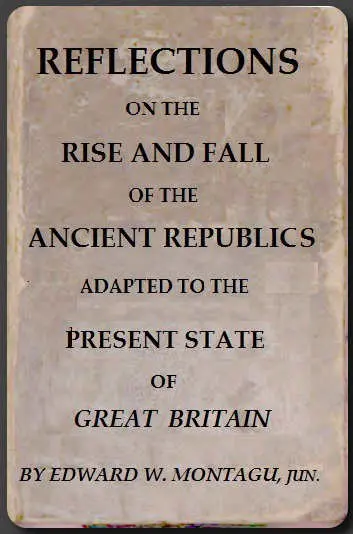
"Reflections on the Rise and Fall of the Ancient Republicks" by Edward W. Montagu is a historical account written in the early 19th century. The work examines the ancient republics such as Sparta, Athens, and Rome, drawing lessons that relate to the political climate of Great Britain at the time. Montagu aims to explore the factors that contributed to the rise and decline of these states, suggesting that contemporary issues in Britain resonate with those of the past. The opening portion of the book sets the stage for Montagu's exploration by introducing the historical context of various republics, particularly focusing on the governance of Sparta under Lycurgus. It discusses how Lycurgus addressed the deep-rooted issues of civil strife and inequality in Spartan society, ultimately leading to his significant reforms that promoted equality and a strong sense of civic duty among citizens. Montagu emphasizes the importance of unity and public virtue to maintain a free state, warning against the disunity that plagued ancient republics as a precursor to their downfall. The narrative establishes a foundation for Montagu's reflections, highlighting the dangers of neglecting the lessons of history in the face of contemporary political turmoil.
Introduction adapted from the source catalogue; source summaries may be automatically generated.
Free to read · English · 84,030 words · No account needed
MAKE TIME FOR A GOOD BOOK
On by default. Untick to stop anonymous reading totals. Each page counts after 10 seconds in view. How this works.
Anonymous counting is on unless you have switched it off.
[322] Verius est igitur nimirum illud quod familiaris omnium nostrum Posidonius disseruit in libro quinto de natura deorum, nullos esse deos Epicuro videri: quæque is de Diis immortalibus dixerit, invidiæ detestandæ gratia dixisse, p. 78.
[323] Οἱ τὰ κοινὰ χειρίζοντες παρὰ μὲν τοῖς Ἕλλησιν, ἐὰν τάλαντον μόνον πιστευθῶσιν ἀντιγραφεῖς ἔχοντες δέκα, καὶ σφραγῖδας τοσαύτας, καὶ μάρτυρας διπλασίους, οὐ δύνανται τηρεῖν τὴν πίστιν. παρὰ δὲ Ῥωμαίοις, κατά τε τὰς ἀρχὰς καὶ πρεσβείας πολύ τι πλῆθος χρημάτων χειρίζοντες δι’ αὐτῆς τῆς κατὰ τὸν ὅρκον πίστεως, τηροῦσι τὸ καθῆκον.
Polyb. lib. 6. p. 693.
I have called ἀντιγραφεῖς, notary publick, because that office answers the idea much better, in my opinion, than contrarotulator, from which may possibly be derived our comptroller, which, I think, is by no means what is here meant.
[324] Te neque hominum neque deorum pudet, quos perfidia et
perjurio violasti. Sall. Fragm. Orat. L. Phil. Cont. Lep. p.
146.
[325] Μεγίστην δέ μοι δοκεῖ διαφορὰν ἔχειν τὸ Ῥωμαίων πολίτευμα πρὸς τὸ βέλτιον ἐν τῇ περὶ θεῶν διαλήψει. καί μοι δοκεῖ τὸ παρὰ τοῖς ἄλλοις ἀνθρώποις ὀνειδιζόμενον, τοῦτο συνέχειν τὰ Ῥωμαίων πράγματα· λέγω δὲ τὴν] δεισιδαιμονίαν. Polyb. lib. 6. p. 692.
[326] There is indeed little occasion for an apology for this translation. The judicious critick will easily see, that in this passage there is a plain contrast drawn between the manners of the Grecians and the Romans in the time of Polybius. The cause of that difference this able writer justly ascribes to that δεισιδαιμονία, or awful fear of the gods, so strongly inculcated amongst the Romans, and so much despised and ridiculed amongst the Grecians, who were at that time greatly tinctured with the atheism of Epicurus. The instance he selects in proof, drawn from the very different effect of an oath upon the manners of those two people, must convince us beyond a doubt, that by the words τοῖς ἄλλοις ἀνθρώποις ὀνειδιζόμενον, he plainly characterizes his own countrymen. As by “οἱ νῦν εἰκῇ καὶ ἀλόγως ἐκβάλλειν αὐτὰ”, they who now (that is, in his time) inconsiderately and absurdly reject those great sanctions of religion, he evidently points at such of the leading men amongst the Romans, as in his time had embraced the pernicious tenets of Epicurus. For though he had stigmatized the Carthaginians immediately before their avarice and lust of gain, yet no man knew better than Polybius, that the Carthaginians rather exceeded the Romans in superstition. That they were sincere too in their belief, is evident from that most horrible method, by which they expressed their δεισιδαιμονία, which was their frequent sacrifices of great numbers of their own children (those of the very first families not excepted) to their god Moloch, who, by the Greeks and Romans, was termed Chronos and Saturn.
I thought this remark might not be unuseful, because as none of the commentators have taken any notice of it, so neither Casaubon, nor any translator I have yet met with, seems to have given us the true spirit and meaning of this remarkable passage.
[327] Ἐπὶ τοσοῦτον γὰρ ἐκτετραγῴδηται καὶ παρεισῆκται τοῦτο τὸ μέρος παρ’ αὐτοῖς εἴς τε τοὺς κατ’ ἰδίαν βίους, καὶ τὰ κοινὰ τῆς πόλεως, ὥστε μὴ καταλιπεῖν ὑπερβολήν. Ibid.
[328] Διόπερ οἱ παλαιοὶ δοκοῦσί μοι τὰς περὶ θεῶν ἐννοίας, καὶ τὰς περὶ τῶν ἐν ᾅδου διαλήψεις οὐκ εἰκῇ καὶ ὡς ἔτυχεν εἰς τὰ πλήθη παρεισαγαγεῖν, πολὺ δὲ μᾶλλον οἱ νῦν εἰκῇ καὶ ἀλόγως ἐκβάλλειν αὐτὰ. Lib. 6. p. 693.
[329] But as soon as Epicurus and his followers began to weaken the foundation and principles of religion, by calling them in question, all manner of immorality came rolling in like a mighty torrent, and threw down the banks of law and sobriety. Lawrence, M. A.
Your reading position is saved on this browser. Take it to another device with a library code. Reading pages adapt to text, rather than matching a printed edition.
BEHIND THE BOOK
This eBook is for the use of anyone anywhere in the United States and most other parts of the world at no cost and with almost no restrictions whatsoever. You may copy it, give it away or re-use it under the terms of the Project Gutenberg License included with this eBook or online at www.gutenberg.org. If you are not located in the United States, you will have to check the laws of the country where you are located before using this eBook. Read the source licence.
The original source file, including credits and licence, is retained by this library. Request an original-format copy at no charge. Please include the book title and Project Gutenberg identifier #45592.
KEEP YOUR CURIOSITY GOING
David Patterson (Spirit) Hatch
Cécile Tormay

Moritz Busch
Coulson Kernahan
John L. Ransom

Ralph Waldo Emerson