
Last letters from the living dead man
David Patterson (Spirit) Hatch
THE CLASSIC COLLECTION · 1759
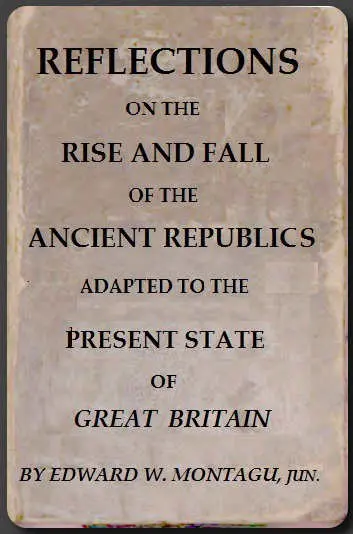
"Reflections on the Rise and Fall of the Ancient Republicks" by Edward W. Montagu is a historical account written in the early 19th century. The work examines the ancient republics such as Sparta, Athens, and Rome, drawing lessons that relate to the political climate of Great Britain at the time. Montagu aims to explore the factors that contributed to the rise and decline of these states, suggesting that contemporary issues in Britain resonate with those of the past. The opening portion of the book sets the stage for Montagu's exploration by introducing the historical context of various republics, particularly focusing on the governance of Sparta under Lycurgus. It discusses how Lycurgus addressed the deep-rooted issues of civil strife and inequality in Spartan society, ultimately leading to his significant reforms that promoted equality and a strong sense of civic duty among citizens. Montagu emphasizes the importance of unity and public virtue to maintain a free state, warning against the disunity that plagued ancient republics as a precursor to their downfall. The narrative establishes a foundation for Montagu's reflections, highlighting the dangers of neglecting the lessons of history in the face of contemporary political turmoil.
Introduction adapted from the source catalogue; source summaries may be automatically generated.
Free to read · English · 84,030 words · No account needed
MAKE TIME FOR A GOOD BOOK
On by default. Untick to stop anonymous reading totals. Each page counts after 10 seconds in view. How this works.
Anonymous counting is on unless you have switched it off.
This was the first rise of the famous agrarian law, which occasioned such frequent contests between the senate and the people, and stirred up the first civil war in Rome, which ended in the murder of both the Gracchi, about three hundred and fifty years after. For the senate not only evaded the nomination of the commissioners, as they had promised in their decree, but, whenever that affair was brought upon the carpet, they acted with an insincerity and artifice which are highly inconsistent with the so much vaunted probity of the Roman senate. Unless therefore we attend to the true reasons, upon which the agrarian law was originally founded, we can never form a right judgment of the perpetual dissensions between the senate and the tribunes upon that subject. For though the chief blame, in all these contests, is most commonly thrown upon the turbulent and seditious temper of the tribunes, yet, if the real cause of those dissensions is impartially examined, we shall find that most of them took rise from the avarice and injustice of the Patricians. But though the tribunitial power was sometimes made subservient to the interested views of some ambitious tribunes, yet no argument can justly be drawn from the abuse of that power against its real utility. For how much it was dreaded as the bulwark of the liberty of the people, is evident from this consideration: that it was reduced almost to nothing by Sylla, and afterwards totally absorbed by Augustus and the succeeding emperors, who never looked upon the people as thoroughly enslaved until they had annexed the tribunitial power to the imperatorial dignity.
I remarked before, that when the highest dignities and employments in the republick were laid open to the Plebeians, and the decrees of the people had the same force, and affected the Patricians in the same manner as those which were issued by the senate, the democratick power was raised to an equality with the aristocratick. But as a third power, or estate (as we term it) was wanting, capable of preserving the requisite æquilibrium between the other two, it was impossible from the very nature of the republican constitution, that the equality between the two powers could be long supported. The concessions made by Hortensius quieted indeed the civil dissensions; and it is remarkable too, that after peace was restored to the republick, the progress of the Roman conquests was so amazingly rapid, that in little more than two hundred years from that period they had subjugated the most opulent empires in the universe. But the same conquests, which raised the republick to the summit of her grandeur, threw too much weight into the democratick scale, and, by totally corrupting the Roman manners, brought on the final ruin of their liberty and constitution. For as every conquered province created successively a new government, these new dignities immediately became new objects of avarice and ambition. But as the command of the armies, the government of provinces, and the highest posts in the state, were disposed of by the suffrages of the people; the candidates for those lucrative employments left no means unattempted to secure a majority. Hence, as the poor Plebeians were extremely numerous, the man who was able to distribute the greatest largesses, or divert the mob with the finest shows, was generally the most successful. When the interest of the candidates was nearly equal, force was frequently made use of to decide the contest; and it was not uncommon to see the forum[262] covered with the slaughtered bodies of the electors. The generals who were elected fleeced the provinces to enable themselves to keep up their interest at home with the people, and connived at the rapines of their soldiers to secure their affections. Hence at Rome liberty degenerated into the most outrageous licentiousness, whilst the soldiers gradually wore off that parental love for their country, which was once the characteristick of the Romans, and attached themselves wholly to the fortunes of their generals. Hence the most succesful leaders began to look upon themselves no longer as servants, but as masters of the republick, and each endeavoured to support his pretensions by force of arms. The faction of Sylla and Marius filled the city alternately with slaughter and rapine, as the fortune of their respective leaders prevailed in the course of that destructive contest. And Rome frequently felt the calamitous effects of war in her own bowels, at a time when her victorious arms abroad were adding new provinces to her dominions. These factions were far from expiring with their leaders, but broke out again with the same baleful fury under the first and second triumvirate. Each of these, strictly speaking, were no more than coalitions of the same factions, where three chiefs united their several parties to crush every other. When they had accomplished this, and satiated their ambition, their avarice, and their private resentments, by the most bloody proscriptions, they quarrelled about the division of power, like captains of banditti about the division of booty, with whom they agreed in principle, and differed only in degree. These quarrels occasioned those civil wars, which gave the finishing blow to the Roman republick. The ablest and most dangerous man, in each triumvirate, proved at last the conqueror; and Julius Cæsar first put those chains upon his country, which Augustus riveted beyond a possibility of removal.
Your reading position is saved on this browser. Take it to another device with a library code. Reading pages adapt to text, rather than matching a printed edition.
BEHIND THE BOOK
This eBook is for the use of anyone anywhere in the United States and most other parts of the world at no cost and with almost no restrictions whatsoever. You may copy it, give it away or re-use it under the terms of the Project Gutenberg License included with this eBook or online at www.gutenberg.org. If you are not located in the United States, you will have to check the laws of the country where you are located before using this eBook. Read the source licence.
The original source file, including credits and licence, is retained by this library. Request an original-format copy at no charge. Please include the book title and Project Gutenberg identifier #45592.
KEEP YOUR CURIOSITY GOING
David Patterson (Spirit) Hatch
Cécile Tormay

Moritz Busch
Coulson Kernahan
John L. Ransom

Ralph Waldo Emerson