
Last letters from the living dead man
David Patterson (Spirit) Hatch
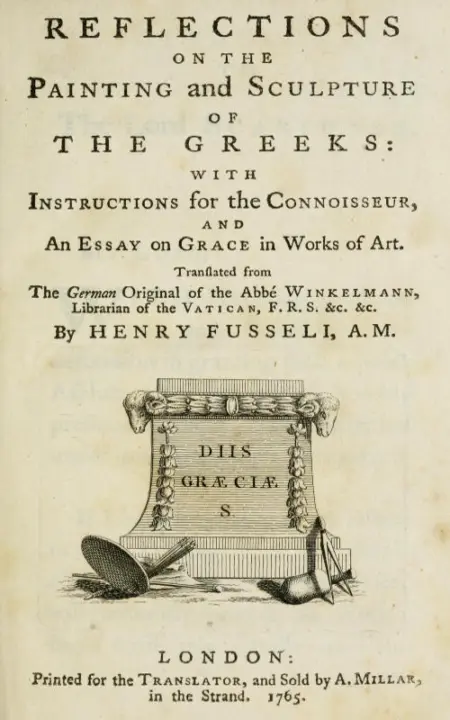
THE CLASSIC COLLECTION · 1765
"Reflections on the Painting and Sculpture of the Greeks: With Instructions for the Connoisseur, and an Essay on Grace in Works of Art" by Abbé Winkelmann, translated by Henry Fuseli, is a scholarly examination of Greek art, composed in the mid-18th century. The text delves into the aesthetic principles and techniques that define the excellence of Greek painting and sculpture, advocating for the insights of classical antiquity to inform and elevate contemporary art practices. It explores the unique qualities of Greek art, such as ideal beauty, contour, drapery, and expression, positioning these elements as benchmarks for artistic mastery. The opening of the work introduces the significance of Greek art, detailing the intrinsic beauty cultivated by the Greek environment and its role in shaping artistic taste. It emphasizes the need for modern artists to study ancient masterpieces closely, suggesting that familiarity with Greek forms fosters a deeper understanding of beauty and excellence in art. Additionally, Winkelmann discusses the athletic and aesthetic ideals of Greek culture, noting how these influenced the portrayal of the human form in art. The text serves as both a tribute to ancient achievements and a guide for artists seeking to replicate that esteemed level of artistic excellence.
Introduction adapted from the source catalogue; source summaries may be automatically generated.
Free to read · English · 42,223 words · No account needed
MAKE TIME FOR A GOOD BOOK
On by default. Untick to stop anonymous reading totals. Each page counts after 10 seconds in view. How this works.
Anonymous counting is on unless you have switched it off.
As for opportunities to study the nudities, our times, I think, afford as advantageous ones as the Gymnasies of the ancients. ’Tis the fault of our artists to make no use of that[34] proposed to the Parisian artists, viz. to walk, during the summer season, along the Seine, in order to have a full view of the naked parts, from the sixth to the fiftieth year.
’Tis perhaps to Michael Angelo’s frequenting such opportunities that we owe his celebrated Carton of the Pisan war[35], where the soldiers bathing in a river, at the sound of a trumpet leap out of the water, and make haste to huddle on their cloaths.
One of the most offensive passages of the treatise is, no doubt, the unjust debasement of the modern sculptors beneath the ancients. These latter times are possessed of several Glycons in muscular heroic figures, and, in tender youthful female bodies, of more than one Praxiteles. Michael Angelo, Algardi, and Sluter, whose genius embellished Berlin, produced muscular bodies,
——Invicti membra Glyconis,
Hor.
in a style rivalling that of Glycon himself; and in delicacy the Greeks are perhaps even outdone by Bernini, Fiammingo, Le Gros, Rauchmüller, Donner.
The unskilfulness of the ancients, in shaping children, is agreed upon by our artists, who, I suppose, would for imitation choose a Cupid of Fiammingo rather than of Praxiteles himself. The story of M. Angelo’s placing a Cupid of his own by the side of an antique one, in order to inform our times of the superiority of the ancient art, is of no weight here: for no work of Michael Angelo can bring us so near perfection as Nature herself.
I think it no hyperbole to advance, that Fiammingo, like a new Prometheus, produced creatures which art had never seen before him. For, if from almost all the children on ancient gems[36] and reliefs[37], we may form a conclusion of the art itself, it wanted the true expression of childhood, as looser forms, more milkiness, and unknit bones. Faults which, from the epoch of Raphael, all children laboured under, till the appearance of Francis Quesnoy, called Fiammingo, whose children having the advantages of suitable innocence and nature, became models to the following artists, as in youthful bodies Apollo and Antinous are: an honour which Algardi, his contemporary, may be allowed to share.
Their models in clay are, by our artists, esteemed superior to all the antique marble children; and an artist of genius and talents assured me, that during a stay of seven years at Vienna, he saw not one copy taken from an ancient Cupid in that academy.
Your reading position is saved on this browser. Take it to another device with a library code. Reading pages adapt to text, rather than matching a printed edition.
BEHIND THE BOOK
This eBook is for the use of anyone anywhere in the United States and most other parts of the world at no cost and with almost no restrictions whatsoever. You may copy it, give it away or re-use it under the terms of the Project Gutenberg License included with this eBook or online at www.gutenberg.org. If you are not located in the United States, you will have to check the laws of the country where you are located before using this eBook. Read the source licence.
The original source file, including credits and licence, is retained by this library. Request an original-format copy at no charge. Please include the book title and Project Gutenberg identifier #61317.
KEEP YOUR CURIOSITY GOING
David Patterson (Spirit) Hatch
Coulson Kernahan

Ralph Waldo Emerson
Frances Wright

Edwin Abbott Abbott

Joseph Droz