
Last letters from the living dead man
David Patterson (Spirit) Hatch
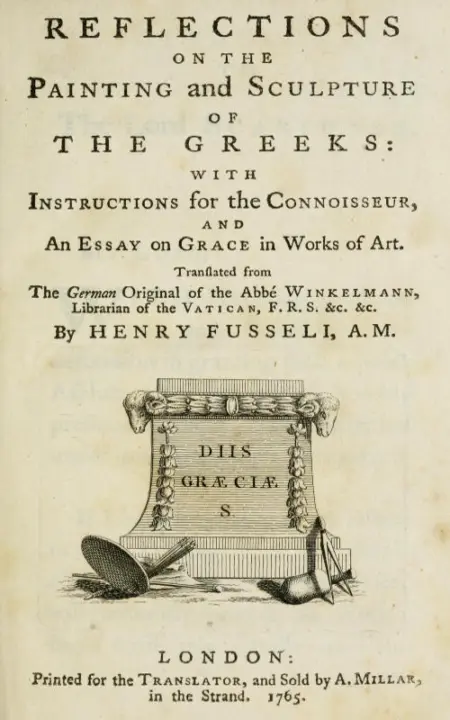
THE CLASSIC COLLECTION · 1765
"Reflections on the Painting and Sculpture of the Greeks: With Instructions for the Connoisseur, and an Essay on Grace in Works of Art" by Abbé Winkelmann, translated by Henry Fuseli, is a scholarly examination of Greek art, composed in the mid-18th century. The text delves into the aesthetic principles and techniques that define the excellence of Greek painting and sculpture, advocating for the insights of classical antiquity to inform and elevate contemporary art practices. It explores the unique qualities of Greek art, such as ideal beauty, contour, drapery, and expression, positioning these elements as benchmarks for artistic mastery. The opening of the work introduces the significance of Greek art, detailing the intrinsic beauty cultivated by the Greek environment and its role in shaping artistic taste. It emphasizes the need for modern artists to study ancient masterpieces closely, suggesting that familiarity with Greek forms fosters a deeper understanding of beauty and excellence in art. Additionally, Winkelmann discusses the athletic and aesthetic ideals of Greek culture, noting how these influenced the portrayal of the human form in art. The text serves as both a tribute to ancient achievements and a guide for artists seeking to replicate that esteemed level of artistic excellence.
Introduction adapted from the source catalogue; source summaries may be automatically generated.
Free to read · English · 42,223 words · No account needed
MAKE TIME FOR A GOOD BOOK
On by default. Untick to stop anonymous reading totals. Each page counts after 10 seconds in view. How this works.
Anonymous counting is on unless you have switched it off.
After him the sublimest performance undertaken and finished, in that kind, is, no doubt, the cupola of the imperial library at Vienna, painted by Daniel Gran, and engraved by Sedelmayer. The Apotheosis of Hercules at Versailles, done by Le Moine, and alluding to the Cardinal Hercules de Fleury, though deemed in France the most august of compositions, is, in comparison of the learned and ingenious performance of the German artist, but a very mean and short-sighted Allegory, resembling a panegyric, the most striking beauties of which are relative to the almanack. The artist had it in his power to indulge grandeur, and his flipping the occasion is astonishing: but even allowing, that the Apotheosis of a minister was all that he ought to have decked the chief cieling of a royal palace with, we nevertheless see through his fig-leaf.
The artist would require a work, containing every image with which any abstracted idea might be poetically inverted; a work collected from all mythology, the best poets of all ages, the mysterious philosophy of different nations, the monuments of the ancients on gems, coins, utensils, &c. This magazine should be distributed into several classes, and, with proper applications to peculiar possible cases, adapted to the instruction of the artist. This would, at the same time, open a vast field for imitating the ancients, and participating of their sublimer taste.
The taste in our decorations, which, since the complaints of Vitruvius, hath changed for the worse, partly by the grotesques brought in vogue by Morto da Feltro, partly by our trifling house-painting, might also, from more intimacy with the ancients, reap the advantages of reality and common sense.
The Caricatura-carvings, and favourite shells, those chief supports of our ornaments, are full as unnatural as the candle-sticks of Vitruvius, with their little castles and palaces: how easy would it be, by the help of Allegory, to give some learned convenience to the smallest ornament!
Reddere personæ scit convenientia cuique.
Hor.
Paintings of ceilings, doors, and chimney-pieces, are commonly but the expletives of these places, because they cannot be gilt all over. Not only they have not the least relation to the rank and circumstances of the proprietor, but often throw some ridicule or reflection upon him.
’Tis an abhorrence of barrenness that fills walls and rooms; and pictures void of thought must supply the vacuum.
Hence the artist, abandoned to the dictates of his own fancy, paints, for want of Allegory, perhaps a satire on him to whom he owes his industry; or, to shun this Charybdis, finds himself reduced to paint figures void of any meaning.
Nay, he may often find it difficult to meet even with those, ’till at last
Your reading position is saved on this browser. Take it to another device with a library code. Reading pages adapt to text, rather than matching a printed edition.
BEHIND THE BOOK
This eBook is for the use of anyone anywhere in the United States and most other parts of the world at no cost and with almost no restrictions whatsoever. You may copy it, give it away or re-use it under the terms of the Project Gutenberg License included with this eBook or online at www.gutenberg.org. If you are not located in the United States, you will have to check the laws of the country where you are located before using this eBook. Read the source licence.
The original source file, including credits and licence, is retained by this library. Request an original-format copy at no charge. Please include the book title and Project Gutenberg identifier #61317.
KEEP YOUR CURIOSITY GOING
David Patterson (Spirit) Hatch
Coulson Kernahan

Ralph Waldo Emerson
Frances Wright

Edwin Abbott Abbott

Joseph Droz