
Last letters from the living dead man
David Patterson (Spirit) Hatch
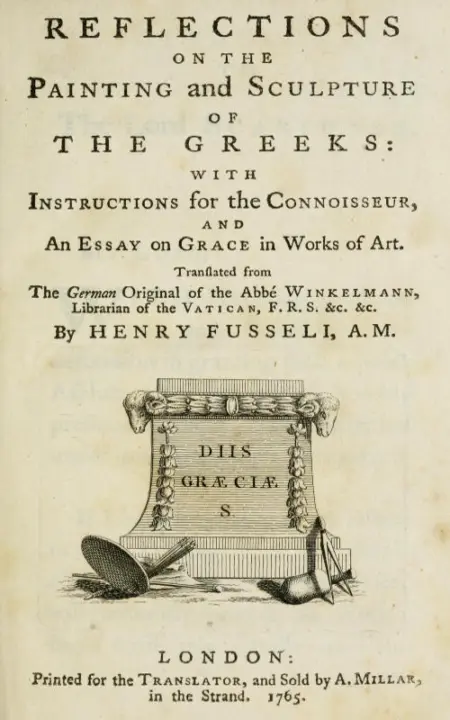
THE CLASSIC COLLECTION · 1765
"Reflections on the Painting and Sculpture of the Greeks: With Instructions for the Connoisseur, and an Essay on Grace in Works of Art" by Abbé Winkelmann, translated by Henry Fuseli, is a scholarly examination of Greek art, composed in the mid-18th century. The text delves into the aesthetic principles and techniques that define the excellence of Greek painting and sculpture, advocating for the insights of classical antiquity to inform and elevate contemporary art practices. It explores the unique qualities of Greek art, such as ideal beauty, contour, drapery, and expression, positioning these elements as benchmarks for artistic mastery. The opening of the work introduces the significance of Greek art, detailing the intrinsic beauty cultivated by the Greek environment and its role in shaping artistic taste. It emphasizes the need for modern artists to study ancient masterpieces closely, suggesting that familiarity with Greek forms fosters a deeper understanding of beauty and excellence in art. Additionally, Winkelmann discusses the athletic and aesthetic ideals of Greek culture, noting how these influenced the portrayal of the human form in art. The text serves as both a tribute to ancient achievements and a guide for artists seeking to replicate that esteemed level of artistic excellence.
Introduction adapted from the source catalogue; source summaries may be automatically generated.
Free to read · English · 42,223 words · No account needed
MAKE TIME FOR A GOOD BOOK
On by default. Untick to stop anonymous reading totals. Each page counts after 10 seconds in view. How this works.
Anonymous counting is on unless you have switched it off.
[58] Xenophon Resp. Laced. c. 3. §. 5.
[59] Origines Contra Cels. L. IV. p. 196. Edit. Cantabr.
[60] Perrault sur Vitruve Explic. de la Planche IX. p. 62.
[61] Dialog. Inconfus. p. 76.
[62] Horapoll. Hierogl. c. 33. Conf. Blackwell’s Enq. into Hom. p. 170.
[63] De Re rust. præf. ad L. I. §. 32. p. 392. Edit. Gesn.
[64] Vitruv. L. IV. c. 1.
[65] Travels, T. II.
[66] Plutarch. Numa. p. 149. L. 14. Edit. Bryani.
[67] Passerii Lucern.
[68] Menage Diction. Etymol. v. Barroque.
[69] Vide Desgodez Edifices antiq. de Rome, p. 91.
[70] Bartoli Sepolcri Antichi, p. 67. ibid. fig. 91.
[71] Perrault notes sur Vitruv. L. IV. ch. 2. n. 21. p. 118.
[72] Martial, L. III. Ep. 41. 1.
[73] Bellori Sepolchri ant. f. 99.
[74] Virgil, Æn. V. v. 250. & seq.
[75] Pausanias, L. IX. c. 40. p. 794. Conf. Spanhem. Not. sur les Cæesars de l’Emp. Julien. p. 240.
[76] Kircheri Oedip. Ægypt. T. III. p. 405, & 433.
[77] Bianchini Istor. Univ. p. 412.
[78] Nehem. Grew Musæum Societ. Reg. Lond. 1681. fol. p. 1.
[79] Vide Gabr. Bremond Viaggi nell’Egitto. Roma. 1579. 4. L. I. c. 15.
p. 77.
[80] Clemens Alex. Strom. L. VI. p. 456.
[81] Shaw, Voyage, T. II. p. 123.
[82] Della Valle Viaggi. Lettr. 11. §. 9. p. 325. & seq.
[83] Herodot. L. II. c. 36. Diod. Sic.
[84] Plutarch. de Isid. & Osirid. p. 374.
[85] Kircher Oed. I. c. ej. Prodrom. Copt. c. 7.
[86] Herodot. L. II. c. 153.
[87] Diogen. Laert. v. Democr.
[88] Diodor. Sic. L. I. c. 29. Edit. Wessel.
[89] Kircher Oedip. I. c.—it. ejusd. China illustrata. III. c. 4. p. 151.
[90] Alberti Englische Briefe, B——.
[91] Clem. Alex. Strom. L. I. p. 354. Edit. Pott.
[92] Herodot. L. II. c. 61.
[93] Montfaucon Palæogr. Græc. L. III. c. 5. p. 230. Kuhn. Not. ad
Pausan. L. II. p. 128.
[94] Augustin. Gem. P. II. l. 32.
[95] Gruter. Corp. Inscr. p. DCCCLXI. ἐυτυχειτε, χαιρετε, &c.
[96] Prideaux Marm. Oxon. 4. & 179.
[97] Demosth. Orat. pro Corona, p. 485, 499. Edit. Frc. 1604.
[98] Gruter, Corp. Inscript. p. DCXLI. 8.
[99] Montfaucon Palæogr. L. IV. c. 10. p. 336, 338.
[100] Montf. L. I. c. 4. II. c. 6. p. 152.
[101] Herod. L. II.
[102] Descript. de l’Egypte, par Mascriere, Lettr. VII. 23.
[103] Descript. de l’Eg. L. c.
[104] Chishul. Inscr. Sig. p. 12.
[105] Kircher. Obelisc. Pamph. c. 8. p. 147.
[106] Cicero de Oratore, L. II. c. 37.
[107] The author was then preparing for a journey to Rome.
[108] Argenville abregé de la V. d. P. T. II. p. 287.
[109] Reise, p. 21.
[110] Strabo, L. XIV. p. 652. al. 965. l. 11.
[111] Richardson Essay, &c. p. 38, 39.
[112] Diomedes, for ought I can see, is neither a sitting nor a standing figure, in both which cases the critick must be allowed to be just. He descends. Remark of the T. L.
[113] Cicero de Fato, c. 4.
[114] Strabo, L. IV. p. 196. al. 299. l. 22.
[115] Misopog. p. 342. l. 13.
[116] Strabo, L. III. p. 158. al. 238.
[117] Du Bos Reflex. sur la Poesie et s. l. P. II. 144.
[118] Herodot. L. III. c. 106. Cicero ad Attic. L. VI. cp. 2.
[119] Περὶ τοπων. p. 288. edit. Foesii. Galenus ὁτι τα τῆς Ψυχῆς Ἠθη τοις του Σωματος κρασεσι ἑπεται. fol. 171. B. I. 43. edit. Ald. T. I.
[120] Chardin voyage en Perse, T. II. p. 127. & seq.
[121] Journal des Sçavans l’An. 1684. Aur. p. 153.
Your reading position is saved on this browser. Take it to another device with a library code. Reading pages adapt to text, rather than matching a printed edition.
BEHIND THE BOOK
This eBook is for the use of anyone anywhere in the United States and most other parts of the world at no cost and with almost no restrictions whatsoever. You may copy it, give it away or re-use it under the terms of the Project Gutenberg License included with this eBook or online at www.gutenberg.org. If you are not located in the United States, you will have to check the laws of the country where you are located before using this eBook. Read the source licence.
The original source file, including credits and licence, is retained by this library. Request an original-format copy at no charge. Please include the book title and Project Gutenberg identifier #61317.
KEEP YOUR CURIOSITY GOING
David Patterson (Spirit) Hatch
Coulson Kernahan

Ralph Waldo Emerson
Frances Wright

Edwin Abbott Abbott

Joseph Droz