THE CLASSIC COLLECTION✦The Wood King; or, Daniel Boone’s last trailCLASSIC FREE BOOKS
The Wood King; or, Daniel Boone’s last trail
Jos. E. (Joseph Edward) Badger
THE CLASSIC COLLECTION · 1884
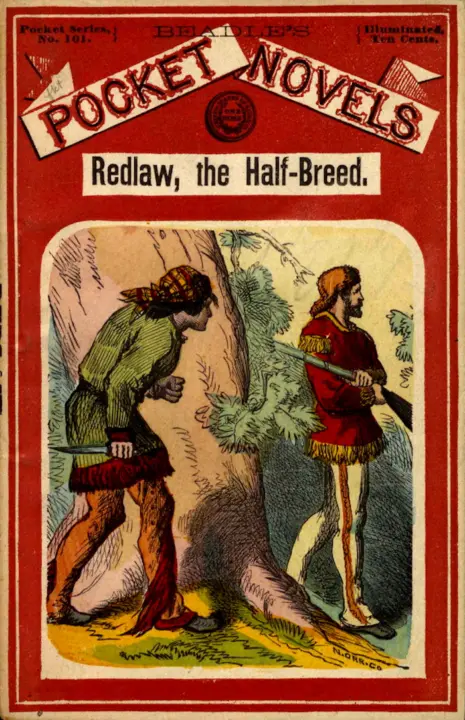
"Redlaw, the Half-Breed; or, The Tangled Trail. A Tale of the Settlements" by Jos. E. Badger, Jr. is a novel likely written in the late 19th century. The book delves into themes of justice, lawlessness, and societal prejudice in a frontier setting, featuring the central character, Clay Poynter, a man accused of being a counterfeiter and a murderer. As the story unfolds, it explores Poynter's struggle to clear his name while navigating the violent, chaotic world of vigilante justice. The opening of the novel introduces a gathering of local men led by Captain Neil McGuire, who discuss the growing problems of counterfeit money and the threat of thieves in their settlement. As they plan to form a vigilance committee to address these issues, tensions rise with the sudden entrance of a mysterious stranger, Clay Poynter, who claims he is interested in joining their cause. However, he is soon accused of various crimes, setting the stage for a dramatic conflict. The narrative establishes an atmosphere of suspicion and impending violence, highlighting Poynter's precarious position as he must defend his reputation amid growing hostility from the community while dealing with the complexities of his past.
Introduction adapted from the source catalogue; source summaries may be automatically generated.
Free to read · English · 32,974 words · No account needed
MAKE TIME FOR A GOOD BOOK
On by default. Untick to stop anonymous reading totals. Each page counts after 10 seconds in view. How this works.
Anonymous counting is on unless you have switched it off.
"Pardon, Nora, I did not mean that. But I was so angry at finding that you had been with that villain, Poynter, I forgot myself. See, those are his tracks. No other man wears such boots, around here."
"Well, I was with him, but he only came to bid me good-by."
"Good-by! Then he thinks it best to leave the country before Judge
Lynch interviews him, the--"
"Hold, Mr. McGuire," slowly said Poynter, as he stepped forward and confronted the father. "Why should I fear Judge Lynch more than any other man?"
"Ah, why, indeed?" sneered McGuire. "Why was it that you left Kentucky so suddenly, and made such a short stop in Arkansas, if I may ask?"
"So, that is your game, is it? Well, of this be assured, that after my return from St. Louis, I will show you such proofs of my innocence that you will beg pardon for your unjust suspicions."
"After your return!" echoed Neil, derisively.
"Father--father!" pleaded Nora, in terror, "come, let us go home; I am
afraid."
"Your daughter is right, Mr. McGuire," added Poynter, a little more coolly. "It will do no good for us to talk further. My explanations can wait."
"So I presume," curtly responded the other, then adding, "Come, child, let us go," and leading Nora by the hand, he left the glade.
For a few moments Poynter stood gazing abstractedly in the direction they had taken, and then arousing himself, with a little laugh, turned upon his heel and walked briskly along a faintly-defined trail. The woods were open and free from undergrowth at this point, but after crossing a narrow tract of bare ground, and once more entering the timber, the path was thickly fringed on either side with bushes of hazel and oak.
After crossing a slight rise and down the valley once more, Poynter came in view of his own house--for that time and section, a perfect palace, a two-story frame, weather-boarded, and painted a neat cream-color. Why he had built this, when he was not at home one-tenth of his time, was a great puzzle to his neighbors, and many a siege of cross-questioning had old aunty Eunice to undergo.
Questions as to who her young master really was, if wealthy, and his reasons for making such frequent journeys; why he had not got married, and countless others, of equal importance. But the old negress knew how to keep a close tongue in her head, or to talk a great deal without saying any thing; so that when her visitors left, they were forced to acknowledge that they knew as much as they did before--and not much more.
Your reading position is saved on this browser. Take it to another device with a library code. Reading pages adapt to text, rather than matching a printed edition.
Jos. E. (Joseph Edward) Badger
Jos. E. (Joseph Edward) Badger
Jos. E. (Joseph Edward) Badger
Jos. E. (Joseph Edward) Badger
BEHIND THE BOOK
This eBook is for the use of anyone anywhere in the United States and most other parts of the world at no cost and with almost no restrictions whatsoever. You may copy it, give it away or re-use it under the terms of the Project Gutenberg License included with this eBook or online at www.gutenberg.org. If you are not located in the United States, you will have to check the laws of the country where you are located before using this eBook. Read the source licence.
The original source file, including credits and licence, is retained by this library. Request an original-format copy at no charge. Please include the book title and Project Gutenberg identifier #68507.
KEEP YOUR CURIOSITY GOING
Coulson Kernahan

Maurice Baring
Frances Wright
Cécile Tormay

Frederic Jesup Stimson

W. H. P. (William Henry Pope) Jarvis