
A Son of Ishmael: A Novel
L. T. Meade
THE CLASSIC COLLECTION · 1894
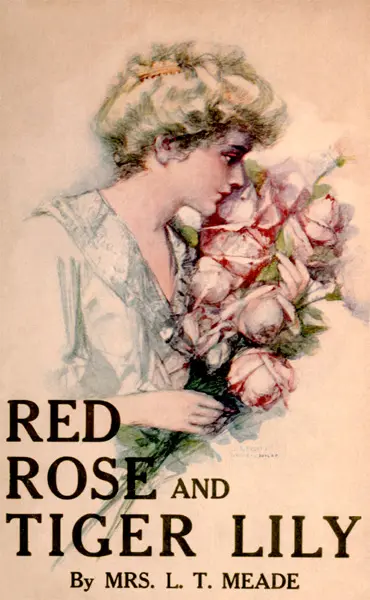
"Red Rose and Tiger Lily; Or, In a Wider World" by L.T. Meade is a novel written in the late 19th century. The story introduces readers to two central characters, Hester and her younger sister Nan, as they navigate the complexities of family life, friendship, and the anticipation of new beginnings. As they reunite with friends from school, the dynamic sisters and their relationships promise to unfold in charming and sometimes tumultuous ways. The opening portion of the book depicts a lively summer evening as Hester eagerly awaits the return of her sister Nan from school. The text captures Hester's excitement and anticipation, providing insight into the contrasting personalities of the sisters—Hester's calm demeanor versus Nan's impulsive nature. Their father, Sir John Thornton, is introduced as a reserved man who seems both fond and wary of Nan's spirited presence. The arrival of their friend Annie Forest adds another layer to the story, hinting at forthcoming adventures as the girls' relationships develop amidst domestic challenges and the implications of a potential new family dynamic.
Introduction adapted from the source catalogue; source summaries may be automatically generated.
Free to read · English · 79,293 words · No account needed
MAKE TIME FOR A GOOD BOOK
On by default. Untick to stop anonymous reading totals. Each page counts after 10 seconds in view. How this works.
Anonymous counting is on unless you have switched it off.
"Doesn't he care for you, then?"
"Care for me? What a thing to say. Of course he cares for me."
"Then he'll come. Now, I give you five minutes. Write the letter, and I'll take it out and post it."
Nora muttered and grumbled, but Antonia's perfectly motionless figure, as she sat in an easy chair facing her, was too much to be resisted. She took up a pen, dipped it in ink, and began to write.
"Do it lovingly," said Antonia; "put heart into it; show that you're a
daughter."
Mrs. Bernard Temple motioned Annie to come and sit near her.
"Really," she said in a whisper, "poor Antonia becomes more peculiar and trying each day. She simply bullies us all. Look at that poor dear little Nora, submitting to her caprice as gently as a lamb. I don't know why she wants Squire Lorrimer to come here. I am not acquainted with him, and it will be really painful for me to see him in his present afflicted condition. I am a very cheerful person by nature, and hate depressing circumstances."
"I am sorry you are not sympathetic," answered Annie.
Mrs. Bernard Temple raised her brows.
"Sympathetic," she exclaimed; "my dear, I'm the soul--the very soul of sympathy; but where's the use of wasting emotion? I can do nothing for Squire Lorrimer, and it will only pain poor Nora to see him. Really, really, Antonia is beyond anything afflicting. Now, my love, where are you going?"
The latter part of this speech was addressed to Miss Bernard Temple, who was leaving the room. "Where are you going, Antonia, my love?" repeated her mother.
"Out, mother; to post this letter."
"I beg of you to do nothing of the kind. I can send it by William, when next he goes for a message."
William was a very diminutive, and much overworked, page-boy.
"Thanks," said Antonia; "but I prefer to go myself."
She left the room, shutting the door rather noisily; and Mrs. Bernard Temple looked for sympathy to the two girls.
"Is not she trying?" she repeated. "With my mind so preoccupied with thoughts of my approaching marriage, and of dear Sir John, and those sweet girls, Hester and Nan; it is really too much to be worried by Antonia's whims."
"Oh, but she means everything splendidly," said Annie. "I admire her beyond anything. If you will let me, Mrs. Bernard Temple, I will go out with her."
"Oh, certainly, my dear. I see you are under her spell, so I have
nothing to say. Dear Nora and I will try to make ourselves happy
together."
Annie left the room, and met Antonia in the hall.
Your reading position is saved on this browser. Take it to another device with a library code. Reading pages adapt to text, rather than matching a printed edition.
BEHIND THE BOOK
This eBook is for the use of anyone anywhere in the United States and most other parts of the world at no cost and with almost no restrictions whatsoever. You may copy it, give it away or re-use it under the terms of the Project Gutenberg License included with this eBook or online at www.gutenberg.org. If you are not located in the United States, you will have to check the laws of the country where you are located before using this eBook. Read the source licence.
The original source file, including credits and licence, is retained by this library. Request an original-format copy at no charge. Please include the book title and Project Gutenberg identifier #23022.
KEEP YOUR CURIOSITY GOING
Coulson Kernahan

Maurice Baring
Frances Wright
Cécile Tormay

Frederic Jesup Stimson

W. H. P. (William Henry Pope) Jarvis


