THE CLASSIC COLLECTION✦A journey in search of ChristmasCLASSIC FREE BOOKS
A journey in search of Christmas
Owen Wister
THE CLASSIC COLLECTION · 1895
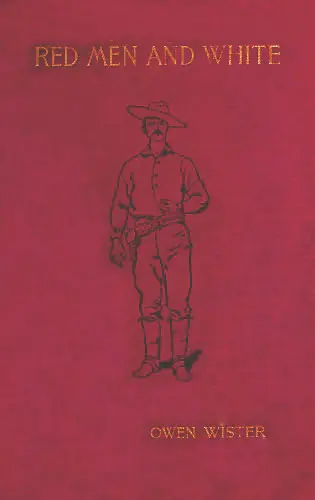
"Red Men and White" by Owen Wister is a collection of short stories written in the late 19th century. The narrative explores the complexities of life on the Western frontier, particularly focusing on the interactions between white settlers and Native American tribes. The stories are connected thematically and feature overlapping characters, suggesting a rich and intertwined tapestry of life during a pivotal time in American history. The opening of the collection sets the stage for these narratives by highlighting the dynamic circumstances of the Crow Indians and their evolving relationship with white settlers and soldiers. It introduces characters like young Cheschapah, a Crow Indian who struggles between his ambition for leadership and duty to his people, and Lieutenant Stirling whose observations about the Indians reveal deeper nuances. As tensions arise with the Sioux tribe visiting the Crows and the calculations of superstitions that could ignite conflict, a stark portrait of life on the frontier is painted—a world of fragile peace overshadowed by the threat of violence, cultural misunderstanding, and the quest for identity and recognition. This sets the tone for a thoughtful exploration of the intersections of cultures, conflict, and human ambition that defines the Wild West.
Introduction adapted from the source catalogue; source summaries may be automatically generated.
Free to read · English · 79,787 words · No account needed
MAKE TIME FOR A GOOD BOOK
On by default. Untick to stop anonymous reading totals. Each page counts after 10 seconds in view. How this works.
Anonymous counting is on unless you have switched it off.
Until lately the Western citizen has known one every-day experience that no dweller in our thirteen original colonies has had for two hundred years. In Massachusetts they have not seen it since 1641; in Virginia not since 1628. It is that of belonging to a community of which every adult was born somewhere else. When you come to think of this a little it is dislocating to many of your conventions. Let a citizen of Salem, for instance, or a well-established Philadelphia Quaker, try to imagine his chief-justice fresh from Louisiana, his mayor from Arkansas, his tax-collector from South Carolina, and himself recently arrived in a wagon from a thousand-mile drive. To be governor of such a community Ballard had travelled in a wagon from one quarter of the horizon; from another quarter Wingo had arrived on a mule. People reached Boise in three ways: by rail to a little west of the Missouri, after which it was wagon, saddle, or walk for the remaining fifteen hundred miles; from California it was shorter; and from Portland, Oregon, only about five hundred miles, and some of these more agreeable, by water up the Columbia. Thus it happened that salt often sold for its weight in gold-dust. A miner in the Bannock Basin would meet a freight teamster coming in with the staples of life, having journeyed perhaps sixty consecutive days through the desert, and valuing his salt highly. The two accordingly bartered in scales, white powder against yellow, and both parties content. Some in Boise to-day can remember these bargains. After all, they were struck but thirty years ago. Governor Ballard and Treasurer Hewley did not come from the same place, but they constituted a minority of two in Territorial politics because they hailed from north of Mason and Dixon's line. Powhattan Wingo and the rest of the Council were from Pike County, Missouri. They had been Secessionists, some of them Knights of the Golden Circle; they had belonged to Price's Left Wing, and they flocked together. They were seven--two lying unwell at the Overland, five now present in the State-House with the Governor and Treasurer. Wingo, Gascon Claiborne, Gratiot des Peres, Pete Cawthon, and F. Jackson Gilet were their names. Besides this Council of seven were thirteen members of the Idaho House of Representatives, mostly of the same political feather with the Council, and they too would be present at noon to receive their pay. How Ballard and Hewley came to be a minority of two is a simple matter. Only twenty-five months had gone since Appomattox Court-House. That surrender was presently followed by Johnston's to Sherman, at Durhams Station, and following this the various Confederate armies in Alabama, or across the Mississippi, or wherever they happened to be, had successively surrendered--but not Price's Left Wing. There was the wide open West under its nose, and no Grant or Sherman infesting that void. Why surrender? Wingos, Claibornes, and all, they melted away. Price's Left Wing sailed into the prairie and passed below the horizon. To know what it next did you must, like Ballard or Hewley, pass below the horizon yourself, clean out of sight of the dome at Washington to remote, untracked Idaho. There, besides wild red men in quantities, would you find not very tame white ones, gentlemen of the ripest Southwestern persuasion, and a Legislature to fit. And if, like Ballard or Hewley, you were a Union man, and the President of the United States had appointed you Governor or Secretary of such a place, your days would be full of awkwardness, though your difference in creed might not hinder you from playing draw-poker with the unreconstructed. These Missourians were whole-souled, ample-natured males in many ways, but born with a habit of hasty shooting. The Governor, on setting foot in Idaho, had begun to study pistolship, but acquired thus in middle life it could never be with him that spontaneous art which it was with Price's Left Wing. Not that the weapons now lying loose about the State-House were brought for use there. Everybody always went armed in Boise, as the gravestones impliedly testified. Still, the thought of the bad quarter of an hour which it might come to at noon did cross Ballard's mind, raising the image of a column in the morrow's paper: "An unfortunate occurrence has ended relations between esteemed gentlemen hitherto the warmest personal friends.... They will be laid to rest at 3 p.m.... As a last token of respect for our lamented Governor, the troops from Boise Barracks...." The Governor trusted that if his friends at the post were to do him any service it would not be a funeral one.
Your reading position is saved on this browser. Take it to another device with a library code. Reading pages adapt to text, rather than matching a printed edition.
Owen Wister

Owen Wister

Caspar Whitney & George Bird Grinnell & Owen Wister
Owen Wister
BEHIND THE BOOK
This eBook is for the use of anyone anywhere in the United States and most other parts of the world at no cost and with almost no restrictions whatsoever. You may copy it, give it away or re-use it under the terms of the Project Gutenberg License included with this eBook or online at www.gutenberg.org. If you are not located in the United States, you will have to check the laws of the country where you are located before using this eBook. Read the source licence.
The original source file, including credits and licence, is retained by this library. Request an original-format copy at no charge. Please include the book title and Project Gutenberg identifier #28675.
KEEP YOUR CURIOSITY GOING
Coulson Kernahan

Maurice Baring
Frances Wright
Cécile Tormay

Frederic Jesup Stimson

W. H. P. (William Henry Pope) Jarvis