THE CLASSIC COLLECTION✦A journey in search of ChristmasCLASSIC FREE BOOKS
A journey in search of Christmas
Owen Wister
THE CLASSIC COLLECTION · 1895
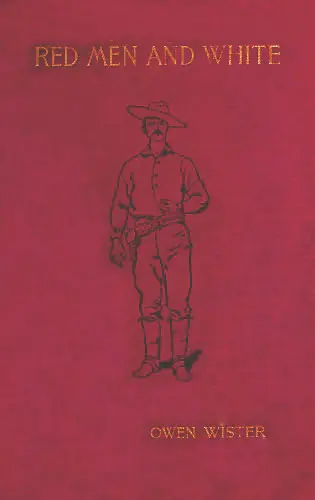
"Red Men and White" by Owen Wister is a collection of short stories written in the late 19th century. The narrative explores the complexities of life on the Western frontier, particularly focusing on the interactions between white settlers and Native American tribes. The stories are connected thematically and feature overlapping characters, suggesting a rich and intertwined tapestry of life during a pivotal time in American history. The opening of the collection sets the stage for these narratives by highlighting the dynamic circumstances of the Crow Indians and their evolving relationship with white settlers and soldiers. It introduces characters like young Cheschapah, a Crow Indian who struggles between his ambition for leadership and duty to his people, and Lieutenant Stirling whose observations about the Indians reveal deeper nuances. As tensions arise with the Sioux tribe visiting the Crows and the calculations of superstitions that could ignite conflict, a stark portrait of life on the frontier is painted—a world of fragile peace overshadowed by the threat of violence, cultural misunderstanding, and the quest for identity and recognition. This sets the tone for a thoughtful exploration of the intersections of cultures, conflict, and human ambition that defines the Wild West.
Introduction adapted from the source catalogue; source summaries may be automatically generated.
Free to read · English · 79,787 words · No account needed
MAKE TIME FOR A GOOD BOOK
On by default. Untick to stop anonymous reading totals. Each page counts after 10 seconds in view. How this works.
Anonymous counting is on unless you have switched it off.
And now came the testimony of Sergeant Brown. He told so clear a story as to chill the enthusiasm of the room. He pointed to the man with the mustache, black curly, and yellow. "I saw them shooting from the right of the road," he said. Jenks tried but little to shake him, and left him unshaken. He was followed by the other wounded soldier, whose story was nearly the same, except that he identified different prisoners.
"Who did you say shot you?" inquired Jenks. "Which of these two?"
"I didn't say. I don't know."
"Don't know a man when he shoots you in broad daylight?"
"Plenty was shooting at me," said the soldier. And his testimony also
remained unshaken.
Then came my own examination, and Jenks did not trouble me at all, but, when I had likewise identified the men I knew, simply bowed smilingly, and had no questions to ask his friend from the East.
Our third morning began with the negress, who said she was married, told a scattered tale, and soon stated that she was single, explaining later that she had two husbands, and one was dead, while the other had disappeared from her ten years ago. Gradually her alarm subsided and she achieved coherence.
"What did this gentleman do at the occurrence?" inquired Jenks,
indicating me.
"Dat gemman? He jes flew, sir, an' I don' blame him fo' bein' no wusser skeer'd dan de hole party. Yesser, we all flew scusin' dey two pore chillun; an' we stayed till de 'currence was ceased."
"But the gentleman says he sat on a stone, and saw those men firing."
"Land! I seed him goin' like he was gwineter Fo't Grant. He run up de hill, an' de Gennul he run down like de day of judgment."
"The General ran?"
"Lawd grashus, honey, yo' could have played checkers on dey coat tails
of his."
The court rapped gently.
"But the gold must have been heavy to carry away to the horses. Did not the General exert his influence to rally his men?"
"No, sah. De Gennul went down de hill, an' he took his inflooence with
him."
"I have no further questions," said Jenks. "When we come to our alibis, gentlemen, I expect to satisfy you that this lady saw more correctly, and when she is unable to recognize my clients it is for a good reason."
"We've not got quite so far yet," Rocklin observed. "We've reached the
hay-stack at present."
"Aren't you going to make her describe her own confusion more?" I began, but stopped, for I saw that the next witness was at hand, and that it was Mrs. Sproud.
Your reading position is saved on this browser. Take it to another device with a library code. Reading pages adapt to text, rather than matching a printed edition.
Owen Wister

Owen Wister

Caspar Whitney & George Bird Grinnell & Owen Wister
Owen Wister
BEHIND THE BOOK
This eBook is for the use of anyone anywhere in the United States and most other parts of the world at no cost and with almost no restrictions whatsoever. You may copy it, give it away or re-use it under the terms of the Project Gutenberg License included with this eBook or online at www.gutenberg.org. If you are not located in the United States, you will have to check the laws of the country where you are located before using this eBook. Read the source licence.
The original source file, including credits and licence, is retained by this library. Request an original-format copy at no charge. Please include the book title and Project Gutenberg identifier #28675.
KEEP YOUR CURIOSITY GOING
Coulson Kernahan

Maurice Baring
Frances Wright
Cécile Tormay

Frederic Jesup Stimson

W. H. P. (William Henry Pope) Jarvis