THE CLASSIC COLLECTION✦A journey in search of ChristmasCLASSIC FREE BOOKS
A journey in search of Christmas
Owen Wister
THE CLASSIC COLLECTION · 1895
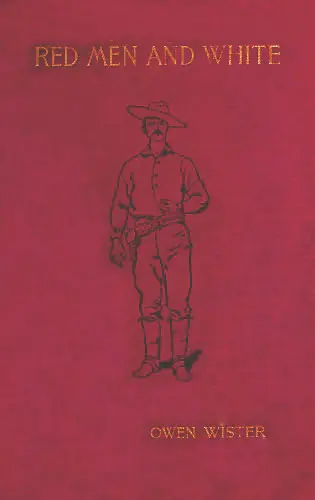
"Red Men and White" by Owen Wister is a collection of short stories written in the late 19th century. The narrative explores the complexities of life on the Western frontier, particularly focusing on the interactions between white settlers and Native American tribes. The stories are connected thematically and feature overlapping characters, suggesting a rich and intertwined tapestry of life during a pivotal time in American history. The opening of the collection sets the stage for these narratives by highlighting the dynamic circumstances of the Crow Indians and their evolving relationship with white settlers and soldiers. It introduces characters like young Cheschapah, a Crow Indian who struggles between his ambition for leadership and duty to his people, and Lieutenant Stirling whose observations about the Indians reveal deeper nuances. As tensions arise with the Sioux tribe visiting the Crows and the calculations of superstitions that could ignite conflict, a stark portrait of life on the frontier is painted—a world of fragile peace overshadowed by the threat of violence, cultural misunderstanding, and the quest for identity and recognition. This sets the tone for a thoughtful exploration of the intersections of cultures, conflict, and human ambition that defines the Wild West.
Introduction adapted from the source catalogue; source summaries may be automatically generated.
Free to read · English · 79,787 words · No account needed
MAKE TIME FOR A GOOD BOOK
On by default. Untick to stop anonymous reading totals. Each page counts after 10 seconds in view. How this works.
Anonymous counting is on unless you have switched it off.
The white man brought a pot of scarlet paint, and the Indian's staring eyes contracted. Kinney took the battered cavalry sabre in his hand, and set its point in the earth floor of the cabin. "Stand back," he said, in mysterious tones, and Cheschapah shrank from the impending sorcery. Now Kinney had been to school once, in his Eastern childhood, and there had committed to memory portions of Shakespeare, Mrs. Hemans, and other poets out of a Reader. He had never forgotten a single word of any of them, and it now occurred to him that for the purposes of an incantation it would be both entertaining for himself and impressive to Cheschapah if he should recite "The Battle of Hohenlinden." He was drawing squares and circles with the point of the sabre.
"No," he said to himself, "that piece won't do. He knows too much English. Some of them words might strike him as bein' too usual, and he'd start to kill me, and spoil the whole thing. 'Munich' and 'chivalry' are snortin', but 'sun was low' ain't worth a damn. I guess--"
He stopped guessing, for the noon recess at school came in his mind, like a picture, and with it certain old-time preliminaries to the game of tag.
"'Eeny, meeny, money, my,'"
said Kinney, tapping himself, the sabre, the paint-pot, and Cheschapah in turn, one for each word. The incantation was begun. He held the sabre solemnly upright, while Cheschapah tried to control his excited breathing where he stood flattened against the wall.
"'Butter, leather, boney, stry;
Hare-bit, frost-neck,
Harrico, barrico, whee, why, whoa, whack!'
"You're it, Cheschapah." After that the weapon was given its fresh coat of paint, and Cheschapah went away with his new miracle in the dark.
"He is it," mused Kinney, grave, but inwardly lively. He was one of those sincere artists who need no popular commendation. "And whoever he does catch, it won't be me," he concluded. He felt pretty sure there would be war now.
Dawn showed the summoned troops near the agency at the corral, standing to horse. Cheschapah gathered his hostiles along the brow of the ridge in the rear of the agency buildings, and the two forces watched each other across the intervening four hundred yards.
"There they are," said the agent, jumping about. "Shoot them, colonel;
shoot them!"
"You can't do that, you know," said the officer, "without an order from the President, or an overt act from the Indians."
Your reading position is saved on this browser. Take it to another device with a library code. Reading pages adapt to text, rather than matching a printed edition.
Owen Wister

Owen Wister

Caspar Whitney & George Bird Grinnell & Owen Wister
Owen Wister
BEHIND THE BOOK
This eBook is for the use of anyone anywhere in the United States and most other parts of the world at no cost and with almost no restrictions whatsoever. You may copy it, give it away or re-use it under the terms of the Project Gutenberg License included with this eBook or online at www.gutenberg.org. If you are not located in the United States, you will have to check the laws of the country where you are located before using this eBook. Read the source licence.
The original source file, including credits and licence, is retained by this library. Request an original-format copy at no charge. Please include the book title and Project Gutenberg identifier #28675.
KEEP YOUR CURIOSITY GOING
Coulson Kernahan

Maurice Baring
Frances Wright
Cécile Tormay

Frederic Jesup Stimson

W. H. P. (William Henry Pope) Jarvis