THE CLASSIC COLLECTION✦An outlaw’s diary: the CommuneCLASSIC FREE BOOKS
An outlaw’s diary: the Commune
Cécile Tormay
THE CLASSIC COLLECTION · 1898
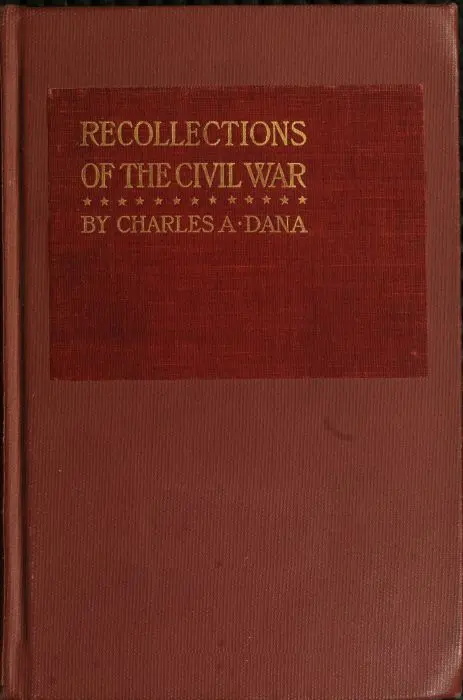
"Recollections of the Civil War" by Charles A. Dana is a historical account written in the late 19th century. This work provides a first-hand narrative of Dana's experiences and observations during the Civil War, particularly focusing on his interactions with key military and political leaders, including President Abraham Lincoln and General Ulysses S. Grant. Dana's position as Assistant Secretary of War gives him unique insights into military strategies and the workings of the War Department during this tumultuous period. The opening of the book describes Dana's transition from his role as a journalist at the New York Tribune to an important position in the War Department, prompted by his correspondence with prominent figures like Edwin Stanton, the Secretary of War. He details his initial meetings with Lincoln and Stanton, as well as the context surrounding his appointment. Dana's narrative sets the stage for his upcoming interactions on the battlefield, illustrating his commitment to the Union cause and providing a glimpse into the complexities of war governance and military logistics during one of America's most defining periods. The narrative illustrates not only the political backdrop of the Civil War but also the personal resolve of those involved in the fight for the nation's future.
Introduction adapted from the source catalogue; source summaries may be automatically generated.
Free to read · English · 81,598 words · No account needed
MAKE TIME FOR A GOOD BOOK
On by default. Untick to stop anonymous reading totals. Each page counts after 10 seconds in view. How this works.
Anonymous counting is on unless you have switched it off.
I was, of course, curious to see what General Sherman would do in passing before Mr. Stanton to take his place on the stand. The general says in his Memoirs that, as he passed, Stanton offered his hand and he refused to take it. He is entirely mistaken. I was watching narrowly. The Secretary made no motion to offer his hand, or to exchange salutations in any manner. As the general passed, Mr. Stanton gave him merely a slight forward motion of his head, equivalent, perhaps, to a quarter of a bow.
In May I had been asked to become the editor of a new paper to be founded in Chicago, the Republican. The active promoter was a Mr. Mack, and the concern was organized with a nominal capital of five hundred thousand dollars. Only a small part of this was ever paid up; a large block of the stock was set aside as a bonus to induce a proper man to become the editor. Mr. Mack had offered the post to me, and, through the influence of the Hon. Lyman Trumbull and other prominent men of Illinois, I was persuaded to accept it. In deciding on the change, I had arranged to stay in Washington until I could finish the routine business upon which I was then engaged, and until Mr. Stanton could conveniently spare me. This was not until the 1st of July. On the first day of the month I sent to the President my resignation as Assistant Secretary of War, and a few days later I left the capital for Chicago.
[E] The secret cipher key was a model consisting of a cylinder, six inches in length and two and one half in diameter, fixed in a frame, the cylinder having the printed key pasted over it. By shifting the pointers fixed over the cylinder on the upper portion of the frame, according to a certain arrangement previously agreed upon, the cipher letter or dispatch could be deciphered readily. The model was put in evidence at the trial.
Army of the Cumberland reorganized, 126.
Augur, General, and the spy, 183;
in command at Washington, 244.
Baltimore merchants arrested, 236.
Banks, General, besieges Port Hudson, 80.
Bates, Edward, impressions of, 171.
Beauregard, General, 222.
Blair, Montgomery, character, 170, 231.
Booth, J. Wilkes, 281.
Bragg, General, driven across the Tennessee, 104;
maneuvers to reach Chattanooga, 107-111;
evacuates Lookout Mountain, 148;
retreats, 151.
Burnside, General, shut up in Knoxville, 135;
character, 138;
forces, 138;
repulses Longstreet, 154;
relieved by Sherman, 154;
transferred to command of Ninth Army Corps, 191.
Cairo, the claims commission, 12.
Campbell, Judge, negotiations with President Lincoln, 266, 270.
Canada, proposed Confederate expedition from, 243.
Cedar Creek, 248.
Champion Hill, 53.
Chase, Salmon P., impressions of, 169.
Chattanooga, defense of, 120;
battle, 143.
Chickamauga, 111.
Cipher dispatches, 22;
Confederate, 280.
Cold Harbor, 208.
Conkling, Roscoe, 17, 177, 263.
Your reading position is saved on this browser. Take it to another device with a library code. Reading pages adapt to text, rather than matching a printed edition.
BEHIND THE BOOK
This eBook is for the use of anyone anywhere in the United States and most other parts of the world at no cost and with almost no restrictions whatsoever. You may copy it, give it away or re-use it under the terms of the Project Gutenberg License included with this eBook or online at www.gutenberg.org. If you are not located in the United States, you will have to check the laws of the country where you are located before using this eBook. Read the source licence.
The original source file, including credits and licence, is retained by this library. Request an original-format copy at no charge. Please include the book title and Project Gutenberg identifier #42892.
KEEP YOUR CURIOSITY GOING
Cécile Tormay

Moritz Busch
John L. Ransom
Frances Wright
Cécile Tormay

Mabel Potter Daggett