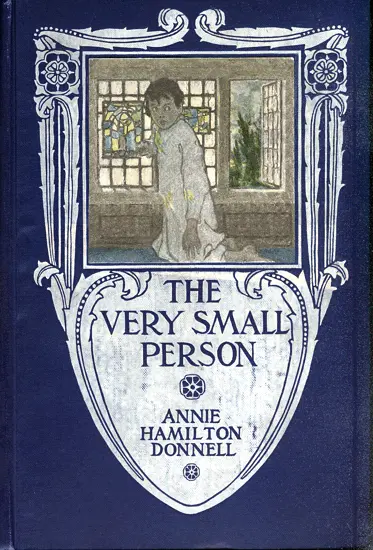
The Very Small Person
Annie Hamilton Donnell
THE CLASSIC COLLECTION · 1905
"Rebecca Mary" by Annie Hamilton Donnell is a novel likely written in the early 20th century. The story centers around a young girl named Rebecca Mary Plummer, who navigates her childhood with determination, resilience, and a unique perspective on the world. Through Rebecca's experiences, the book explores themes of individuality, the complexities of familial relationships, and the innocence of childhood. The opening of the novel introduces Rebecca Mary as she is completing a challenging sewing project, expressing her anxiety about her hundred-and-oneth stitch. Her interactions with Aunt Olivia, her stern guardian, reveal the strict and demanding upbringing she endures. Despite her meticulous nature and the pressure she feels, Rebecca Mary ultimately decides to stop sewing altogether, which leads to a tense standoff with her aunt. This moment encapsulates her struggle for independence and the weight of her circumstances, setting the stage for further developments in her relationship with Aunt Olivia and her understanding of the world around her. The gentle yet profound dynamics between children and adults, highlighted through Rebecca's friendship with her pet rooster, Thomas Jefferson, add a layer of warmth and poignancy to the narrative.
Introduction adapted from the source catalogue; source summaries may be automatically generated.
Free to read · English · 28,560 words · No account needed
MAKE TIME FOR A GOOD BOOK
On by default. Untick to stop anonymous reading totals. Each page counts after 10 seconds in view. How this works.
Anonymous counting is on unless you have switched it off.
“You don't—I don't suppose you LOVE me?” panted Rebecca Mary. But Aunt Olivia was gone out of the room in a swirl of white nightgown.
“Everything's on the table,” she called back from the stairs. “I'm going to light a fire. You come right down. I think it's high time—” her voice trailing out thinly.
“She does,” murmured Rebecca Mary, radiant of face.
At half past twelve o'clock they both ate supper, both in their scant, white nightgowns, both very hungry indeed. But before she sat down in her old place at the table, Rebecca Mary went round to Aunt Olivia's place and whispered something rather shyly in her ear. She had been by herself in a corner of the room for a moment.
“I've sewed the hundred and twoth,” Rebecca Mary whispered.
The Thousand Quilt
“Good afternoon,” Rebecca Mary said, politely.
The minister's wife was cutting little trousers out of big ones—the minister's big ones. It was the old puzzle of how to steer clear of the thin places.
“Boys grow so!” sighed, tenderly, the minister's wife, over her work. She had not heard the voice from the doorway.
“Good afternoon”—again.
It was a quaint little figure in tight red calico standing there. It might easily have stepped down from some old picture on the wall. Rebecca Mary had a bundle in her arms. It was so large that it obscured breast and face, and only a pair of grave blue eyes, presided over by thin, light brows, seemed visible to the minister's wife. The trousers puzzle merged into this one. Now who could—
“Oh! Oh, it's Miss Plummer's little girl Rebecca,” she said, cordially.
“Rebecca Mary her NIECE,” came, a little muffled, from behind the great
bundle.
“Rebecca Mary's niece—— Oh, you mean Miss Plummer's niece, and your whole name is that! But I suppose she calls you Rebecca or Becky, for short? Walk in, Rebecca.”
But Rebecca Mary was struggling with the paralyzing vision of Aunt Olivia calling her Becky. She had passed by the lesser wonder of being called Rebecca without the Mary.
“Oh no'm, indeed; Aunt 'Livia never shortens me,” gently gasped the child. And the minister's wife, measuring from the bundle down, smiled to herself. There did not seem much room for shortening.
“But walk in, dear—you're going to walk in? I hope you have come to make me a little call?”
Rebecca Mary struggled out of her paralysis. Here was occasion for new embarrassment. For Rebecca Mary was honest.
“N-o'm I mean, not a LITTLE call. I've come to spend the afternoon,” she said, slowly, “and I've brought my work.”
Your reading position is saved on this browser. Take it to another device with a library code. Reading pages adapt to text, rather than matching a printed edition.
Annie Hamilton Donnell
Annie Hamilton Donnell
Annie Hamilton Donnell
Annie Hamilton Donnell
BEHIND THE BOOK
This eBook is for the use of anyone anywhere in the United States and most other parts of the world at no cost and with almost no restrictions whatsoever. You may copy it, give it away or re-use it under the terms of the Project Gutenberg License included with this eBook or online at www.gutenberg.org. If you are not located in the United States, you will have to check the laws of the country where you are located before using this eBook. Read the source licence.
The original source file, including credits and licence, is retained by this library. Request an original-format copy at no charge. Please include the book title and Project Gutenberg identifier #3419.
KEEP YOUR CURIOSITY GOING
Coulson Kernahan

Maurice Baring
Frances Wright
Cécile Tormay

Frederic Jesup Stimson

W. H. P. (William Henry Pope) Jarvis