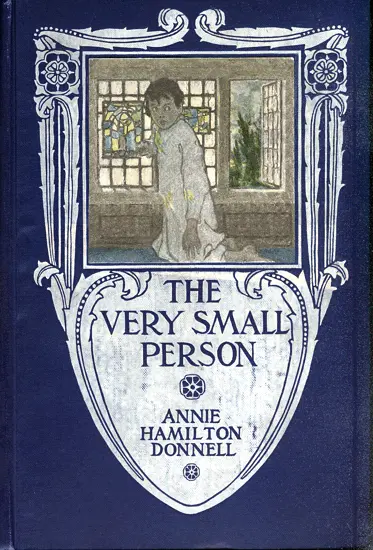
The Very Small Person
Annie Hamilton Donnell
THE CLASSIC COLLECTION · 1905
"Rebecca Mary" by Annie Hamilton Donnell is a novel likely written in the early 20th century. The story centers around a young girl named Rebecca Mary Plummer, who navigates her childhood with determination, resilience, and a unique perspective on the world. Through Rebecca's experiences, the book explores themes of individuality, the complexities of familial relationships, and the innocence of childhood. The opening of the novel introduces Rebecca Mary as she is completing a challenging sewing project, expressing her anxiety about her hundred-and-oneth stitch. Her interactions with Aunt Olivia, her stern guardian, reveal the strict and demanding upbringing she endures. Despite her meticulous nature and the pressure she feels, Rebecca Mary ultimately decides to stop sewing altogether, which leads to a tense standoff with her aunt. This moment encapsulates her struggle for independence and the weight of her circumstances, setting the stage for further developments in her relationship with Aunt Olivia and her understanding of the world around her. The gentle yet profound dynamics between children and adults, highlighted through Rebecca's friendship with her pet rooster, Thomas Jefferson, add a layer of warmth and poignancy to the narrative.
Introduction adapted from the source catalogue; source summaries may be automatically generated.
Free to read · English · 28,560 words · No account needed
MAKE TIME FOR A GOOD BOOK
On by default. Untick to stop anonymous reading totals. Each page counts after 10 seconds in view. How this works.
Anonymous counting is on unless you have switched it off.
Softly, patiently, very wearily, Aunt Olivia went in and out. The things she brought out in her arms she folded carefully and packed, but not in the lank old valise. She put them all with tender painstaking into a quaint little carpetbag. When the work was done she set the bag away out of sight, and went about packing her own things in the old valise.
The day before, she had been to see the minister and the minister's wife. She called for them both, and sat down gravely and made her proposition. It was startling only because of the few words it took to make it. Otherwise it was very pleasant, and the minister and the minister's wife received it with nods and smiles.
“Of course, Miss Olivia—why, certainly!” smiled and nodded the minister.
“Why, it will be delightful—and Rhoda will be so pleased!” nodded and smiled the minister's wife. But after their caller had gone she faced the minister with indignant eyes.
“Why did you let her?” she demanded. “Why did you spoil it all by that?”
“Because she was Miss Olivia,” he answered, gently.
“Yes—yes, I suppose so,” reluctantly; “but, anyway, you needn't have let her do it in advance. Actually it made me blush, Robert!”
The minister rubbed his cheeks tentatively. “Made me, too,” he admitted, “but I respect Miss Olivia so much—”
The minister's wife tacked abruptly to her other source of indignation.
“Why doesn't she TAKE Rebecca Mary? Robert, wait! You know it isn't because—You know better!”
“It isn't because, dear—I know better,” he hurried, assuringly. The minister was used to her little indignations and loved them for being hers. They were harmless, too, and wont to have a good excuse for being. This one, now—the minister in his heart wondered that Miss Olivia did not take Rebecca Mary.
“It would be such a treat. Robert, you think what a treat it would be to
Rebecca Mary!”
“Still, dear—”
“I don't want to be still! I want Rebecca Mary to have that treat!” But she kissed him in token of being willing to drop it there—it was her usual token—and ran away to get a little room ready. There was not a device known to the minister's wife that she did not use to make that room pleasant.
“Shall I take your pincushion, Rhoda?” Rhoda had come up to help.
“Yes,” eagerly, “and I'll write Welcome with the pins.”
“And the little fan to put on the wall—the pink one?”
“Yes, yes; let me spread it out, mamma!”
“That's grand. Now if we only had a pink quilt—”
Your reading position is saved on this browser. Take it to another device with a library code. Reading pages adapt to text, rather than matching a printed edition.
Annie Hamilton Donnell
Annie Hamilton Donnell
Annie Hamilton Donnell
Annie Hamilton Donnell
BEHIND THE BOOK
This eBook is for the use of anyone anywhere in the United States and most other parts of the world at no cost and with almost no restrictions whatsoever. You may copy it, give it away or re-use it under the terms of the Project Gutenberg License included with this eBook or online at www.gutenberg.org. If you are not located in the United States, you will have to check the laws of the country where you are located before using this eBook. Read the source licence.
The original source file, including credits and licence, is retained by this library. Request an original-format copy at no charge. Please include the book title and Project Gutenberg identifier #3419.
KEEP YOUR CURIOSITY GOING
Coulson Kernahan

Maurice Baring
Frances Wright
Cécile Tormay

Frederic Jesup Stimson

W. H. P. (William Henry Pope) Jarvis