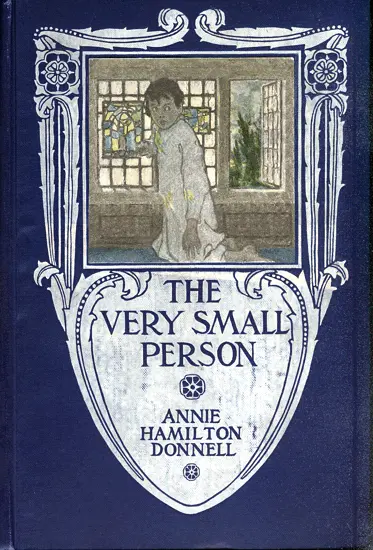
The Very Small Person
Annie Hamilton Donnell
THE CLASSIC COLLECTION · 1905
"Rebecca Mary" by Annie Hamilton Donnell is a novel likely written in the early 20th century. The story centers around a young girl named Rebecca Mary Plummer, who navigates her childhood with determination, resilience, and a unique perspective on the world. Through Rebecca's experiences, the book explores themes of individuality, the complexities of familial relationships, and the innocence of childhood. The opening of the novel introduces Rebecca Mary as she is completing a challenging sewing project, expressing her anxiety about her hundred-and-oneth stitch. Her interactions with Aunt Olivia, her stern guardian, reveal the strict and demanding upbringing she endures. Despite her meticulous nature and the pressure she feels, Rebecca Mary ultimately decides to stop sewing altogether, which leads to a tense standoff with her aunt. This moment encapsulates her struggle for independence and the weight of her circumstances, setting the stage for further developments in her relationship with Aunt Olivia and her understanding of the world around her. The gentle yet profound dynamics between children and adults, highlighted through Rebecca's friendship with her pet rooster, Thomas Jefferson, add a layer of warmth and poignancy to the narrative.
Introduction adapted from the source catalogue; source summaries may be automatically generated.
Free to read · English · 28,560 words · No account needed
MAKE TIME FOR A GOOD BOOK
On by default. Untick to stop anonymous reading totals. Each page counts after 10 seconds in view. How this works.
Anonymous counting is on unless you have switched it off.
“I think it's going to rain,” the minister said. But he kissed her to
make it easier.
Rebecca Mary came over to bring Aunt Olivia's rule for parson-cake that the minister's wife had asked for.
“Come in, Rebecca Mary,” the minister's wife said, cordially. “Don't you want to see the new dress Rhoda's doll is going to have? I suppose you could make your doll's dress yourself?” It seemed a hard thing to say. Feeling round was not pleasant.
“P'haps I could, but she doesn't wear dresses,” Rebecca Mary answered,
gravely.
“No?” This was puzzling. “Her clothes don't come off, I suppose?” Then it could not be the nice, friendly doll.
“No'm. Nor they don't go on, either. She isn't a feel doll.”
“A—what kind did you say, dear?” The minister's wife paused in her work interestedly. Distinctly, Miss Olivia had not given her THE doll; but this doll—“I don't think I quite understood, Rebecca Mary.”
“No'm; it's a little hard. She isn't a FEEL doll, I said. I never had a feel one. Mine hasn't any body, just a soul. But she's a great comfort.”
“Robert,” appealed the minister's wife, helplessly. This was a case for the minister—a case of souls.
“Tell us some more about her, Rebecca Mary,” the minister urged, gently. But there was helplessness, too, in his eyes.
“Why, that's all!” returned Rebecca Mary, in surprise. “Of course I can't dress her or undress her or take her out calling. But it's a great comfort to rock her soul to sleep.”
“Call Rhoda,” murmured the wife to the minister; but Rhoda was already there. She volunteered prompt explanation. There was no hesitation in Rhoda's face.
“She means a make believe doll. Don't you, Rebecca Mary?”
“Yes,” Rebecca Mary assented; “that's her other name, I suppose, but I never called her by it.”
“What did you call her?” demanded practical Rhoda. “What's her name
mean?”
“Rhoda!”—hastily, from the minister's wife. This seemed like sacrilege. But Rhoda's clear, blue eyes were fixed upon Rebecca Mary; she had not heard her mother's warning little word.
A shy color spread thinly over the lean little face of Rebecca Mary. For the space of a breath or two she hesitated.
“Her name's—Felicia,” then, softly.
“Robert”—the children had gone out together; the minister's wife's eyes were unashamedly wet—“Robert, I wish you were a—a sheriff instead of a minister. Because I think I would make a better sheriff's wife. Do you know what I would make you do?”
The minister could guess.
“I'd make you ARREST that woman, Robert!”
Your reading position is saved on this browser. Take it to another device with a library code. Reading pages adapt to text, rather than matching a printed edition.
Annie Hamilton Donnell
Annie Hamilton Donnell
Annie Hamilton Donnell
Annie Hamilton Donnell
BEHIND THE BOOK
This eBook is for the use of anyone anywhere in the United States and most other parts of the world at no cost and with almost no restrictions whatsoever. You may copy it, give it away or re-use it under the terms of the Project Gutenberg License included with this eBook or online at www.gutenberg.org. If you are not located in the United States, you will have to check the laws of the country where you are located before using this eBook. Read the source licence.
The original source file, including credits and licence, is retained by this library. Request an original-format copy at no charge. Please include the book title and Project Gutenberg identifier #3419.
KEEP YOUR CURIOSITY GOING
Coulson Kernahan

Maurice Baring
Frances Wright
Cécile Tormay

Frederic Jesup Stimson

W. H. P. (William Henry Pope) Jarvis