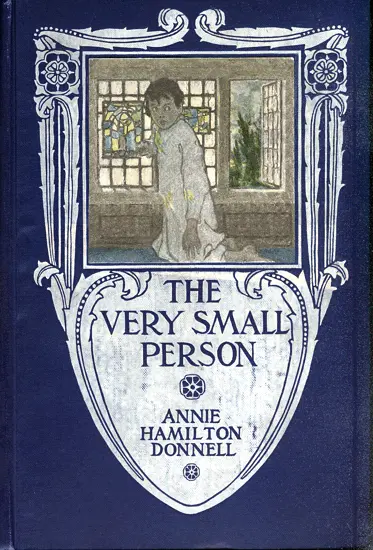
The Very Small Person
Annie Hamilton Donnell
THE CLASSIC COLLECTION · 1905
"Rebecca Mary" by Annie Hamilton Donnell is a novel likely written in the early 20th century. The story centers around a young girl named Rebecca Mary Plummer, who navigates her childhood with determination, resilience, and a unique perspective on the world. Through Rebecca's experiences, the book explores themes of individuality, the complexities of familial relationships, and the innocence of childhood. The opening of the novel introduces Rebecca Mary as she is completing a challenging sewing project, expressing her anxiety about her hundred-and-oneth stitch. Her interactions with Aunt Olivia, her stern guardian, reveal the strict and demanding upbringing she endures. Despite her meticulous nature and the pressure she feels, Rebecca Mary ultimately decides to stop sewing altogether, which leads to a tense standoff with her aunt. This moment encapsulates her struggle for independence and the weight of her circumstances, setting the stage for further developments in her relationship with Aunt Olivia and her understanding of the world around her. The gentle yet profound dynamics between children and adults, highlighted through Rebecca's friendship with her pet rooster, Thomas Jefferson, add a layer of warmth and poignancy to the narrative.
Introduction adapted from the source catalogue; source summaries may be automatically generated.
Free to read · English · 28,560 words · No account needed
MAKE TIME FOR A GOOD BOOK
On by default. Untick to stop anonymous reading totals. Each page counts after 10 seconds in view. How this works.
Anonymous counting is on unless you have switched it off.
“You little, white cat!” she cried, muffledly, her face in his thick coat, “you've waited and waited, but I think I'm going to love you now—you needn't wait any more.”
The Feel Doll
The minister uttered a suppressed note of warning as solid little steps sounded in the hall. It was he who threw a hasty covering over the doll. The minister's wife sewed on undisturbedly. She did worse than that.
“Come here, Rhoda,” she called, “and tell me which you like better, three tucks or five in this petticoat?”
“Five,” promptly, upon inspection. Rhoda pulled away the concealing cover and regarded the stolid doll with tilted head. “She's 'nough like my Pharaoh's Daughter to be a blood relation,” she remarked. “She's got the Pharaoh complexion.”
“Spoken like MY daughter!” laughed the minister. “But I thought new dolls in this house were always surprises. And here's Mrs. Minister making doll petticoats out in the open!”
“This is Rebecca Mary's—I'm dressing a doll for Rebecca Mary, Robert. She's eleven years old and never had a doll! Rhoda's ten and has had—How many dolls have you had, Rhoda?”
“Gracious! Why, Pharaoh's Daughter, an' Caiapha, an' Esther the Beautiful Queen, an' the Children of Israel—five o' them—an' Mrs. Job, an'—”
“Never mind the rest, dear. You hear, Robert? Do you think Rhoda would be alive now if she'd never had a doll?”
The minister pondered the question. “Maybe not, maybe not,” he decided; “but possibly the dolls would have been.”
“Don't make me smile, Robert. I'm trying to make you cry. If Rebecca Mary were sixty instead of eleven I should dress her a doll.”
“Then why not one for Miss Olivia?”
“I may dress her one,” undauntedly, “if I find out she never had one in
her life.”
“She never did.” The minister's voice was positive. “And for that reason, dear, aren't you afraid she would not approve of Rebecca Mary's having one? Isn't it rather a delicate mat—”
“Don't, Robert, don't discourage me. It's going to be such a beautiful doll! And you needn't tell me that poor little eleven-year-old woman- child won't hold out her empty arms for it. Robert, you're a minister; would it be wrong to give it to her STRAIGHT?”
“Straight, dear?”
“Yes; without saying anything to her aunt Olivia. Tell me. Rhoda's gone. Say it as—as liberally as you can.”
The minister for answer swept doll, petticoat, and minister's wife into his arms, and kissed them all impartially.
“Think if it were Rhoda,” she pleaded.
“And you were 'Aunt Olivia'? You ask me to think such hard things, dear! If I could stop being a minister long enough—”
Your reading position is saved on this browser. Take it to another device with a library code. Reading pages adapt to text, rather than matching a printed edition.
Annie Hamilton Donnell
Annie Hamilton Donnell
Annie Hamilton Donnell
Annie Hamilton Donnell
BEHIND THE BOOK
This eBook is for the use of anyone anywhere in the United States and most other parts of the world at no cost and with almost no restrictions whatsoever. You may copy it, give it away or re-use it under the terms of the Project Gutenberg License included with this eBook or online at www.gutenberg.org. If you are not located in the United States, you will have to check the laws of the country where you are located before using this eBook. Read the source licence.
The original source file, including credits and licence, is retained by this library. Request an original-format copy at no charge. Please include the book title and Project Gutenberg identifier #3419.
KEEP YOUR CURIOSITY GOING
Coulson Kernahan

Maurice Baring
Frances Wright
Cécile Tormay

Frederic Jesup Stimson

W. H. P. (William Henry Pope) Jarvis