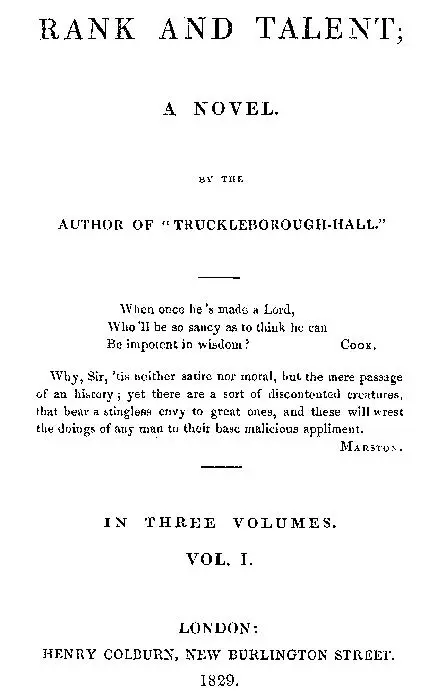
Rank and Talent; A Novel, Vol. 1 (of 3)
William Pitt Scargill
THE CLASSIC COLLECTION · 1829
"Rank and Talent; A Novel, Vol. 3 (of 3)" by William Pitt Scargill is a novel written in the early 19th century. The narrative revolves around intertwined stories of social class, romantic entanglements, and the follies of the privileged, particularly focusing on characters such as the self-indulgent Earl of Trimmerstone and the gentle Clara Rivolta. Themes of societal expectation and personal dissatisfaction emerge as various characters navigate their relationships and aspirations. The opening of the novel picks up from a previous climax, highlighting Dr. Crack's budding romance with Miss Henderson while depicting Clara Rivolta's delicate situation under the attention of the vain Tippetson. The text outlines Clara's internal struggles with her feelings of longing and dissatisfaction, especially in contrast to Tippetson's superficiality. Meanwhile, tensions arise involving Lord Trimmerstone, who faces moral dilemmas resulting from his gambling habits and the indifference he encounters in his relationships. The narrative paints a vivid picture of social dynamics, focusing on the characters' flaws and aspirations as they engage in various romantic and social intrigues.
Introduction adapted from the source catalogue; source summaries may be automatically generated.
Free to read · English · 50,651 words · No account needed
MAKE TIME FOR A GOOD BOOK
On by default. Untick to stop anonymous reading totals. Each page counts after 10 seconds in view. How this works.
Anonymous counting is on unless you have switched it off.
As one of these frolics to which we here allude is somewhat connected with the development of our history, we will relate it. One evening, towards the latter end of May, when the days are at such an inconvenient length that it is hardly candle-light by dinner-time, the Earl of Trimmerstone and Singleton Sloper had agreed to dine at a club-house at nine in the evening, together with a set of honorable ones of the same slip-shod dignity as themselves. Every thing was ordered to be prepared on the most sumptuous possible scale; and though the weather was not warm enough to render ice a luxury, the apartment was ordered to be raised to such a temperature that iced wines might be properly enjoyed. The Earl and his friend did not design to be at the expense of this entertainment; but promised themselves that a young gentleman who was to be of the party, would, for the sake of the honor of such high society, suffer himself to be honorably deprived of enough, and more than enough, to defray the cost of the banquet. The bait appeared to take; but as neither the Earl nor his friend Sloper was absolutely dishonest or addicted to play unfairly, as they both trusted rather to their own skill and experience than to any dishonorable artifices, they were most cruelly and miserably disappointed. For our own part, such is our fastidiousness and delicacy, that we think it at least dishonorable, if not absolutely dishonest, to sit down deliberately to play for large stakes where there is a supposed great advantage in skill or experience; and therefore we do not think that money is fairly won under such circumstances, even though only what is called fair play has been used. We are, however, very glad, when in such cases the knowing ones are taken in. So it happened in the present case. Whatever the young gentleman, whom his lordship intended to pluck, wanted in experience, he seemed to make up by natural quickness and observant attention; and without any design of deep play, he was led on “deeper and deeper still.” Now, Singleton hinted to his lordship that it would be absolutely necessary to apply the “vinous stimulus,” as Dr. Crack called it, more copiously to their too vigilant friend. But whether it was from superior strength and vigor of constitution in the young man, or from the anxiety and agitation of the others, it so happened that the Right Hon. the Earl of Trimmerstone and his worthy friend Mr. Singleton Sloper felt most powerfully the effects of the wine. So much did they feel its effects, that they were compelled to leave off play after being considerable losers. The young gentleman, who had not the slightest supposition that any conspiracy had been formed against him, though he, perhaps, might not be reluctant, with his apparent simplicity, to form a conspiracy against another, felt in high spirits, pleased with his winnings, and proud of the honor of an acquaintance with a man of rank. At an early hour in the morning the party separated; but the young gentleman, as his home lay partly in the same direction, accompanied the Earl and his friend Mr. Sloper. By this time all three of them were under the influence of strong drink, and they were disposed to be exceedingly facetious. The Earl and his friend were on very intimate terms with the watchmen of their own immediate neighbourhood; but, to speak again after the manner of Dr. Crack, “the vinous stimulus had obfuscated their geographical apprehension,” so that they roamed beyond their usual precincts, amusing themselves as they went by copiously complying with the exhortation inscribed on many doors--“knock and ring.” This was not unobserved, nor did it pass unrebuked by the trusty guardians of the night. Advice and reproof are seldom very agreeable; and they are more frequently received with nominal than with real thanks. In the present instance they were most uncourteously received, seeing that an hereditary legislator ought certainly to know how to conduct himself without any monitory assistance from a watchman. The consequence of this indisposition to take good advice, terminated in the unpleasant and mortifying catastrophe of sending a noble earl and two illustrious commoners to the watch-house. But this was not effected by the arm of one individual watchman, nor was it accomplished till a great conflict had taken place between the parties; by the exertions of which conflict the already inebriated gentlemen were reduced to a state of nearly unconscious apathy and insensibility.
Your reading position is saved on this browser. Take it to another device with a library code. Reading pages adapt to text, rather than matching a printed edition.
William Pitt Scargill
William Pitt Scargill
BEHIND THE BOOK
This eBook is for the use of anyone anywhere in the United States and most other parts of the world at no cost and with almost no restrictions whatsoever. You may copy it, give it away or re-use it under the terms of the Project Gutenberg License included with this eBook or online at www.gutenberg.org. If you are not located in the United States, you will have to check the laws of the country where you are located before using this eBook. Read the source licence.
The original source file, including credits and licence, is retained by this library. Request an original-format copy at no charge. Please include the book title and Project Gutenberg identifier #54864.
KEEP YOUR CURIOSITY GOING
Coulson Kernahan

Maurice Baring
Frances Wright
Cécile Tormay

Frederic Jesup Stimson

W. H. P. (William Henry Pope) Jarvis