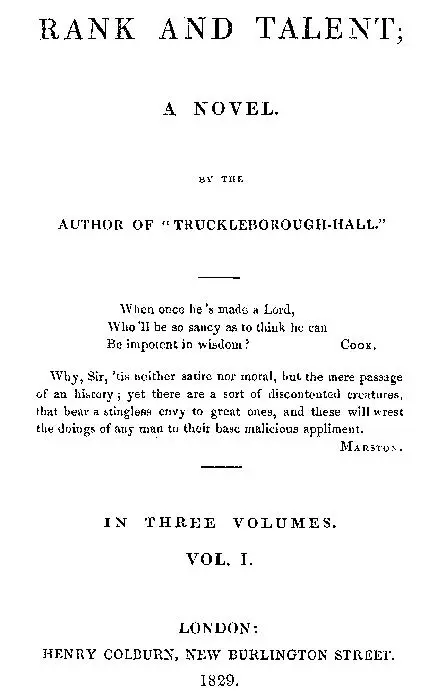
Rank and Talent; A Novel, Vol. 1 (of 3)
William Pitt Scargill
THE CLASSIC COLLECTION · 1829
"Rank and Talent; A Novel, Vol. 3 (of 3)" by William Pitt Scargill is a novel written in the early 19th century. The narrative revolves around intertwined stories of social class, romantic entanglements, and the follies of the privileged, particularly focusing on characters such as the self-indulgent Earl of Trimmerstone and the gentle Clara Rivolta. Themes of societal expectation and personal dissatisfaction emerge as various characters navigate their relationships and aspirations. The opening of the novel picks up from a previous climax, highlighting Dr. Crack's budding romance with Miss Henderson while depicting Clara Rivolta's delicate situation under the attention of the vain Tippetson. The text outlines Clara's internal struggles with her feelings of longing and dissatisfaction, especially in contrast to Tippetson's superficiality. Meanwhile, tensions arise involving Lord Trimmerstone, who faces moral dilemmas resulting from his gambling habits and the indifference he encounters in his relationships. The narrative paints a vivid picture of social dynamics, focusing on the characters' flaws and aspirations as they engage in various romantic and social intrigues.
Introduction adapted from the source catalogue; source summaries may be automatically generated.
Free to read · English · 50,651 words · No account needed
MAKE TIME FOR A GOOD BOOK
On by default. Untick to stop anonymous reading totals. Each page counts after 10 seconds in view. How this works.
Anonymous counting is on unless you have switched it off.
“Now, gentlemen of the jury, can you for a moment imagine that the plaintiff had any regard whatever for his wife, when he did not even take the trouble to pursue her and bring her home again. Here was a virtual manifestation of his indifference to her. If a robber carries off that which is valuable and valued, and the person robbed has time and power to pursue the plunderer, does he not immediately use his efforts to compel the thief to restore his ill-gotten booty? Gentlemen of the jury, if one of you should have your pockets picked, would you not immediately cry out, ‘Stop thief!’ Yet the plaintiff, in the present action, suffered a robber to carry off his greatest treasure without any endeavour on his part to recover it. Here, gentlemen, is proof positive, that the plaintiff cared less for his wife than any one of you would for a snuff-box or pocket-handkerchief.”
At this impressive and conclusive sentence, the learned gentleman paused, astonished at his own wit, and waiting for the murmur of approbation, which he thought must necessarily follow such a combination of eloquence and sagacity; but, unfortunately, some of the jury did not see the point of the argument, and they smiled at the learned gentleman’s simplicity; but they saw that he was a young man, and knew no better.
It has often been with us a matter of consideration, how far it is advisable to defend a bad cause; and what discretion should be allowed in such cases to those learned gentlemen, who have not received from nature any very great share of discernment. We have heard that it has been said by them of Ireland, that bad luck is better than no luck at all; and by parity of reasoning, peradventure it may appear to some, both of Ireland and England, that a bad defence is better than no defence at all. Of this we have our doubts; for we can suppose it very possible that a defendant, whose cause was a bad one, should say to his counsel, “My cause is bad enough of itself, I beseech you not to make it worse by your wit or eloquence.” The use of a clumsy non sequitur argument has sometimes prevailed with some juries. But juries are now growing more enlightened; and the system of composing juries is improved. There still, however, remains room for farther improvement: for since the science of crani…--we beg pardon, we mean phrenology--has been brought to such perfection as to prove, beyond the shadow of a doubt, that a man who has been hanged for murder has the organ of destructiveness strongly developed, it is quite a reproach to the legislature that no steps have been taken to render that most exact of all the sciences subservient to the purposes of society. The size of the head is the measure of the judgment: the upper classes, as it has lately been shown, having larger heads, generally speaking, than the lower and labouring classes. In order then to form an intelligent jury, nothing farther is necessary than that a law should be forthwith made, enacting that no person should be eligible on a jury who has not a head of a certain thickness. The discovery that wisdom and thick heads go together is certainly not modern; it is quite as old as our big wigs for judges, bishops, and others who, if not absolutely wise, ought to be always thought so. Moreover, we are humbly of opinion, that the vulgar notion that thick-headed people are stupid, has arisen from the ironical application of the term thick-head. Exactly in the same manner do we now give the name of Solomon to a simpleton; not that we consider Solomon to have been a fool, but quite the reverse. This theory of ours also solves what has hitherto been a matter of difficulty and perplexity to the ingenious; viz. the apparent paradox that thick-headed and shallow-pated should mean the same. Thick-headed, we see, is used ironically, and shallow-pated seriously, to express a fool. It may be still farther observed, that our young gentlemen do now take marvellous pains to make their heads appear thick, by wearing a large quantity of hair, bushed and bristled out with great pains and study; and when entering a house, or any place of public resort, they do ordinarily poke their fingers through their hair to make it stick out as widely as possible. This is a nasty trick; but for the sake of looking very wise, it is worth while to be a little nasty. We make no apology for this digression, seeing that it is very wise and valuable and entertaining; and an apology would be dull, flat, and unprofitable.
Your reading position is saved on this browser. Take it to another device with a library code. Reading pages adapt to text, rather than matching a printed edition.
William Pitt Scargill
William Pitt Scargill
BEHIND THE BOOK
This eBook is for the use of anyone anywhere in the United States and most other parts of the world at no cost and with almost no restrictions whatsoever. You may copy it, give it away or re-use it under the terms of the Project Gutenberg License included with this eBook or online at www.gutenberg.org. If you are not located in the United States, you will have to check the laws of the country where you are located before using this eBook. Read the source licence.
The original source file, including credits and licence, is retained by this library. Request an original-format copy at no charge. Please include the book title and Project Gutenberg identifier #54864.
KEEP YOUR CURIOSITY GOING
Coulson Kernahan

Maurice Baring
Frances Wright
Cécile Tormay

Frederic Jesup Stimson

W. H. P. (William Henry Pope) Jarvis