THE CLASSIC COLLECTION✦My diaries, being a personal narrative of events 1888-1914, Part 2 (1900-1914)CLASSIC FREE BOOKS
My diaries, being a personal narrative of events 1888-1914, Part 2 (1900-1914)
Wilfrid Scawen Blunt
THE CLASSIC COLLECTION · 1882
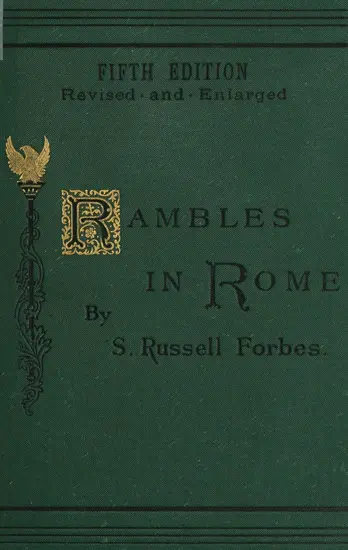
"Rambles in Rome" by S. Russell Forbes is an archaeological and historical guide written in the late 19th century. The work serves as a comprehensive companion for travelers to Rome, chronicling significant museums, galleries, churches, and ancient ruins while also providing insights into their historical contexts. This guide is likely aimed at visitors seeking to deepen their understanding of Rome’s rich heritage through concise commentary on its artifacts and landmarks. At the start of the guide, the author expresses the intent to provide visitors with practical descriptions of notable sites in Rome. He encourages readers to explore the city through a series of "Rambles," offering guidance on routes that showcase both the major attractions and hidden treasures. The opening chapters include introductory observations about Rome’s geography, hints for health and safety, and a brief history explaining the city's gradual decline into ruins, setting the stage for detailed explorations of specific locations in the subsequent sections.
Introduction adapted from the source catalogue; source summaries may be automatically generated.
Free to read · English · 135,448 words · No account needed
MAKE TIME FOR A GOOD BOOK
On by default. Untick to stop anonymous reading totals. Each page counts after 10 seconds in view. How this works.
Anonymous counting is on unless you have switched it off.
stood on the south-east side of the hill. He constructed a passage from the Palatine to the arena of the Colosseum. He was strangled in his chamber; and his successor, Pertinax, was stabbed in the same palace. This was destroyed by fire, and on the top of the ruins was erected the Palace of Septimius Severus, Caracalla, and Alexander Severus. The remains consist of numerous chambers, corridors, and vaults, still retaining some of their mosaic pavements and stucco roofs, with walls built into them in a very confused manner, showing different alterations. The palace is to be cleared out.
After the death of Alexander Severus, A.D. 235, we have little or no history of buildings upon the Palatine, and there are no remains the construction of which shows a later date. Indeed the emperors reigned but a short time down to Diocletian, except Gallienus, who, we know, had a palace and gardens on the Esquiline. Fifty years after Alexander Severus died a great blow was struck at the grandeur of Rome; for the colleagues in empire, Diocletian and Maximian, made new capitals at Milan and Nicomedia, and thus divided the seat of power and empire. In A.D. 302, eighteen years after his declaration, Diocletian came to Rome for the first time, to celebrate his triumph, making a short stay of two months. The year 312 witnessed a great change. On October 28 the great Constantine, the first Christian emperor, and a Briton, made his entry into the imperial city, which for years had ceased to give rulers to the empire, and was now to be the seat of government no longer. Constantine did not make a long stay in the city; and, after he had secured his power, removed in 330 the capital of the empire to Byzantium, which was named Constantinople, to decorate which Rome was stripped of statues, marbles, and works of art. In 356 Constantius visited Rome, which had been abandoned by her rulers and denied the splendours of the imperial court. "After his entry he retired into the imperial palace, where he enjoyed the luxury he had wished for." "He quitted Rome on the thirtieth day after his entry (29th May)" (Marcellinus). The same historian informs us that, "on the night of the 18th of March 362, the Temple of Apollo, on the Palatine, was burned down." Theodosius, in 394, entered Rome in triumph. Honorius, his son, in 403 celebrated the grandest triumph since that of Diocletian, one hundred years before. Indeed, during this long period but four emperors had paid flying visits only to their ancient capital, and the Palace of the Cæsars was falling into decay, as Claudian, the last of the Roman poets, sings. Honorius for a short time revived the glories and memories of the past; the curule chairs once more surrounded the rostra, and their emperor's voice was once more heard by the plebs, whilst they gazed with awe at the lictors with their gilt fasces. After Honorius's departure, Alaric, and the barbarians that were with him, in 410, "took Rome itself, which they pillaged, burning the greatest part of the magnificent structures and other admirable works of art it contained" (Socrates, "E. H." v. 10). In 417 Honorius again entered Rome in triumph, and endeavoured to restore the city, and invited fugitives from all parts to people it. This benefactor of the city was buried near the supposed remains of S. Peter in the Vatican basilica. In 425 Valentinian III., whilst still a boy, received the imperial purple in the ancient Palace of the Cæsars, at the hands of an ambassador of Theodosius; and, although Ravenna was the seat of his government, he frequently visited Rome and inhabited the imperial palace. During one of these visits, in 454, Aetius, the general, fell in the imperial palace, stabbed by the hand of the licentious emperor, who drew his sword for the first time to kill the general who had saved his empire. In the following year, March 27, he was himself assassinated in the Campus Martius during a review; and Petronius Maximus was declared emperor, but was in his turn soon after murdered. The third day thereafter, Genseric and his Vandals entered Rome, and plundered it of everything they could carry off, from the seven-branched candlestick to the common utensils of Cæsar's Palace, which they completely stripped. Avitus, a Gaul, the successor of Petronius, visited Rome for a short time, and was murdered on his return to Auvergne. After the throne had been vacant for ten months, Majorianus was made emperor by Ricimer, 457. He published an edict from Ravenna against destroying the ancient monuments of Rome and using the materials for building. Severus Libius was his successor, and he was poisoned within the walls of the Palatine, August 465. Anthemius entered Rome in a triumphal procession in April 467, and revived the Lupercalia games; he was put to death in the palace by Ricimer, who captured Rome, July 11, 472. From 472 to 476 there were four emperors, the last of whom, Romulus Augustus, abdicated in presence of the senate, who proclaimed the extinction of the Western Empire.
Your reading position is saved on this browser. Take it to another device with a library code. Reading pages adapt to text, rather than matching a printed edition.
BEHIND THE BOOK
This eBook is for the use of anyone anywhere in the United States and most other parts of the world at no cost and with almost no restrictions whatsoever. You may copy it, give it away or re-use it under the terms of the Project Gutenberg License included with this eBook or online at www.gutenberg.org. If you are not located in the United States, you will have to check the laws of the country where you are located before using this eBook. Read the source licence.
The original source file, including credits and licence, is retained by this library. Request an original-format copy at no charge. Please include the book title and Project Gutenberg identifier #43416.
KEEP YOUR CURIOSITY GOING
Wilfrid Scawen Blunt
Wilfrid Scawen Blunt

E. W. (Edgar Watson) Howe
Cécile Tormay

Moritz Busch
John L. Ransom