THE CLASSIC COLLECTION✦My diaries, being a personal narrative of events 1888-1914, Part 2 (1900-1914)CLASSIC FREE BOOKS
My diaries, being a personal narrative of events 1888-1914, Part 2 (1900-1914)
Wilfrid Scawen Blunt
THE CLASSIC COLLECTION · 1882
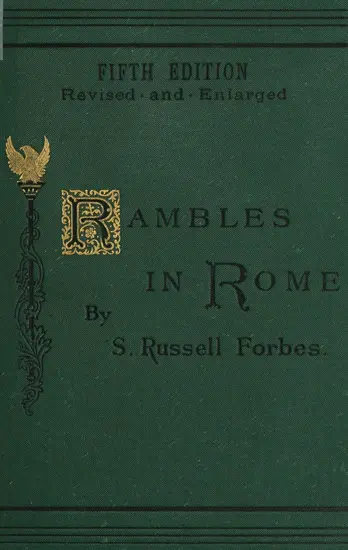
"Rambles in Rome" by S. Russell Forbes is an archaeological and historical guide written in the late 19th century. The work serves as a comprehensive companion for travelers to Rome, chronicling significant museums, galleries, churches, and ancient ruins while also providing insights into their historical contexts. This guide is likely aimed at visitors seeking to deepen their understanding of Rome’s rich heritage through concise commentary on its artifacts and landmarks. At the start of the guide, the author expresses the intent to provide visitors with practical descriptions of notable sites in Rome. He encourages readers to explore the city through a series of "Rambles," offering guidance on routes that showcase both the major attractions and hidden treasures. The opening chapters include introductory observations about Rome’s geography, hints for health and safety, and a brief history explaining the city's gradual decline into ruins, setting the stage for detailed explorations of specific locations in the subsequent sections.
Introduction adapted from the source catalogue; source summaries may be automatically generated.
Free to read · English · 135,448 words · No account needed
MAKE TIME FOR A GOOD BOOK
On by default. Untick to stop anonymous reading totals. Each page counts after 10 seconds in view. How this works.
Anonymous counting is on unless you have switched it off.
The other scene on this relief represents a female figure advancing to the seated figure of the Emperor Marcus Aurelius, leading a child and carrying another, to thank him for the orphan schools he founded in Rome in memory of his wife after her death, and which he named after her. "New Faustinian schools he instituted in honour of his dead wife" (Julius Capitolinus, "M. Antoninus," xxvi.).
Upon the inner sides of the Avenue are represented on each balustrade a boar, a ram, and a bull--the animals offered at the triple sacrifice, or suovetaurilia (from sus, ovis, taurus), which was performed once every five years, or lustrum, for the purification of the city.
It was an institution of Servius Tullius, the ceremony consisting in leading the boar, ram, and bull thrice round the assembly of the people, and then offering them to Mars. There is a similar representation upon a relief of Trajan on the Arch of Constantine, and upon a pedestal found near the Arch of Septimius Severus.
To our left of the Arch of Severus is
Neither the position nor the construction of this Rostra answers to that of the original Suggestum, which took the name of Rostra from having fixed on it the six bronze beaks of the Antiates' ships. The original Rostra, shown on a coin of Palikanus, the orator mentioned by Cicero ("Brutus," lxii.)--see page 42--was a wooden pulpit. Its exact site we have already identified. The last historical notice that we have of it is in Spartianus's "Life of Didius Julianus" (iv.), A.D. 193. After saying that the emperor addressed the Senate, he adds, "but the people expressly in the Rostra before the Curia."
Under the Empire the Rostra had lost its use, and only served occasionally for the emperor to address the people from, or for reading out edicts and proclamations. The western end of the Forum saw many changes after the fire under Commodus, and was rearranged under Septimius Severus, who restored the old edifices, retaining the names of the founders, and erected others (Spartianus, "Severus," xxiii.). In 203 an arch was erected to Severus and his two sons, and a new Rostra was made on the south side of this arch. By cutting away a piece of the slope of the Capitoline Hill, he formed an escarpment 11 feet high, which was faced with a curved brick wall, and cased with Porta Santa marble, in panels 3 feet 1 inch wide. Between each pair of panels there is a space 6½ inches wide, from which a piece of marble jutted out 3½ inches. Only one of these exists. On it there was fixed a bronze beak, probably made in imitation of the old ones, for in that day they had no naval foes from whom to capture ships. If there was one row only, there were eighteen in all; if two rows, thirty-six. This in itself is sufficient to show the ridiculousness of calling this the original Rostra, which had six beaks only. The peculiar marble casing also shows late work. At the north end of this platform was erected the Umbilicus (E), and on the south end was placed the Milliarium Aureum (F). From the level space on the top of this escarpment the orator would speak; whilst at a short distance in his rear was the street Clivus Argentarius, leading from the Via Sacra to the Porta Rutuminia. This Rostra was popularly known as the People's Rostra, because from it they were addressed--"Deinde ad Rostra Populum convocarunt" (Capitolinus, "Maximus et Balbinus," iii.). The narrowness of the level space on the top of this Rostra caused great inconvenience; and as room could not be gained in the rear, it had to be taken in front, encroaching on the Comitium. Forty-three and a half feet in front of the curved wall of Porta Santa a straight wall was built of travertine and tufa, 78 feet long, with side walls from it back to the extreme ends of the Rostra, and this was cased with Carrara white marble, the space between the two walls being filled with earth, thus making a large platform with a square instead of a curved front. The blocks of tufa and marble were tied together by iron clamps, of which fragments remain, of a shape not used in the earlier days, but used now. [Illustration] That the curved wall and the straight wall are not contemporary is shown by the construction, as well as by the fact that the curved wall is faced with coloured marble, which would not have been the case if it had not at one time been open to the Forum. The curved wall is on a line with the Arch of Severus; but the tufa wall comes out 25½ feet beyond the arch, and is not parallel with the curved wall behind it. The tufa and travertine wall is erected on the travertine pavement of the Comitium.
Your reading position is saved on this browser. Take it to another device with a library code. Reading pages adapt to text, rather than matching a printed edition.
BEHIND THE BOOK
This eBook is for the use of anyone anywhere in the United States and most other parts of the world at no cost and with almost no restrictions whatsoever. You may copy it, give it away or re-use it under the terms of the Project Gutenberg License included with this eBook or online at www.gutenberg.org. If you are not located in the United States, you will have to check the laws of the country where you are located before using this eBook. Read the source licence.
The original source file, including credits and licence, is retained by this library. Request an original-format copy at no charge. Please include the book title and Project Gutenberg identifier #43416.
KEEP YOUR CURIOSITY GOING
Wilfrid Scawen Blunt
Wilfrid Scawen Blunt

E. W. (Edgar Watson) Howe
Cécile Tormay

Moritz Busch
John L. Ransom