THE CLASSIC COLLECTION✦My diaries, being a personal narrative of events 1888-1914, Part 2 (1900-1914)CLASSIC FREE BOOKS
My diaries, being a personal narrative of events 1888-1914, Part 2 (1900-1914)
Wilfrid Scawen Blunt
THE CLASSIC COLLECTION · 1882
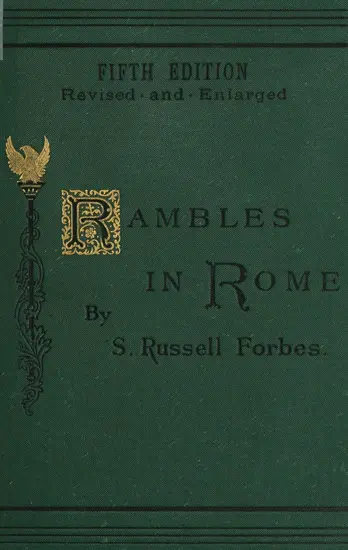
"Rambles in Rome" by S. Russell Forbes is an archaeological and historical guide written in the late 19th century. The work serves as a comprehensive companion for travelers to Rome, chronicling significant museums, galleries, churches, and ancient ruins while also providing insights into their historical contexts. This guide is likely aimed at visitors seeking to deepen their understanding of Rome’s rich heritage through concise commentary on its artifacts and landmarks. At the start of the guide, the author expresses the intent to provide visitors with practical descriptions of notable sites in Rome. He encourages readers to explore the city through a series of "Rambles," offering guidance on routes that showcase both the major attractions and hidden treasures. The opening chapters include introductory observations about Rome’s geography, hints for health and safety, and a brief history explaining the city's gradual decline into ruins, setting the stage for detailed explorations of specific locations in the subsequent sections.
Introduction adapted from the source catalogue; source summaries may be automatically generated.
Free to read · English · 135,448 words · No account needed
MAKE TIME FOR A GOOD BOOK
On by default. Untick to stop anonymous reading totals. Each page counts after 10 seconds in view. How this works.
Anonymous counting is on unless you have switched it off.
or Golden Milestone, set up by Augustus (Dion Cassius, liv. 5), the site of which is at the angle of the temple on the side of the old Clivus Capitolinus, the ancient road leading up from the Forum. It was a gilded stone, on which the distance of all the principal towns was recorded, the distance being always measured from the city gates. Suetonius ("Otho," vi.) tells that "Otho gave his accomplices notice to wait for him in the Forum near the Temple of Saturn, at the Golden Milestone." Tacitus ("H." i. 27) relates the same; and Plutarch (in "Galba") agrees with them both, adding, "There terminate all the great roads in Italy."
Behind the Temple of Saturn, in the corner, is
the Schola Xantha, and the portico of the Dii Consentes, restored by Visconti in 1858, marked by eight Corinthian columns, partly modern, but with antique capitals and architraves; and the cellæ arranged in compact masonry behind them. It was called the Schola Xantha, from Fabius Xanthus, a curator of the monuments, who placed here the images of the household gods of Rome--Dii Consentes, because admitted to the council of Jove--Juno, Vesta, Minerva, Ceres, Diana, Venus, Mars, Mercurius, Jovi', Neptunus, Vulcanus, Apollo (Ennius). The inscription tells us they were reinstated under Vettius Pretextatus, A.D. 367.
Facing towards the Forum, at the back of the line of buildings at its
top, is
(See page 170.)
In front of the Senate House, S. Adriano, is
which formerly supported the statue of that emperor. It faced the Senate House; and is placed upon a pedestal rising from a pyramidal basement of steps, the whole evidently the plunder of other edifices.
It was erected by Smaragdus, the Exarch of Italy, in A.D. 608, and was excavated by the Countess of Devonshire in 1816.
It is thus mentioned by Byron,--
"Tully was not so eloquent as thou,
Thou nameless column with the buried base!"
Childe Harold, iv. 90.
Between the Temples of Saturn and Castor are the remains of
on the site of the Basilica Sempronia, erected by Sempronius Gracchus, B.C. 169 (Livy, xliv. 16). This was burned down, and rebuilt by Julius Cæsar, and called Julia, after his daughter. It was destroyed by fire, and rebuilt by Augustus (Dion Cassius, "Augustus"). It was again destroyed by fire, and rebuilt A.D. 283. Suetonius tells us that Caligula, "during three days successively, scattered money to a prodigious amount among the people, from the top of the Julian Basilica" ("Caligula," xxxvii.). It is shown on two pieces of the marble plan.
Your reading position is saved on this browser. Take it to another device with a library code. Reading pages adapt to text, rather than matching a printed edition.
BEHIND THE BOOK
This eBook is for the use of anyone anywhere in the United States and most other parts of the world at no cost and with almost no restrictions whatsoever. You may copy it, give it away or re-use it under the terms of the Project Gutenberg License included with this eBook or online at www.gutenberg.org. If you are not located in the United States, you will have to check the laws of the country where you are located before using this eBook. Read the source licence.
The original source file, including credits and licence, is retained by this library. Request an original-format copy at no charge. Please include the book title and Project Gutenberg identifier #43416.
KEEP YOUR CURIOSITY GOING
Wilfrid Scawen Blunt
Wilfrid Scawen Blunt

E. W. (Edgar Watson) Howe
Cécile Tormay

Moritz Busch
John L. Ransom