THE CLASSIC COLLECTION✦My diaries, being a personal narrative of events 1888-1914, Part 2 (1900-1914)CLASSIC FREE BOOKS
My diaries, being a personal narrative of events 1888-1914, Part 2 (1900-1914)
Wilfrid Scawen Blunt
THE CLASSIC COLLECTION · 1882
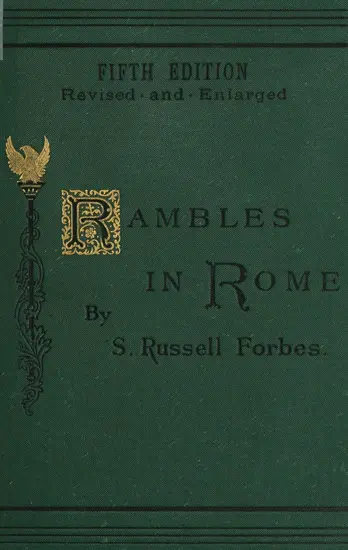
"Rambles in Rome" by S. Russell Forbes is an archaeological and historical guide written in the late 19th century. The work serves as a comprehensive companion for travelers to Rome, chronicling significant museums, galleries, churches, and ancient ruins while also providing insights into their historical contexts. This guide is likely aimed at visitors seeking to deepen their understanding of Rome’s rich heritage through concise commentary on its artifacts and landmarks. At the start of the guide, the author expresses the intent to provide visitors with practical descriptions of notable sites in Rome. He encourages readers to explore the city through a series of "Rambles," offering guidance on routes that showcase both the major attractions and hidden treasures. The opening chapters include introductory observations about Rome’s geography, hints for health and safety, and a brief history explaining the city's gradual decline into ruins, setting the stage for detailed explorations of specific locations in the subsequent sections.
Introduction adapted from the source catalogue; source summaries may be automatically generated.
Free to read · English · 135,448 words · No account needed
MAKE TIME FOR A GOOD BOOK
On by default. Untick to stop anonymous reading totals. Each page counts after 10 seconds in view. How this works.
Anonymous counting is on unless you have switched it off.
From the Piazza S. Bernardo we take the VIA SUSANNA into the VIA S. NICCOLO DA TOLENTINO. The first turning on the right, VICOLO FIAMME, leads into the VIA DI S. BASILIO, which leads to the
Open every day from 12 till 4, with permission to be had at the
consuls or bankers.
The beautiful villa has been cut up into building plots, and a new quarter now occupies its site.
On the left of the entry is the Museum. The principal objects are--1. Hercules. 4. Pan and Olympus. 11. Venus. 14. The Labours of Hercules. 34. A fine mask.
SECOND ROOM.--Group of Mars and Cupid, found in the portico of Octavia. 7. Theseus and Æthra, by Menelaos. 9. Satyr. 17. Julius Cæsar. 28. Gallic group, of which the wounded Gaul in the Capitol Museum formed a part. 41. Juno, the finest head of the goddess known. 43. Pluto carrying off Proserpine.
Towards the Porta Pinciana is the casino containing Guercino's beautiful fresco of Aurora driving away Night. A beautiful view is to be had here.
Leaving the Museum, we pass down the Basilio into the Piazza Barberini. On the right, up under the trees, are
In the first chapel on the right in the church is Guido Reni's beautiful picture of S. Michael, and in the third chapel two pictures by Domenichino. But the most interesting part, the cemetery, is beneath the church, though entirely above ground, and lighted by a row of iron-grated windows without glass. "A corridor runs along beside these windows, and gives access to three or four vaulted recesses, or chapels, of considerable breadth and height, the floor of which consists of consecrated earth from Jerusalem. It is smoothed decorously over the deceased brethren of the convent, and is kept quite free from grass or weeds, such as would grow even in these gloomy recesses if pains were not bestowed to root them up. But as the cemetery is small, and it is a precious privilege to sleep in holy ground, the brotherhood are immemorially accustomed, when one of their number dies, to take the longest-buried skeleton out of the oldest grave, and lay the new slumberer there instead. Thus each of the good friars, in his turn, enjoys the luxury of a consecrated bed, attended with the slight drawback of being forced to get up long before daybreak, as it were, and make room for another lodger. The arrangement of the unearthed skeletons is what makes the special interest of the cemetery. The arched and vaulted walls of the burial recesses are supported by massive pillars and pilasters made of thigh-bones and skulls; the whole material of the structure appears to be of a similar kind, and the knobs and embossed ornaments of this strange architecture are represented by the joints of the spine, and the more delicate tracery of the smaller bones of the human frame. The summits of the arches are adorned with entire skeletons, looking as if they were wrought most skilfully in bas-relief. There is no possibility of describing how ugly and grotesque is the effect, combined with a certain artistic merit, nor how much perverted ingenuity has been shown in this queer way; nor what a multitude of dead monks, through how many hundred years, must have contributed their bony framework to build up these great arches of mortality. On some of the skulls there are inscriptions, purporting that such a monk, who formerly made use of that particular head-piece, died on such a day and year; but vastly the greater number are piled up undistinguishably into the architectural design like the many deaths that make up the one glory of a victory. In the side walls of the vaults are niches where skeleton monks sit or stand, clad in the brown habits that they wore in life, and labelled with their names and the dates of their decease. Their skulls (some quite bare, and others still covered with yellow skin and the hair that has known the earth-damps) look out from beneath their hoods, grinning hideously repulsive. One reverend father has his mouth wide open, as if he had died in the midst of a howl of terror and remorse, which perhaps is even now screeching through eternity. As a general thing, however, these frocked and hooded skeletons seem to take a more cheerful view of their position, and try with ghastly smiles to turn it into a jest. There is no disagreeable scent, such as might be expected from the decay of so many holy persons, in whatever odour of sanctity they may have taken their departure. The same number of living monks would not smell half so unexceptionably." Hawthorne gives this graphic description.
Your reading position is saved on this browser. Take it to another device with a library code. Reading pages adapt to text, rather than matching a printed edition.
BEHIND THE BOOK
This eBook is for the use of anyone anywhere in the United States and most other parts of the world at no cost and with almost no restrictions whatsoever. You may copy it, give it away or re-use it under the terms of the Project Gutenberg License included with this eBook or online at www.gutenberg.org. If you are not located in the United States, you will have to check the laws of the country where you are located before using this eBook. Read the source licence.
The original source file, including credits and licence, is retained by this library. Request an original-format copy at no charge. Please include the book title and Project Gutenberg identifier #43416.
KEEP YOUR CURIOSITY GOING
Wilfrid Scawen Blunt
Wilfrid Scawen Blunt

E. W. (Edgar Watson) Howe
Cécile Tormay

Moritz Busch
John L. Ransom