THE CLASSIC COLLECTION✦My diaries, being a personal narrative of events 1888-1914, Part 2 (1900-1914)CLASSIC FREE BOOKS
My diaries, being a personal narrative of events 1888-1914, Part 2 (1900-1914)
Wilfrid Scawen Blunt
THE CLASSIC COLLECTION · 1882
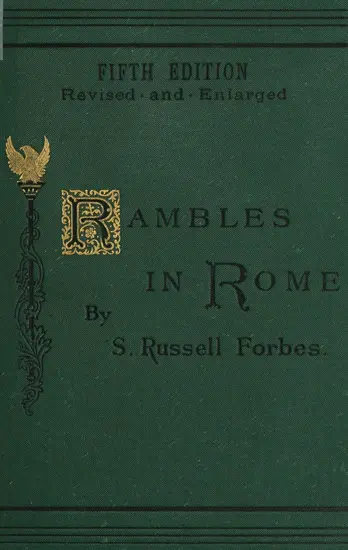
"Rambles in Rome" by S. Russell Forbes is an archaeological and historical guide written in the late 19th century. The work serves as a comprehensive companion for travelers to Rome, chronicling significant museums, galleries, churches, and ancient ruins while also providing insights into their historical contexts. This guide is likely aimed at visitors seeking to deepen their understanding of Rome’s rich heritage through concise commentary on its artifacts and landmarks. At the start of the guide, the author expresses the intent to provide visitors with practical descriptions of notable sites in Rome. He encourages readers to explore the city through a series of "Rambles," offering guidance on routes that showcase both the major attractions and hidden treasures. The opening chapters include introductory observations about Rome’s geography, hints for health and safety, and a brief history explaining the city's gradual decline into ruins, setting the stage for detailed explorations of specific locations in the subsequent sections.
Introduction adapted from the source catalogue; source summaries may be automatically generated.
Free to read · English · 135,448 words · No account needed
MAKE TIME FOR A GOOD BOOK
On by default. Untick to stop anonymous reading totals. Each page counts after 10 seconds in view. How this works.
Anonymous counting is on unless you have switched it off.
From the Loggia upstairs we enter the
FIRST ROOM, or Mosaic Hall.--This beautiful mosaic was found in the Baths of Caracalla, and represents full length figures and busts of boxers, each occupying a separate panel, some having the names upon them. The walls are decorated with scenes from the life of Constantine the Great.
SECOND ROOM.--Early medieval frescoes from old churches. Frescoes cut from the walls of the Church of S. Agnese fuori le mura. Paintings of prophets and birds, from the crypt of the Church of S. Nicolò in Carcere.
THIRD ROOM.--We commence with the left-hand wall immediately on entering the different rooms. Crowning the Madonna, by Lippi; S. Thomas receiving the Belt from the Virgin, by Benezoto Gozzoli; Scenes from Life of the Virgin, by the same; S. Antonio, by Antonio di Murano; Madonna, by Carlo Crivelli, 1482; Virgin and four Saints, by Bartolo di Murano, 1481; Assumption, SS. Lawrence and Benedict, Catherine and Gertrude--all three by Cola di Amatrice, 1515; S. Jerome, by Santis, in tempera; mosaic flooring from the Palazzo Sorra on the Via Nazionale.
FOURTH ROOM.--Holy Family, by Andrea del Sarto; Annunciation, by Francia; Virgin and Saints in fresco, by Botticelli; Crucifixion, a fresco; Baptism of Christ, by Cæsar da Sesto; a panel, by Perugino; copy of the Transfiguration; copy of Giulio Romano's Coronation; Deposition, by Luca Signorelli; S. Stephen, a sketch, by Giulio Romano.
From here we enter into two off-rooms containing statues, busts, and reliefs, representing North American Indian life, by Pettrich.
FIFTH ROOM.--Madonna of the Belt, by Spagna; the Virgin with S. John and S. Jerome, by Marko Palmezzano, 1500; three tapestries; S. Peter, by Fra Bartolomeo; Sixtus V., by Domenichino; S. Paul, by Bartolomeo; Madonna and Saints, by Palmezzano; Sixtus V. as Cardinal Peretti, by Sassoferrato; mythological subject, by Paul Veronese; a Pagan Sacrifice, by Caravaggio.
SIXTH ROOM.--Cartoons of Volterra; Annunciation, by Arpino; Christ and the Tribute Money, by Caravaggio; the Supper at Emmaus, by Caravaggio; copy of Guercino's Assumption, original in Russia; copy of Domenichino's S. Andrew; "The First Gentleman in Europe," by Lawrence; S. Thomas, by Cammuccini; a Head, by Vandyck.
SEVENTH ROOM.--Cartoons of Maratta's, for S. Peter's dome; a Greek Baptism, by Nocchi, 1840. The last room contains plaster casts of ancient statues.
On the left coming out of the Museum is the back entrance to the Church of S. John. Enter here, and pass out to the front. The bronze statue on the left of the back portico is that of Henry of Navarre.
"The mother and head of the churches of the city and of the
world."
Your reading position is saved on this browser. Take it to another device with a library code. Reading pages adapt to text, rather than matching a printed edition.
BEHIND THE BOOK
This eBook is for the use of anyone anywhere in the United States and most other parts of the world at no cost and with almost no restrictions whatsoever. You may copy it, give it away or re-use it under the terms of the Project Gutenberg License included with this eBook or online at www.gutenberg.org. If you are not located in the United States, you will have to check the laws of the country where you are located before using this eBook. Read the source licence.
The original source file, including credits and licence, is retained by this library. Request an original-format copy at no charge. Please include the book title and Project Gutenberg identifier #43416.
KEEP YOUR CURIOSITY GOING
Wilfrid Scawen Blunt
Wilfrid Scawen Blunt

E. W. (Edgar Watson) Howe
Cécile Tormay

Moritz Busch
John L. Ransom