THE CLASSIC COLLECTION✦My diaries, being a personal narrative of events 1888-1914, Part 2 (1900-1914)CLASSIC FREE BOOKS
My diaries, being a personal narrative of events 1888-1914, Part 2 (1900-1914)
Wilfrid Scawen Blunt
THE CLASSIC COLLECTION · 1882
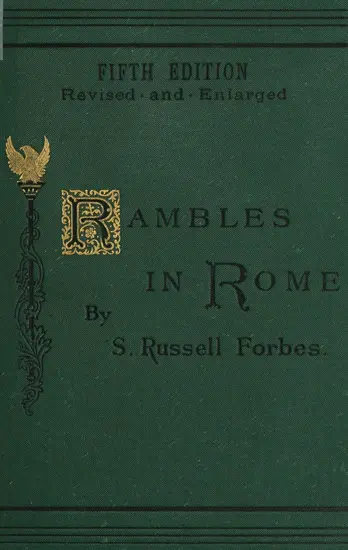
"Rambles in Rome" by S. Russell Forbes is an archaeological and historical guide written in the late 19th century. The work serves as a comprehensive companion for travelers to Rome, chronicling significant museums, galleries, churches, and ancient ruins while also providing insights into their historical contexts. This guide is likely aimed at visitors seeking to deepen their understanding of Rome’s rich heritage through concise commentary on its artifacts and landmarks. At the start of the guide, the author expresses the intent to provide visitors with practical descriptions of notable sites in Rome. He encourages readers to explore the city through a series of "Rambles," offering guidance on routes that showcase both the major attractions and hidden treasures. The opening chapters include introductory observations about Rome’s geography, hints for health and safety, and a brief history explaining the city's gradual decline into ruins, setting the stage for detailed explorations of specific locations in the subsequent sections.
Introduction adapted from the source catalogue; source summaries may be automatically generated.
Free to read · English · 135,448 words · No account needed
MAKE TIME FOR A GOOD BOOK
On by default. Untick to stop anonymous reading totals. Each page counts after 10 seconds in view. How this works.
Anonymous counting is on unless you have switched it off.
From the time of Constantine to 1377 this was the palace of the popes. In 1843 Gregory XVI. founded the museum. The original palace was destroyed by fire in the time of Clement V., and the present pile was built from the designs of Fontana in the pontificate of Sixtus V. It was subsequently used for many years as an hospital.
On our left is the entrance to
Ring the bell on the right in the passage, if the custodian is not at the door. The custodian will conduct you over, if desired; and he can give a good account of the objects of interest. It is open every day from 9 till 3, and is comprised in sixteen rooms. Fee, half a franc each person. The principal objects are as follows:--
FIRST ROOM.--Bas-reliefs: Procession of Lictors and Senators, with figure of Trajan, found in his forum; Dares and Entellus, boxers, a fragment, found near the Arch of Gallienus; part of a sarcophagus, with the history of Mars and Rhea Sylvia, Diana and Endymion; a Circus Race; Helen and Paris; Soldier and Wife Parting; Leucothea feeding the Infant Bacchus. Bust of Marcus Aurelius; pavement mosaic of Boxers, from Baths of Caracalla.
SECOND ROOM.--Portions brought from the Forum of Trajan, representing arabesques, children, chimeras, griffins.
FOURTH ROOM.--Faun of Praxiteles, copy; bust of the Young Tiberius; bas-reliefs, Medea and Pelias's Daughters; statue of Mars; Germanicus; sepulchral cippi and bas-reliefs, found on the Via Appia.
FIFTH ROOM.--Stag in gray marble; a Cow; Mithraic group; mutilated figure of a lynx; bust of Scipio; an altar with bas-reliefs, one representing cock-fighting.
SIXTH ROOM.--Statues of members of the family of Augustus, found at Cervetri, 1839: Drusus, Agrippina the elder, and Livia, full figures; Tiberius and Claudius, sitting; Germanicus and Britannicus, in armour; Head of Augustus. Inscriptions to the members of the family; a bas-relief of an altar; recumbent statues of Silenus.
SEVENTH ROOM.--Statue of Sophocles, the best object in the museum; a Dancing Faun; female draped figure; Apollino; sepulchral inscriptions, from the Columbaria of the Vigna Codini (see page 283), to Musicus Scuranus of Lyons, a tourist to Rome, who died there, with the names of the persons of his suite, on jamb of door.
EIGHTH ROOM.--Statue of Neptune; curious bas-reliefs, a man surrounded with masks; Cupid and Mars.
NINTH ROOM.--Fragments from the Forum.
TENTH ROOM.--Bas-reliefs from the tomb of the Aterii, representing a temple, with a crane moved by a tread-wheel for hoisting stones. Opposite, monuments in Rome, the Arch of Isis, Colosseum, Arch of Titus, and the Temple of Jupiter Stator. (See page 95.) Cupid and Dolphin.
ELEVENTH ROOM.--Bas-reliefs of Boxers; Diana Multimammæ.
Your reading position is saved on this browser. Take it to another device with a library code. Reading pages adapt to text, rather than matching a printed edition.
BEHIND THE BOOK
This eBook is for the use of anyone anywhere in the United States and most other parts of the world at no cost and with almost no restrictions whatsoever. You may copy it, give it away or re-use it under the terms of the Project Gutenberg License included with this eBook or online at www.gutenberg.org. If you are not located in the United States, you will have to check the laws of the country where you are located before using this eBook. Read the source licence.
The original source file, including credits and licence, is retained by this library. Request an original-format copy at no charge. Please include the book title and Project Gutenberg identifier #43416.
KEEP YOUR CURIOSITY GOING
Wilfrid Scawen Blunt
Wilfrid Scawen Blunt

E. W. (Edgar Watson) Howe
Cécile Tormay

Moritz Busch
John L. Ransom