THE CLASSIC COLLECTION✦My diaries, being a personal narrative of events 1888-1914, Part 2 (1900-1914)CLASSIC FREE BOOKS
My diaries, being a personal narrative of events 1888-1914, Part 2 (1900-1914)
Wilfrid Scawen Blunt
THE CLASSIC COLLECTION · 1882
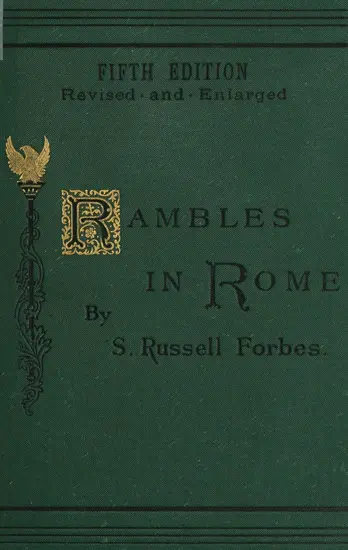
"Rambles in Rome" by S. Russell Forbes is an archaeological and historical guide written in the late 19th century. The work serves as a comprehensive companion for travelers to Rome, chronicling significant museums, galleries, churches, and ancient ruins while also providing insights into their historical contexts. This guide is likely aimed at visitors seeking to deepen their understanding of Rome’s rich heritage through concise commentary on its artifacts and landmarks. At the start of the guide, the author expresses the intent to provide visitors with practical descriptions of notable sites in Rome. He encourages readers to explore the city through a series of "Rambles," offering guidance on routes that showcase both the major attractions and hidden treasures. The opening chapters include introductory observations about Rome’s geography, hints for health and safety, and a brief history explaining the city's gradual decline into ruins, setting the stage for detailed explorations of specific locations in the subsequent sections.
Introduction adapted from the source catalogue; source summaries may be automatically generated.
Free to read · English · 135,448 words · No account needed
MAKE TIME FOR A GOOD BOOK
On by default. Untick to stop anonymous reading totals. Each page counts after 10 seconds in view. How this works.
Anonymous counting is on unless you have switched it off.
It contains statues of muses, busts of Greek philosophers, poets, and statesmen, all of which deserve special attention. Left. 525, Bust of Pericles; 524, Seated Statue of Sappho; 523, Bust of Aspasia. Right. 535, Mnemosyne, the mother of the muses; 511, Erato, muse of love song; 514, Bust of Socrates; 515, Calliope, muse of epic poetry; 516, Apollo, as leader of the muses; 517, Terpsichore, muse of dancing; 520, Euterpe, muse of melody. Left. 508, Polyhymnia, muse of sacred poetry; 505, Clio, muse of history; 506, Bust of Demosthenes; 504, Urania, muse of astronomy; 503, Thalia, comic and pastoral muse; 499, Melpomene, muse of tragedy. Beyond, left. 492, Sophocles; 491, Silenus; 490, Diogenes. Right. 498, Epicurus; 496, Homer. Now pass into
The principal objects of interest are--124, Mithraic Sacrifice found at Ostia, in the temple dedicated to the worship of the Persian deity; 139, Commodus on Horseback; 143, Sleeping Shepherd; 228, Triton carrying off a Nereid. We next enter
In the centre of the gallery is a magnificent bath of the finest Oriental alabaster. Right-hand side on entering. 248, Clodius Albinus, governor of Britain under Commodus; 250, Cupid, by Praxiteles, the "Genius of the Vatican;" 255, Paris; 259, Minerva as the Peace-bearer; 261, Penelope; 262, Caligula; 264, Apollo with the Lizard; 267, Drunken Faun; 270, Urania; 271, Posidippus, the master of Greek comedy. Entrance to Hall of Busts (see below). 390, Menander; 391, Nero as Apollo; 392, Septimius Severus; 393, Dido; 394, Neptune; 396, Narcissus; 398, Macrinus; 399, Æsculapius and Hygeia; 401, Fragment of Hæmon and Antigone; 402, Seneca; 405, One of the fifty daughters of Danaus drawing water from Lethe; 406, Faun, repetition of Praxiteles. Entrance on left to Cabinet of Masks. 414, Sleeping Ariadne; 417, Mercury, by Ingenui; 420, Lucius Verus.
280, Augustus; 282, Cæsar; 285, Caracalla; 307, Saturn, colossal veiled head; 311, Menelaus; 326, Jupiter seated; 333, Crispina; 352, Livia as Piety, or Diana, or Surprise; 366, Scipio.
So called from the mosaic pavement found in Hadrian's Villa. The ceiling is by Domenico de Angelis, representing the marriage of Bacchus and Ariadne, Diana contemplating Endymion, Paris refusing Minerva the apple, Adonis and Venus. 427, Replica of the Venus of Cos, by Praxiteles. The head does not belong to this statue. 428, the Crouching Venus, a copy after Heliodorus, by Bupalus; 429, the Empress Sabina, Hadrian's wife, as Venus Genetrix, after Arcesilaus. The head and arms have been inserted in an older statue; 432, Faun in rosso antico; 433, Venus rising from the Sea, after Alcamenes; 436, Venus anointing herself, after Polycharmes; 441, Ganymedes; 442, Adonis.
We now proceed to the Court of the Belvedere, which is supported by sixteen columns, having a fountain in the centre. The court is adorned with baths, urns, sarcophagi, statues, columns, bas-reliefs, and medallions. The four corners of the court are occupied by cabinets in the following order, commencing on the left:--
Your reading position is saved on this browser. Take it to another device with a library code. Reading pages adapt to text, rather than matching a printed edition.
BEHIND THE BOOK
This eBook is for the use of anyone anywhere in the United States and most other parts of the world at no cost and with almost no restrictions whatsoever. You may copy it, give it away or re-use it under the terms of the Project Gutenberg License included with this eBook or online at www.gutenberg.org. If you are not located in the United States, you will have to check the laws of the country where you are located before using this eBook. Read the source licence.
The original source file, including credits and licence, is retained by this library. Request an original-format copy at no charge. Please include the book title and Project Gutenberg identifier #43416.
KEEP YOUR CURIOSITY GOING
Wilfrid Scawen Blunt
Wilfrid Scawen Blunt

E. W. (Edgar Watson) Howe
Cécile Tormay

Moritz Busch
John L. Ransom