THE CLASSIC COLLECTION✦An outlaw’s diary: the CommuneCLASSIC FREE BOOKS
An outlaw’s diary: the Commune
Cécile Tormay
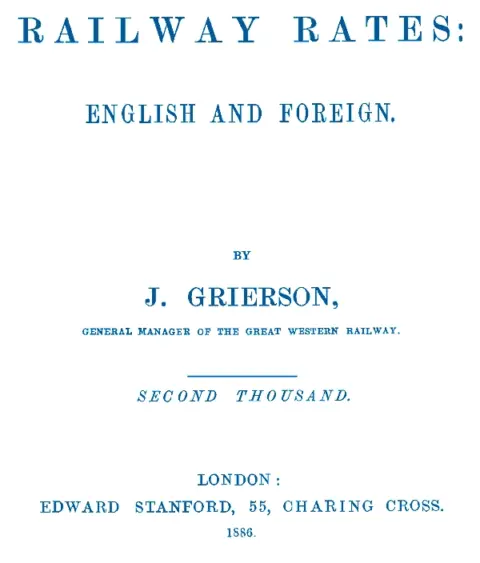
THE CLASSIC COLLECTION · 1886
"Railway Rates: English and Foreign" by James Grierson is a scientific publication written in the late 19th century. It explores the principles, practices, and controversies surrounding railway rates in the United Kingdom compared to those in other countries, providing analysis and commentary on various rate-setting methods. Grierson, the General Manager of the Great Western Railway, delves into the complex interplay of interests between railway companies, traders, and consumers, aiming for an understanding that serves the needs of all parties involved in railway transportation. The opening of the text begins with a preface in which the author outlines the impetus for his examination of railway rates, citing public complaints and discussions regarding the contentious Railway and Canal Traffic Bill. He sets the stage by emphasizing the necessity of considering all stakeholders—traders, the public, and railway companies—when discussing and establishing rates. Grierson acknowledges that misconceptions surround the current practices and indicates his intent to present a balanced view that avoids hasty legislation or simplistic solutions. He warns against ignoring the complexities inherent in the operation of railways and the diverse needs of different trading communities, foreshadowing the detailed analysis to follow in subsequent sections.
Introduction adapted from the source catalogue; source summaries may be automatically generated.
Free to read · English · 78,139 words · No account needed
MAKE TIME FOR A GOOD BOOK
On by default. Untick to stop anonymous reading totals. Each page counts after 10 seconds in view. How this works.
Anonymous counting is on unless you have switched it off.
The rates for merchandise in Holland and Belgium are the lowest of any of the countries. Independently of the construction of the lines being cheaper, the wages paid to servants less, and the State being the principal proprietors, natural causes favour this. From the flatness of those countries and their consequently having exceptionally level railroads, the average loads far exceed what can be carried in the United Kingdom. In Holland 450 to upwards of 500 tons are the usual train loads. Even on the Northern Railway of France an average load of 400 to 450 tons is common. Owing to the gradients of the lines and the speed of the trains, such weights are rarely carried in this country. The consequence of the paying load being less is, of course, that the working expenses are proportionately greater.
Branch lines in this country have, as has been already stated, been carried into sparsely populated districts to an extent unknown in France, Germany, Belgium or Holland, and the English railways afford greater facilities by reason of a larger proportion of the lines being double.
The following table shows the state of things in 1884:--
-----+-----------------+-----------------+-----------------+---------- | | Double Line. | Single Line. | Year.| |--------+--------+--------+--------+ Total | | Length.| Per | Length.| Per | mileage. | | |Centage.| |Centage.| -----+-----------------+--------+--------+--------+--------+---------- 1884 |United Kingdom | 10,239 | 54·28 | 8,625 | 45·72 | 18,864 1884 |England and Wales| 8,504 | 63·75 | 4,836 | 36·25 | 13,340 1884 |France | 7,470 | 38·84 | 11,765 | 61·16 | 19,235 1884 |Germany | 6,724 | 29·74 | 15,887 | 70·26 | 22,611 1884 |Holland[58] | 435 | 26·90 | 1,182 | 73·10 | 1,617 1884 |Belgium | 943 | 34·80 | 1,768 | 65·20 | 2,711 -----------------------+--------+--------+--------+--------+----------
It is well known that train service in this country is much more frequent than in any other country. How great is the difference will be seen by comparing the average number of train miles run per mile of railway, per square mile of country, and per 1,000 people.
----+------------------+---------------+--------+------+--------------- | | PER MILE | PER SQUARE | PER 1,000 | | OF RAILWAY. | MILE. | PEOPLE. YEAR| +---------------+-------+-------+-------+------- | |Pssngr.| Goods.|Pssngr.| Goods.|Pssngr.| Goods ----+------------------+-------+-------+-------+-------+-------+------- 1884| United Kingdom | 7,588 | 6,715 | 1,185 | 1,048 | 3,981 | 3,523 1884| England and Wales| 9,114 | 7,991 | 2,090 | 1,832 | 4,481 | 3,929 1884| France | 4,644 | 2,792 | 415 | 250 | 2,222 | 1,336 1884| Germany | 3,997 | 2,610 | 426 | 278 | 1,971 | 1,287 1884| Holland | 4,941 | 1,752 | 600 | 213 | 1,773 | 629 1884| Belgium | 4,819 | 4,783 | 1,149 | 1,140 | 2,258 | 2,241 ----+------------------+-------+-------+-------+-------+-------+------
[58] Including 90 miles on German and Belgian Frontier.
[59] The mixed train mileage introduces a disturbing element, but the calculations have been made as accurately as possible.
Your reading position is saved on this browser. Take it to another device with a library code. Reading pages adapt to text, rather than matching a printed edition.
BEHIND THE BOOK
This eBook is for the use of anyone anywhere in the United States and most other parts of the world at no cost and with almost no restrictions whatsoever. You may copy it, give it away or re-use it under the terms of the Project Gutenberg License included with this eBook or online at www.gutenberg.org. If you are not located in the United States, you will have to check the laws of the country where you are located before using this eBook. Read the source licence.
The original source file, including credits and licence, is retained by this library. Request an original-format copy at no charge. Please include the book title and Project Gutenberg identifier #47719.
KEEP YOUR CURIOSITY GOING
Cécile Tormay

Moritz Busch
John L. Ransom
Frances Wright
Cécile Tormay

Mabel Potter Daggett