THE CLASSIC COLLECTION✦An outlaw’s diary: the CommuneCLASSIC FREE BOOKS
An outlaw’s diary: the Commune
Cécile Tormay
THE CLASSIC COLLECTION · 1886
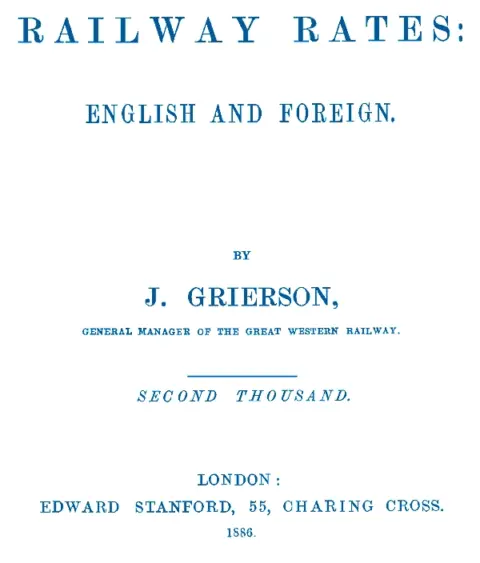
"Railway Rates: English and Foreign" by James Grierson is a scientific publication written in the late 19th century. It explores the principles, practices, and controversies surrounding railway rates in the United Kingdom compared to those in other countries, providing analysis and commentary on various rate-setting methods. Grierson, the General Manager of the Great Western Railway, delves into the complex interplay of interests between railway companies, traders, and consumers, aiming for an understanding that serves the needs of all parties involved in railway transportation. The opening of the text begins with a preface in which the author outlines the impetus for his examination of railway rates, citing public complaints and discussions regarding the contentious Railway and Canal Traffic Bill. He sets the stage by emphasizing the necessity of considering all stakeholders—traders, the public, and railway companies—when discussing and establishing rates. Grierson acknowledges that misconceptions surround the current practices and indicates his intent to present a balanced view that avoids hasty legislation or simplistic solutions. He warns against ignoring the complexities inherent in the operation of railways and the diverse needs of different trading communities, foreshadowing the detailed analysis to follow in subsequent sections.
Introduction adapted from the source catalogue; source summaries may be automatically generated.
Free to read · English · 78,139 words · No account needed
MAKE TIME FOR A GOOD BOOK
On by default. Untick to stop anonymous reading totals. Each page counts after 10 seconds in view. How this works.
Anonymous counting is on unless you have switched it off.
In Holland, the classification is very similar to that which exists in Germany. Goods are divided into two classes, i.e., “Stückgut” or “Piece” goods, to which belong all consignments less than 5 tons carried by goods train; and “Truck Load” goods, which includes goods in truck loads of 5 or 10 tons, or which pay as for those weights. The “Stückgut” class is subdivided into two classes, and the “Truck Load” class into four classes. The total number of articles enumerated in the classification is about 242. Although the bases of the tariffs charged for conveyance differ, the classification is practically the same on all the railways in Holland. The following is an example of the classification of goods on the Dutch Rhenish Railway. It will be seen that such articles as coffee, cheese, butter, in consignments of less than 5 tons, are included in the same class as coal, coke, gravel and raw iron; a feature not likely to be imitated by admirers of the “scientific classification” supposed to exist abroad.
---------------------------------------------------------------------- | In Lots of |----------------------- DESCRIPTION OF GOODS. | Less | 5 Tons|10 Tons | than | and | and |5 Tons.| above.| above. ----------------------------------------------+-------+-------+------- Bark, asphalt pipes, petroleum, vinegar, clay | | | drain pipes, oils, paper, trees, butter, | | | fresh meat, coffee, spirits, cheese, hair, | | | dyeing earths, pencils, sugar, sumac | II. | A | | | | Raw tobacco, pitch, lithographers’ stone, | | | cabbage and vegetables in bulk, herrings, | | | window glass, dye-woods, cotton yarn, | | | Glauber-salts, soda, cotton twist, wool, jute| II. | B | | | | Raw asphalt, ashes, potato meal, beetroot, | | | seeds, sheet iron, iron pipes, iron wire, | | | lime, linseed, cake, lead, parts of machines,| | | pasteboard, corn and grain, raw sugar, iron | II. | C | | | | Guano, grindstones in the rough, stone | | | troughs, coal tar, worked stones, sleepers, | | | spath millstone, fuel, marble in blocks | II. | D | | | | Raw iron, cast iron, gravel, wood, coal, | | | limestone, pebbles, raw chalk, clay, manure, | | | coal, coke, turf, ore, tiles | II. | D | S R ----------------------------------------------------------------------
This diversity of system and practice will give some idea of the difficulty experienced in framing a classification suitable to each country, or, indeed, to various portions of the same country. The difficulty will be still better understood by observing the different manner in which goods placed in the 2nd Class, under the Railway Clearing House Classification, are classified in other countries.
Your reading position is saved on this browser. Take it to another device with a library code. Reading pages adapt to text, rather than matching a printed edition.
BEHIND THE BOOK
This eBook is for the use of anyone anywhere in the United States and most other parts of the world at no cost and with almost no restrictions whatsoever. You may copy it, give it away or re-use it under the terms of the Project Gutenberg License included with this eBook or online at www.gutenberg.org. If you are not located in the United States, you will have to check the laws of the country where you are located before using this eBook. Read the source licence.
The original source file, including credits and licence, is retained by this library. Request an original-format copy at no charge. Please include the book title and Project Gutenberg identifier #47719.
KEEP YOUR CURIOSITY GOING
Cécile Tormay

Moritz Busch
John L. Ransom
Frances Wright
Cécile Tormay

Mabel Potter Daggett