THE CLASSIC COLLECTION✦An outlaw’s diary: the CommuneCLASSIC FREE BOOKS
An outlaw’s diary: the Commune
Cécile Tormay
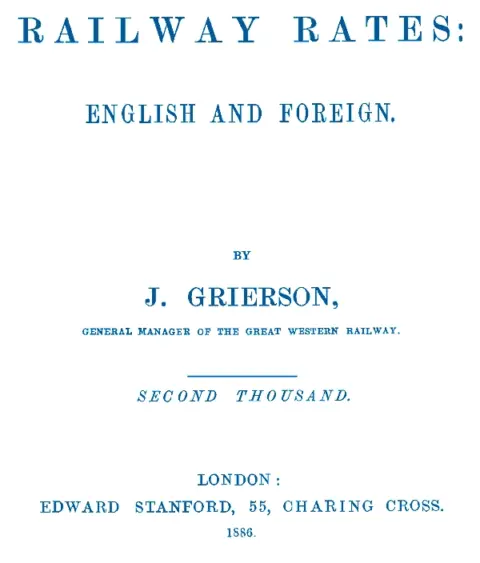
THE CLASSIC COLLECTION · 1886
"Railway Rates: English and Foreign" by James Grierson is a scientific publication written in the late 19th century. It explores the principles, practices, and controversies surrounding railway rates in the United Kingdom compared to those in other countries, providing analysis and commentary on various rate-setting methods. Grierson, the General Manager of the Great Western Railway, delves into the complex interplay of interests between railway companies, traders, and consumers, aiming for an understanding that serves the needs of all parties involved in railway transportation. The opening of the text begins with a preface in which the author outlines the impetus for his examination of railway rates, citing public complaints and discussions regarding the contentious Railway and Canal Traffic Bill. He sets the stage by emphasizing the necessity of considering all stakeholders—traders, the public, and railway companies—when discussing and establishing rates. Grierson acknowledges that misconceptions surround the current practices and indicates his intent to present a balanced view that avoids hasty legislation or simplistic solutions. He warns against ignoring the complexities inherent in the operation of railways and the diverse needs of different trading communities, foreshadowing the detailed analysis to follow in subsequent sections.
Introduction adapted from the source catalogue; source summaries may be automatically generated.
Free to read · English · 78,139 words · No account needed
MAKE TIME FOR A GOOD BOOK
On by default. Untick to stop anonymous reading totals. Each page counts after 10 seconds in view. How this works.
Anonymous counting is on unless you have switched it off.
Further information can be obtained at all the Stations; or on application to the Agent of the ______________________________ Railway.
[COPIES OF NOTICES OF SPECIAL CONTRACTS.]
From the “Dutch Guide,” of 28th January, 1886.
HOLLAND RAILWAY COMPANY.
A contract has been entered into for the carriage of a large quantity of goods over the Company’s lines.
Further information can be obtained at the Goods Office, at the Central Administration Buildings, Droogbak, Amsterdam. The ADMINISTRATOR. AMSTERDAM, 25th Jan., 1886. ______________________________
From the “Dutch Guide,” of 25th February, 1886. COMPANY FOR WORKING THE DUTCH STATE RAILWAYS.
Various contracts have been entered into for the carriage of large quantities of goods on the Southern net of the State Railways.
Further information can be obtained at the Goods Manager’s Office, Moreelselaan, No. 1, Utrecht. The GENERAL MANAGER. UTRECHT, 17th-24th Feb., 1886.
A Contract for the carriage of cattle has been entered into. Further information can be obtained at the Goods Manager’s Office, Catharijne Kade 759, Utrecht.
The result is that a considerable portion of the traffic is carried
under special agreements, under conditions such as the following,
viz.:--
The sender agrees to forward between A and B special quantities, for
instance:--
80 tons Soap,
10 ” Sugar,
5 ” Pepper,
5 ” Tobacco,
or to forward the whole of his traffic between C and D estimated at a specific quantity for a certain period, for instance:--
400 tons General goods,
10,000 ” Coal,
1,000 ” Coke.
In Italy, differential rates have been the subject of public inquiry, and the representatives of some local interests have asked for their abolition. But they exist; and the verdict upon them of the Parliamentary Committee of Inquiry in 1881 was: “It is indisputable that the system of differential rates has helped to strengthen and improve the national industries.”[26]
[26] Parte II., Vol. II., Sec. 32.
The fact of railways in other countries charging special rates for import, export and transit traffic, is, of course, not a proof of their being right in principle. But the foregoing information may correct loose assertions or suggestions that differential rates are unknown or rare elsewhere. It shows that the railway authorities and the Governments who control the rates in those countries, even while professing to charge mileage rates, have considered it necessary, with the view of promoting and protecting the interests of their trade, to charge differential rates.
Your reading position is saved on this browser. Take it to another device with a library code. Reading pages adapt to text, rather than matching a printed edition.
BEHIND THE BOOK
This eBook is for the use of anyone anywhere in the United States and most other parts of the world at no cost and with almost no restrictions whatsoever. You may copy it, give it away or re-use it under the terms of the Project Gutenberg License included with this eBook or online at www.gutenberg.org. If you are not located in the United States, you will have to check the laws of the country where you are located before using this eBook. Read the source licence.
The original source file, including credits and licence, is retained by this library. Request an original-format copy at no charge. Please include the book title and Project Gutenberg identifier #47719.
KEEP YOUR CURIOSITY GOING
Cécile Tormay

Moritz Busch
John L. Ransom
Frances Wright
Cécile Tormay

Mabel Potter Daggett