THE CLASSIC COLLECTION✦An outlaw’s diary: the CommuneCLASSIC FREE BOOKS
An outlaw’s diary: the Commune
Cécile Tormay
THE CLASSIC COLLECTION · 1886
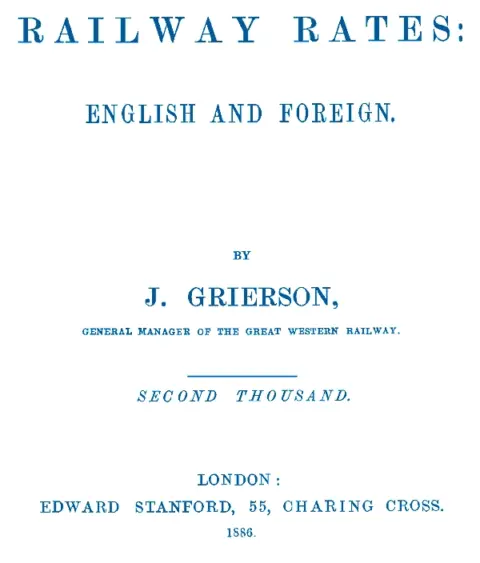
"Railway Rates: English and Foreign" by James Grierson is a scientific publication written in the late 19th century. It explores the principles, practices, and controversies surrounding railway rates in the United Kingdom compared to those in other countries, providing analysis and commentary on various rate-setting methods. Grierson, the General Manager of the Great Western Railway, delves into the complex interplay of interests between railway companies, traders, and consumers, aiming for an understanding that serves the needs of all parties involved in railway transportation. The opening of the text begins with a preface in which the author outlines the impetus for his examination of railway rates, citing public complaints and discussions regarding the contentious Railway and Canal Traffic Bill. He sets the stage by emphasizing the necessity of considering all stakeholders—traders, the public, and railway companies—when discussing and establishing rates. Grierson acknowledges that misconceptions surround the current practices and indicates his intent to present a balanced view that avoids hasty legislation or simplistic solutions. He warns against ignoring the complexities inherent in the operation of railways and the diverse needs of different trading communities, foreshadowing the detailed analysis to follow in subsequent sections.
Introduction adapted from the source catalogue; source summaries may be automatically generated.
Free to read · English · 78,139 words · No account needed
MAKE TIME FOR A GOOD BOOK
On by default. Untick to stop anonymous reading totals. Each page counts after 10 seconds in view. How this works.
Anonymous counting is on unless you have switched it off.
According to the test of railway receipts for conveyance of minerals and goods, the killing process seems very slow indeed, and it is not even sure, because in 1885 the railway receipts for minerals were in some instances reduced. The average receipts for minerals were about 2¼ per cent. less on the average of the past two years as compared with those of the previous three years. In the case of goods traffic this percentage was only 0·82 per cent. But, as against the above average receipts for 1884 and 1885, let us place the average for the preceding nine years. For minerals, £14,398,012; for goods, £19,635,080, which shows an increased receipt on the average of the past two years--on minerals of £989,431; on goods of £995,986. Certainly these results are the reverse of decay in traffic or trade.
Another and better test is the tonnage of minerals and goods conveyed on the railways of the United Kingdom for the like period.
Years. Minerals. Goods. Tons. Tons. 1875 to 1877, average 141,910,505 64,094,565 1878 ” 1880 ” 152,528,097 65,548,450 1881 ” 1883 ” 182,310,041 74,204,559 1884 ” 1885 ” 183,696,151 74,612,020
This test contradicts the theory of decaying trade in an unmistakable manner, but it may be urged that these averages are insufficient to show the great depression in 1885. The fact is, that in 1885 there was a larger tonnage of minerals conveyed than in any year, with the exception of 1883, and a larger tonnage of goods than in any year except 1882, 1883 and 1884.
But a third test, that of production, may be applied. In 1884, the quantity of coal raised in the United Kingdom
was 160,758,000 tons. and in 1885 159,351,000 ” ----------------- Decrease 1,407,000 tons. or about ·88 per cent. In 1884 the tonnage of iron ore raised was 16,138,000 tons, And Iron Ore imported 2,730,800 ” ----------------- 18,868,800 tons.
In 1885, 15,418,000 tons of Iron Ore were raised
Add 2,822,600 ” imported.
----------
18,240,600 ”
being a decrease of 628,200 tons, or a decrease of 3·33 per cent.
In 1883, the quantity of pig iron produced in Great
Britain was 8,529,000 tons.
” 1884 7,812,000 ”
” 1885 7,415,000 ”
The fact is, that 1883 was an exceptional year. The tonnage of minerals conveyed by railway in 1883 was 8,075,101 tons greater than in 1882, 13,451,612 tons greater than in 1881, and 23,815,308 tons greater than in 1880.
And in like manner the tonnage of general merchandise conveyed in 1883 was 2,192,034 tons in excess of 1882, 5,886,356 tons in excess of 1881, and 7,262,031 tons in excess of the tonnage of 1880.
The production of pig iron is not a real test, inasmuch as large stocks accumulate at certain periods, and the ratio of production is lessened in order to reduce the quantity in stock.
No doubt depression of trade may arise from lower prices. The years 1876 and 1877 were probably those during which the highest possible prices ruled for coal, iron, &c. What were the quantities conveyed by railway?
Minerals. Merchandise.
Tons. Tons.
In 1875 137,087,713 62,981,938
” 1876 141,779,393 64,185,671
” 1877 146,864,410 65,116,085
” 1880 165,670,304 69,635,325
” 1883 189,485,612 76,897,356
” 1885 183,776,745 73,511,709
Your reading position is saved on this browser. Take it to another device with a library code. Reading pages adapt to text, rather than matching a printed edition.
BEHIND THE BOOK
This eBook is for the use of anyone anywhere in the United States and most other parts of the world at no cost and with almost no restrictions whatsoever. You may copy it, give it away or re-use it under the terms of the Project Gutenberg License included with this eBook or online at www.gutenberg.org. If you are not located in the United States, you will have to check the laws of the country where you are located before using this eBook. Read the source licence.
The original source file, including credits and licence, is retained by this library. Request an original-format copy at no charge. Please include the book title and Project Gutenberg identifier #47719.
KEEP YOUR CURIOSITY GOING
Cécile Tormay

Moritz Busch
John L. Ransom
Frances Wright
Cécile Tormay

Mabel Potter Daggett