THE CLASSIC COLLECTION✦An outlaw’s diary: the CommuneCLASSIC FREE BOOKS
An outlaw’s diary: the Commune
Cécile Tormay
THE CLASSIC COLLECTION · 1886
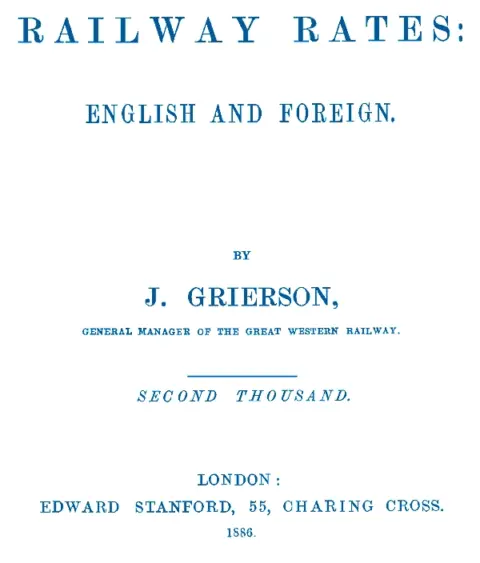
"Railway Rates: English and Foreign" by James Grierson is a scientific publication written in the late 19th century. It explores the principles, practices, and controversies surrounding railway rates in the United Kingdom compared to those in other countries, providing analysis and commentary on various rate-setting methods. Grierson, the General Manager of the Great Western Railway, delves into the complex interplay of interests between railway companies, traders, and consumers, aiming for an understanding that serves the needs of all parties involved in railway transportation. The opening of the text begins with a preface in which the author outlines the impetus for his examination of railway rates, citing public complaints and discussions regarding the contentious Railway and Canal Traffic Bill. He sets the stage by emphasizing the necessity of considering all stakeholders—traders, the public, and railway companies—when discussing and establishing rates. Grierson acknowledges that misconceptions surround the current practices and indicates his intent to present a balanced view that avoids hasty legislation or simplistic solutions. He warns against ignoring the complexities inherent in the operation of railways and the diverse needs of different trading communities, foreshadowing the detailed analysis to follow in subsequent sections.
Introduction adapted from the source catalogue; source summaries may be automatically generated.
Free to read · English · 78,139 words · No account needed
MAKE TIME FOR A GOOD BOOK
On by default. Untick to stop anonymous reading totals. Each page counts after 10 seconds in view. How this works.
Anonymous counting is on unless you have switched it off.
Though every railway company owning or managing a canal may be compelled under the Section cited on page 193 to keep it in repair, only one application for that purpose has been made to the Railway Commissioners. This is scarcely consistent with the loose, unverified accusations as to the shortcomings of railway companies. Besides, it is not true that the whole canal system has passed under the influence of railways. Of the 3,029 miles of canals in Great Britain, 1,592½ miles are owned or managed by other than railway companies.[108] An examination of the map prepared by Mr. Abernethy, C.E., for the Select Committee of 1883, shows, that south of a line passing through Worcester, Birmingham, Nottingham and Hull, there is scarcely a canal of any importance, with the exception of the Kennet and Avon canal, between Bath and Reading, permanently, temporarily, or partially in the hands of a railway company.
[108] Appendix to Report of Select Committee on Canals, page 214, “These lengths are exclusive of the River Thames, Severn, Wye, Humber, Wear, and Tyne in England; the Rivers Clyde, Forth, Tay, and the Caledonian Ship Canal in Scotland; the Shannon and other navigations in Ireland.” According to Mr. Taunton’s Report, the canals and navigable rivers in England, Wales, and Scotland under control of railways are 1,447 miles as against 2,335, which are independent of railway companies (Appendix 228.)
The fact appears to be that canals flourish only where certain conditions exist. Where a large traffic can be conveyed in full boatloads; where the country is flat, and there are consequently few locks; where large vessels propelled by steam can be used; where works are so situated that the cost of collection or delivery can be saved; in such circumstances, canals are suitable for coal, chalk, cotton, stone, bricks, pig-iron, round timber, grain, &c., and such like goods carried in large quantities, or for short distances. They can, no doubt, when such conditions exist, be beneficially used at a low cost for carriage; but for traffic not large, or composed of a great variety of articles, which have to be collected in small quantities from different places, or to be distributed all over the country, canals cannot successfully compete with railways. Want of water in dry summers, interruptions from ice in winter, and diversity of gauges in locks and tunnels--all matters which add to cost--are great inconveniences, and grave objections to water carriage. Often carriage by canal necessitates the erection of warehouses for storing goods, which is saved by the transit of traffic by rail. The speed and despatch demanded by the modern necessities of trade have tended to throw upon the railway more and more of the traffic which formerly went by canals, as well as the increase in the traffic of the country. In Staffordshire, canal boats meet from all the principal towns such as Manchester, Liverpool, and parts of Yorkshire in the North, and London and Bristol in the South; but no through traffic is exchanged. All the traffic of Staffordshire in iron, hardware, chains, anchors, nails, &c., outwards, and grain, timber, spelter, bone, manures, &c. inwards, requiring speed, is carried by railways. Where the canal charges are equal to, or lower than, the railway rates, the railways and canals divide the traffic. Newly-opened collieries and works are now, as a rule, laid out for loading into railway wagons, not into boats, because railway stations and railway trucks give greater facilities for distribution of coal to all parts of the country. No doubt certain large canals--for example, the Aire and Calder, Bridgwater, and the Leeds and Liverpool--can be profitably worked in their exceptional circumstances, as they possess a plentiful supply of water, and traverse a long stretch of comparatively level country. Where such conditions exist for distances of fifty to sixty miles, canals may compete successfully for heavy traffic with railways.
Your reading position is saved on this browser. Take it to another device with a library code. Reading pages adapt to text, rather than matching a printed edition.
BEHIND THE BOOK
This eBook is for the use of anyone anywhere in the United States and most other parts of the world at no cost and with almost no restrictions whatsoever. You may copy it, give it away or re-use it under the terms of the Project Gutenberg License included with this eBook or online at www.gutenberg.org. If you are not located in the United States, you will have to check the laws of the country where you are located before using this eBook. Read the source licence.
The original source file, including credits and licence, is retained by this library. Request an original-format copy at no charge. Please include the book title and Project Gutenberg identifier #47719.
KEEP YOUR CURIOSITY GOING
Cécile Tormay

Moritz Busch
John L. Ransom
Frances Wright
Cécile Tormay

Mabel Potter Daggett