THE CLASSIC COLLECTION✦An outlaw’s diary: the CommuneCLASSIC FREE BOOKS
An outlaw’s diary: the Commune
Cécile Tormay
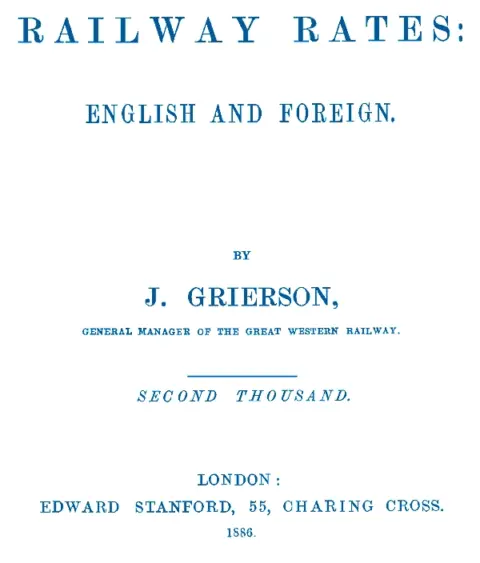
THE CLASSIC COLLECTION · 1886
"Railway Rates: English and Foreign" by James Grierson is a scientific publication written in the late 19th century. It explores the principles, practices, and controversies surrounding railway rates in the United Kingdom compared to those in other countries, providing analysis and commentary on various rate-setting methods. Grierson, the General Manager of the Great Western Railway, delves into the complex interplay of interests between railway companies, traders, and consumers, aiming for an understanding that serves the needs of all parties involved in railway transportation. The opening of the text begins with a preface in which the author outlines the impetus for his examination of railway rates, citing public complaints and discussions regarding the contentious Railway and Canal Traffic Bill. He sets the stage by emphasizing the necessity of considering all stakeholders—traders, the public, and railway companies—when discussing and establishing rates. Grierson acknowledges that misconceptions surround the current practices and indicates his intent to present a balanced view that avoids hasty legislation or simplistic solutions. He warns against ignoring the complexities inherent in the operation of railways and the diverse needs of different trading communities, foreshadowing the detailed analysis to follow in subsequent sections.
Introduction adapted from the source catalogue; source summaries may be automatically generated.
Free to read · English · 78,139 words · No account needed
MAKE TIME FOR A GOOD BOOK
On by default. Untick to stop anonymous reading totals. Each page counts after 10 seconds in view. How this works.
Anonymous counting is on unless you have switched it off.
[97] In a case of the kind referred to, which was brought before the Board of Trade when the Bill was before Parliament, as a skilled officer of the company was occupied 150 hours, in preparing the information alone to reply to the Board of Trade, irrespective of the time occupied by others in analysing the information, and in corresponding with the Board of Trade on the subject, all of which had no practical result.
When we are invited to place in the hands of a tribunal the control of the rates, it is expedient to note the difficulties which the Railway Commissioners seem to have felt in dealing with the various questions raised before them, and the manner in which they have dealt with them.
In determining under the Traffic Act questions of alleged undue preference, they have been obliged to express their opinion on the reasonableness of particular rates. As to the legal correctness of their decisions, nothing need here be said; for the present purpose it may be assumed that they are open to no legal exception, and we fully recognise the ability and care which they manifest. Only their economical effects are here considered. There would be no difficulty in showing that they have acted upon principles, so far as they have acted upon any, which have not merely not been sanctioned, but have been condemned, by every Royal Commission or Select Committee which has inquired into the subject, and by almost every economist of eminence. On the part of the Commissioners there have been--not unnaturally--some waverings in opinion. But on the whole, they appear to have attempted to frame rates according to cost of service; and they appear not to admit that the existence of competition is a reason for varying them. Now, in the first place they apply--it may be added, necessarily apply--the cost of service principle in an imperfect fashion. They deal only with undue preference in regard to the same or very similar articles. They do not say, what consistent adherence to the theory would compel them to say, that a ton of coals and a ton of tin ingots must be carried at much the same rate; they are bound by the existing classification, which forbids this. Occasionally their decisions are indeed curiously inconsistent in many respects, as was probably inevitable, where they were called upon to face the commercial results which would have followed a too rigid adherence to some of the principles by which they felt themselves bound.[98] In the case of the Nitshill and Lesmahagow Coal Company v. Caledonian Railway Company,[99] the defendant company claimed to charge more for carrying cannel coal, which, it was alleged, cost 38s. a ton, than they charged for carrying splint, which cost 15s. 6d. On the principle on which the classifications in most special Acts were framed, this would be reasonable; the more valuable article could bear more, and ought to pay more. But the Railway Commissioners decided differently. “As the quality of coal does not affect the cost of carriage to the railway company,” they said, “we are of opinion that the two kinds of coal ought to receive the same treatment.” If this principle had been carried out since the beginning of railways, if rates had been settled without regard to the value of merchandise, the prosperity of many districts and industries would never have been developed. In the second place, the cost of carriage is, inevitably, sometimes guessed at rather than calculated. We have already stated the nice calculations which must be entered into in order to determine the exact cost of carriage; calculations in which it is practically impossible to attain accuracy. Many elements in cost, the Commissioners cannot accurately measure; the data do not exist. In the third place, the effect of their later decisions is to exclude, practically, if not theoretically, competition from the considerations to be taken into account. This is, not only for the reasons already stated, contrary to sound commercial principles; it is contrary to the language of the early decisions of the Court of Common Pleas, which distinctly recognised competition as rightly taken into account in fixing rates. In Garton v. Bristol & Exeter Railway Co. (1 N. & M. 1859, p. 218), for example, the Court of Common Pleas decided, among other reasons against the validity of a certain charge, because, in the words of Byles, J., “it is not shown that it is rendered necessary for the purpose of meeting and overcoming competition”.[100] The early judgments of the Railway Commissioners themselves recognised the right to take into account the existence of competition. In Foreman v. Great Eastern Railway Co., decided in 1875 (2 N. & M. 202), the point in dispute was the validity of a scale of charges for the carriage of coal from Peterborough to Norwich and Great Yarmouth and intermediate stations. The Great Eastern Company were alleged to give an undue preference to coal consigned to such stations, as compared with the carriage of sea-borne coal from Great Yarmouth to Norwich and the stations between it and Peterborough. The Commissioners observed: “Nor does the Traffic Act prevent a railway company from having special rates of charges to a terminus to which traffic can be carried by other routes, or other modes of carriage with which theirs is in competition,” a dictum inconsistent with the view “that cost of service is the necessary measure of rates.” In a case decided the same year, Thompson v. London and North Western Railway Co., 2 N. & M. (1875) 115, the Commissioners speak dubiously. They observe with respect to the argument that “the Traffic Act prohibits only undue advantages, and that an advantage given by a railway company to obtain traffic for which it competes with another railway company is not undue” (p. 120). “Such a proposition cannot, in our opinion, be laid down unreservedly. It may be true in certain circumstances; it would not be so in others, and what degree of favour can be lawfully shown to some person to the prejudice of others under the pressure of competition can only be decided in any case that arises by reference to its special circumstances.”[101] In still later judgments there is a faint recognition of the fact that the existence of competition ought to be taken into account; e.g., in Richardson v. Midland Railway Company, decided in 1881 (4 N. and M. 1) the Commissioners say: “The difference (between the Burton and Newark rates) or part of it, may possibly be required by the route from the same district, not being the same all the way to the two places, and by the separate portions of line passed over being more costly to work or construct in the one case than in the other; or, again, may be required by a competition for the conveyance of the particular traffic between the two termini, existing in one case but not in the other. They proceed to speak of “due allowance for such causes of difference,” which implies that allowance must be made for both of such causes. But in the Broughton Coal Company’s case (4 N. and M. p. 191, 1883) the Commissioners use somewhat different language. They observe that “if goods of the same kind are carried to the same destination over the same railway for distances that are not the same, and the gross charge from the intermediate distance is as great as from the more distant one, there is a preference of one traffic over the other within the meaning of the Traffic Act of 1854; and that it is not sufficient to rebut this presumption to show that the charge for the longer distance has been reduced to meet a competition from another route.” Lately the Commissioners have, to say the least, lost sight of the element of competition in determining rates; and in all the applications to them, there is no clear instance in which they have found the circumstances in which it ought, in their opinion, to operate.
Your reading position is saved on this browser. Take it to another device with a library code. Reading pages adapt to text, rather than matching a printed edition.
BEHIND THE BOOK
This eBook is for the use of anyone anywhere in the United States and most other parts of the world at no cost and with almost no restrictions whatsoever. You may copy it, give it away or re-use it under the terms of the Project Gutenberg License included with this eBook or online at www.gutenberg.org. If you are not located in the United States, you will have to check the laws of the country where you are located before using this eBook. Read the source licence.
The original source file, including credits and licence, is retained by this library. Request an original-format copy at no charge. Please include the book title and Project Gutenberg identifier #47719.
KEEP YOUR CURIOSITY GOING
Cécile Tormay

Moritz Busch
John L. Ransom
Frances Wright
Cécile Tormay

Mabel Potter Daggett