Great Mysteries and Little Plagues
John Neal
THE CLASSIC COLLECTION · 1828
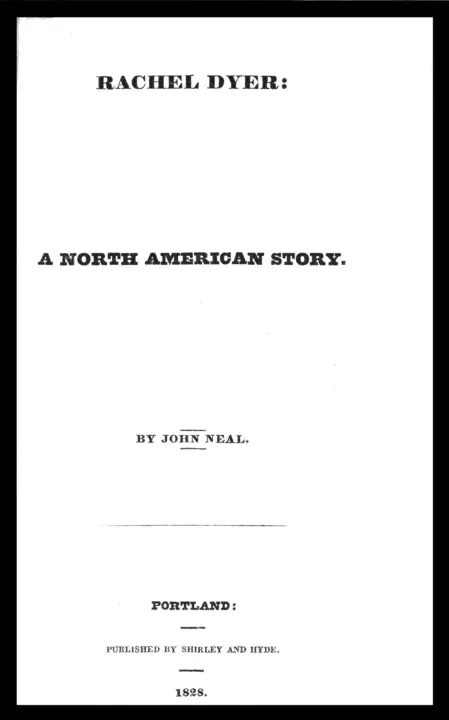
"Rachel Dyer: A North American Story" by John Neal is a Gothic historical novel published in 1828. Set during the Salem witch trials, it follows the fictionalized minister George Burroughs and the invented character Rachel Dyer as they confront mounting hysteria and false accusations of witchcraft. With most of the story unfolding in the courtroom, the novel tracks multiple trials of alleged witches, exploring themes of justice, republican ideals, and the collision between Old World authority and New World freedom. This pioneering work became the first bound novel about Salem's dark chapter.
Introduction adapted from the source catalogue; source summaries may be automatically generated.
Free to read · English · 80,188 words · No account needed
MAKE TIME FOR A GOOD BOOK
On by default. Untick to stop anonymous reading totals. Each page counts after 10 seconds in view. How this works.
Anonymous counting is on unless you have switched it off.
Of the trial of “good-wife Proctor,” the following interpretation was
had.
“About this time, besides the experiment of the afflicted falling at the sight, &c. they put the accused upon saying the Lord’s prayer, which one among them performed, except in that petition, deliver us from evil, she expressed it thus, deliver us from all evil: this was looked upon as if she prayed against what she was now justly under, and being put upon it again, and repeating those words, hallowed be thy name, she expressed it, hollowed be thy name: this was counted a depraving the words, as signifying to make void, and so a curse rather than a prayer: upon the whole it was concluded that she also could not say it, &c. Proceeding in this work of examination and commitment, many were sent to prison.
“In August, 1697, the superior court sat at Hartford, in the colony of Connecticut, where one mistress Benom was tried for witchcraft. She had been accused by some children that pretended to the spectral sight: they searched her several times for teats; they tried the experiment of casting her into the water, and after this she was excommunicated by the minister of Wallinsford. Upon her trial nothing material appeared against her, save spectre evidence. She was acquitted, as also her daughter, a girl of twelve or thirteen years old, who had been likewise accused; but upon renewed complaints against them, they both flew into New-York government.
Second--Of the Confessions.--The following is a letter written by six of the confessing witches, by which it may be understood in some degree how they came to accuse themselves.
“We, whose names are under written, inhabitants of Andover, when as that horrible and tremendous judgment beginning at Salem Village, in the year 1692, (by some called witchcraft) first breaking forth at Mr. Parris’s house, several young persons being seemingly afflicted, did accuse several persons for afflicting them, and many there believing it so to be; we being informed that if a person were sick, the afflicted person could tell what or who was the cause of that sickness: Joseph Ballard of Andover (his wife being sick at the same time) he either from himself, or by the advice of others, fetched two of the persons, called the afflicted persons, from Salem Village to Andover: which was the beginning of that dreadful calamity that befel us in Andover. And the authority in Andover, believing the said accusations to be true, sent for the said persons to come together to the meeting-house in Andover (the afflicted persons being there.) After Mr. Barnard had been at prayer, we were blindfolded, and our hands were laid upon the afflicted persons, they being in their fits, and falling into their fits at our coming into their presence [as they said] and some led us and laid our hands upon them, and then they said they were well, and that we were guilty of afflicting of them whereupon we were all seized as prisoners, by a warrant from a justice of the peace, and forthwith carried to Salem. And by reason of that sudden surprisal, we knowing ourselves altogether innocent of that crime, we were all exceedingly astonished and amazed, and affrighted even out of our reason; and our nearest and dearest relations, seeing us in that dreadful condition, and knowing our great danger, apprehending that there was no other way to save our lives, as the case was then circumstanced, but by our confessing ourselves to be such and such persons, as the afflicted represented us to be, they out of tender love and pity persuaded us to confess what we did confess. And indeed that confession, that it is said we made, was no other than what was suggested to us by some gentlemen; they telling us, that we were witches, and they knew it, and we knew it, and they knew that we knew it, which made us think that it was so; and our understanding, our reason and our faculties almost gone, we were not capable of judging our condition; as also the hard measures they used with us rendered us uncapable of making our defence; but said anything which they desired: and most of what we said was but in effect a consenting to what they said. Sometime after, when we were better composed, they telling of us what we had confessed, we did profess that we were innocent, and ignorant of such things. And we hearing that Samuel Wardwell had renounced his confession, and quickly after was condemned and executed, some of us were told that we were going after Wardwell.
Your reading position is saved on this browser. Take it to another device with a library code. Reading pages adapt to text, rather than matching a printed edition.
BEHIND THE BOOK
This eBook is for the use of anyone anywhere in the United States and most other parts of the world at no cost and with almost no restrictions whatsoever. You may copy it, give it away or re-use it under the terms of the Project Gutenberg License included with this eBook or online at www.gutenberg.org. If you are not located in the United States, you will have to check the laws of the country where you are located before using this eBook. Read the source licence.
The original source file, including credits and licence, is retained by this library. Request an original-format copy at no charge. Please include the book title and Project Gutenberg identifier #71766.
KEEP YOUR CURIOSITY GOING
Cécile Tormay

Moritz Busch
Coulson Kernahan
John L. Ransom

Maurice Baring
Frances Wright