THE CLASSIC COLLECTION✦The Chaldean Magician An Adventure in Rome in the Reign of the Emperor DiocletianCLASSIC FREE BOOKS
The Chaldean Magician An Adventure in Rome in the Reign of the Emperor Diocletian
Ernst Eckstein
THE CLASSIC COLLECTION · 1882
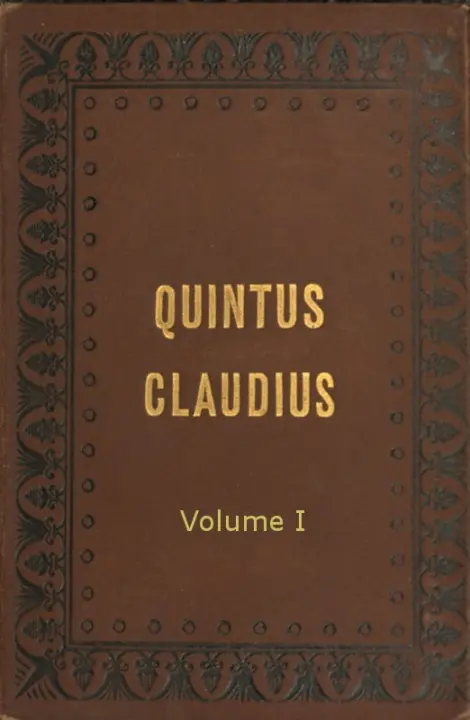
"Quintus Claudius: A Romance of Imperial Rome. Volume 1" by Ernst Eckstein is a historical novel written in the late 19th century. Set during the era of Imperial Rome, the story appears to explore the lives of its characters amidst the grandeur and intrigue of Roman society, centering particularly on a young man named Caius Aurelius and his encounters with various individuals, including the noblewomen Octavia and Claudia. Themes of adventure, love, and the contrasts within the human experience are likely key elements of the narrative. At the start of the novel, the reader is introduced to Caius Aurelius aboard a trireme navigating the waters of Campania. The atmosphere is lively yet tumultuous, as Aurelius and his companion, Herodianus, discuss their arduous journey from Hispania to Rome. Their voyage takes an unexpected turn when they encounter a distressed pleasure boat carrying three ladies caught in a storm. Aurelius and his crew spring into action, successfully rescuing the women. The ladies, Octavia and her daughter Claudia, express their gratitude, leading to an invitation for Aurelius to visit their villa in Baiae. This initial adventure sets the stage for deeper relationships and challenges as Aurelius's journey intertwines with the lives of these noblewomen amidst the backdrop of a politically charged Rome.
Introduction adapted from the source catalogue; source summaries may be automatically generated.
Free to read · English · 92,798 words · No account needed
MAKE TIME FOR A GOOD BOOK
On by default. Untick to stop anonymous reading totals. Each page counts after 10 seconds in view. How this works.
Anonymous counting is on unless you have switched it off.
“Long have I search’d, my Soph, the town,
To find a damsel that would frown,
But not a damsel will deny,
As if a shame ’t were to be shy;
As if a sin, will no one dare:
I see not one denying fair.
‘Then of the fair is no one chaste?’
A thousand, Soph, you urge in haste.
‘What does the chaste? Enlarge my views.’
She does not grant, nor yet refuse.”
ELPHINSTON.
In contrast to the hyperbolical expressions of the satirical writers, we are made acquainted in the letters of the younger Pliny, with a number of women of noble character; the historians too, especially Tacitus, as well as inscriptions on the monuments prove--if proof were required--that even in this corrupt age feminine virtue and loftiness of character were not rare. It is natural, that a satirical author should have special keenness of vision for errors and weaknesses.
[158] WHAT RAVIDUS?. The poem to which Martial here alludes is found
Cat. Carm. XL.
“Quaenam te mala mens, miselle Ravide
Agit praecipitem in meos iambos?”
[159] TRYPHON, (LUPERCUS). The episode described here, which seems almost like a satirical allusion to the present time, is only one of Martial’s epigrams transposed into action. (Mart. Ep. I, 117.)
“As oft, Sir Tradewell, as we meet,
You’re sure to ask me in the street,
When you shall send your boy to me,
To fetch my book of poetry? etc.”
OLDHAM.
The bookseller Atrectus, who had a shop on the Argiletum, a public square not far from the Forum Caesaris, is also mentioned.--Traces of a well-organized book-trade are found towards the end of the republic. The first publisher on a larger scale is Pomponius Atticus, a friend of Cicero, who formally issued a series of Cicero’s works, for instance the Orator, Quaestiones Academicae, etc., and not only distributed them to the different bookstores in Rome, but supplied the numerous shops in Greece and Asia Minor. (See Cic. ad. Att. XII, 6, XV, 13, XVI, 5.) Yet Atticus was a patron of literature and an aesthetic, rather than a business man. The best-known booksellers and publishers under the emperors were: the Brothers Sosii, who issued the works of Horatius Flaccus (Hor. Ep. I, 20, 2, Ars. poet. 345); Dorus, the Phillip Reclam junior of ancient times, who in the reign of Nero introduced cheap popular editions of Livy and Cicero, (Sen. Benef. VII, 61) and Martial’s publisher, the Tryphon mentioned in this story. (Mart. Ep. IV, 72, XIII, 13.) The editions were provided by slaves, who wrote from dictation. The books were delivered in covers, the backs, glued together, being fastened in the hollow of a cylinder, through which ran a revolving stick. The volumes were cut, the edges were dyed sometimes black and sometimes purple. (See Göll: “Book-trade of the Greeks and Romans,” Schleiz., 1865.) Pollio Valerianus published Martial’s early poems. (Mart. Ep. I, 113, 5.)
Your reading position is saved on this browser. Take it to another device with a library code. Reading pages adapt to text, rather than matching a printed edition.
Ernst Eckstein
Ernst Eckstein
BEHIND THE BOOK
This eBook is for the use of anyone anywhere in the United States and most other parts of the world at no cost and with almost no restrictions whatsoever. You may copy it, give it away or re-use it under the terms of the Project Gutenberg License included with this eBook or online at www.gutenberg.org. If you are not located in the United States, you will have to check the laws of the country where you are located before using this eBook. Read the source licence.
The original source file, including credits and licence, is retained by this library. Request an original-format copy at no charge. Please include the book title and Project Gutenberg identifier #47221.
KEEP YOUR CURIOSITY GOING
Cécile Tormay

Moritz Busch
Coulson Kernahan
John L. Ransom

Maurice Baring
Frances Wright