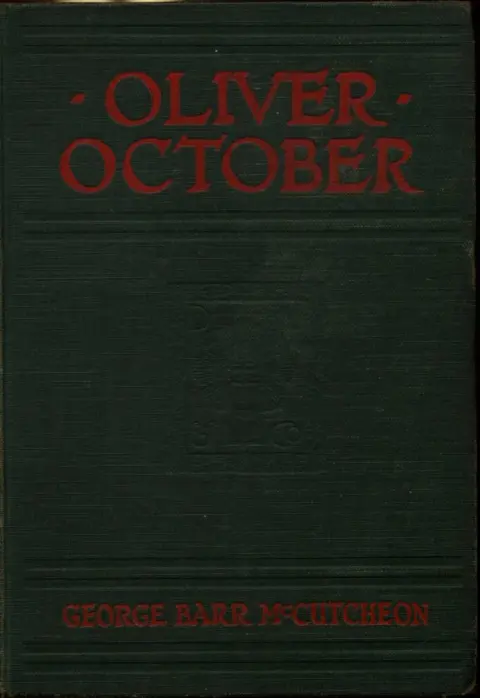
Oliver October
George Barr McCutcheon
THE CLASSIC COLLECTION · 1921
"Quill's Window" by George Barr McCutcheon is a novel likely written in the early 20th century. The story revolves around complex family dynamics and the unfolding drama surrounding the character David Windom, who has a troubled history tied to the mysterious location known as Quill's Window—a cliff with an eerie past and significant emotional weight. The book introduces themes of love, loss, and the intertwining lives of several characters, including Windom's daughter Alix and the significant impact of past actions on present relationships. The opening portion of the novel begins with an engaging scene by the river, where two characters, an older man and a younger man, sit fishing and sharing a conversation that reveals much about their life experiences and the local lore. As they discuss the imposing rock known as Quill's Window, the older man recounts its dark history, including tales of an Irish hermit and a series of tragic events tied to its name. Through their dialogue, the reader is introduced to the intriguing backstory of Quill’s Window and its connection to the Windom family, setting up a rich tapestry of narrative that hints at deeper conflicts and the way haunting memories shape the present lives of the characters involved.
Introduction adapted from the source catalogue; source summaries may be automatically generated.
Free to read · English · 93,036 words · No account needed
MAKE TIME FOR A GOOD BOOK
On by default. Untick to stop anonymous reading totals. Each page counts after 10 seconds in view. How this works.
Anonymous counting is on unless you have switched it off.
Now, Courtney Thane knew almost nothing about books, and even less about pictures. He possessed, however, a remarkable facility when it came to discussing them. He belonged to that rather extensive class of people who thrive on ignorance. If you wanted to talk about Keats or Shelley, he managed to give you the impression that he was thoroughly familiar with both,--though lamenting a certain rustiness of memory at times. He could talk intelligently about Joseph Conrad, Arnold Bennet, Bernard Shaw, Galsworthy, Walpole, Mackenzie, Wells and others of the modern English school of novelists,--that is to say, he could differ or agree with you on almost anything they had written, notwithstanding the fact that he had never read a line by any one of them. He professed not to care for Thomas Hardy's "Jude the Obscure," though nothing could have been more obscure to him than the book itself or the author thereof, and agreed with the delightful Mrs. Pollock that "The Mayor of Casterbridge" was an infinitely better piece of work than "Tess of the D'Urbervilles." As for the American writers, he admitted a shameful ignorance about them.
"Of course, I read Scott when I was a boy,--I was compelled to do so, by the way,--but as for the others I am shockingly unfamiliar with them. Ever since I grew up I've preferred the English novelists and poets, so I fear I--"
"I thought Scott was an English writer," put in Charlie Webster
quietly.
"What Scott are you referring to, Charlie?" he asked indulgently.
"Why, Sir Walter Scott,--he wrote 'Ivanhoe,' you know."
"Well, I happen to be speaking of William Scott, the American novelist,--no doubt unknown to most of you. He was one of the old-timers, and I fancy has dropped out of the running altogether."
"Never heard of him," said Mr. Pollock, scratching his ear
reflectively.
"Indigenous to New England, I fancy,--like the estimable codfish," drawled Courtney, and was rewarded by a wholesome Middle West laugh.
"What are those cabarets like?" inquired Mr. Hatch. He pronounced it as if he were saying cigarettes.
"Pretty rotten," said Thane.
"Are you fond of dancing, Mr. Thane?" inquired Mrs. Pollock. "I used to love to trip the light fantastic."
"I am very fond of dancing," said he, and then added with a smile: "Especially since the girls have taken to parking their corsets."
There was a shocked silence, broken by Miss Grady, who, as a dressmaker, was not quite so finicky about the word.
"What do you mean by parking?" she inquired.
Your reading position is saved on this browser. Take it to another device with a library code. Reading pages adapt to text, rather than matching a printed edition.
George Barr McCutcheon
George Barr McCutcheon
George Barr McCutcheon
George Barr McCutcheon
BEHIND THE BOOK
This eBook is for the use of anyone anywhere in the United States and most other parts of the world at no cost and with almost no restrictions whatsoever. You may copy it, give it away or re-use it under the terms of the Project Gutenberg License included with this eBook or online at www.gutenberg.org. If you are not located in the United States, you will have to check the laws of the country where you are located before using this eBook. Read the source licence.
The original source file, including credits and licence, is retained by this library. Request an original-format copy at no charge. Please include the book title and Project Gutenberg identifier #6044.
KEEP YOUR CURIOSITY GOING
Coulson Kernahan

Maurice Baring
Frances Wright
Cécile Tormay

Frederic Jesup Stimson

W. H. P. (William Henry Pope) Jarvis