THE CLASSIC COLLECTION✦Some Diversions of a Man of LettersCLASSIC FREE BOOKS
Some Diversions of a Man of Letters
Edmund Gosse
THE CLASSIC COLLECTION · 1893
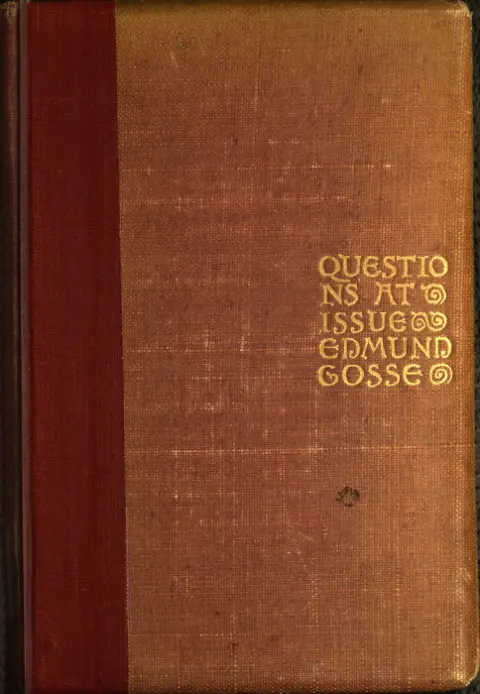
"Questions at Issue" by Edmund Gosse is a collection of literary essays written in the late 19th century. The work explores contemporary literature and examines the nature of criticism, particularly focusing on the impact of the novel and the changing dynamics of literary appreciation. Gosse's writing reflects his observations and thoughts on the literary movements of his time, as well as his insights into how democracy influences literature and the roles of both poets and novelists within that landscape. The opening of the collection begins with a preface in which Gosse lays down his approach to the essays, distinguishing them from traditional literary criticism. He presents a case for a more open, conversational style of critique regarding contemporary writers. Gosse expresses his belief that examining the literary scene of one’s own time can be complex and less authoritative due to ever-changing tastes and societal influences. He discusses the predominance of novels over other literary forms and argues that contemporary criticism should engage sincerely with current literature while remaining rooted in fundamental principles of literary quality.
Introduction adapted from the source catalogue; source summaries may be automatically generated.
Free to read · English · 64,081 words · No account needed
MAKE TIME FOR A GOOD BOOK
On by default. Untick to stop anonymous reading totals. Each page counts after 10 seconds in view. How this works.
Anonymous counting is on unless you have switched it off.
"Female writers as well as male?" asked Black; "are we to have the literary Daphne at our conversaziones--
With legs toss'd high on her sophee she sits, Vouchsafing audience to contending wits?
How do you like that prospect, Lecky?"
"But poorly, I must confess. We have tiresome institutions enough in London without adding to them a sort of Ptolemaic Mouseion, for us to strut about on the steps of, in our palm-costume, attended by dialectical ladies and troops of intriguing pupils. Though that, I am sure," he added courteously, "is the last thing our friend Besant desires, yet I conceive it would tend to be the result of such consultation."
"What then," said the novelist, "is to be the practical service of the English Academy to life and literature?"
At this we all put on a grave and yet animated expression, for certainly, to each of us, this was a very important consideration.
"Putting on one side," began Mr. Spencer, "the social advantage, the unquestionable dignity and importance given to individual literary accomplishment at a time when the purer parts of writing--I mean no disrespect to you novelists--are greatly neglected in the general hurly-burly; putting on one side this function of the English Academy, there remains, of course----"
But, at this precise moment, when I was literally hanging on the lips of our eminent philosopher, the door opened with a considerable noise of gaiety, and Mr. Arthur Balfour entered, in company with a gentleman, who was introduced to me presently as Mr. Andrew Lang.
"Two more Academicians, and this time neither novelists nor
philosophers," said Black.
They sat down close to us, so that the conversation was still general.
"We were discussing the Academy," said Lord Lytton. "And we," replied Mr. Balfour, "were comparing notes about rackets. Lang tells me he has found a complete description of the game in one of the Icelandic sagas."
"Played with a shuttlecock," said Mr. Lang, throwing himself back with a gesture of intense fatigue. "By the way, when we get to B in our Academy dictionary, I will write the article battledore. It is Provençal, I believe; but one must look up Skeat."
"We shall be very old, I am afraid, before we reach letter B," I
remarked, "shall we not?"
"Oh! no," said Mr. Lang, "we shall fire away like fun. All we have to do is to crib our definitions out of Murray."
"I hardly think that," said Mr. Besant; "we seem to have precious little to occupy ourselves with, but our dictionary at least you must leave us."
Your reading position is saved on this browser. Take it to another device with a library code. Reading pages adapt to text, rather than matching a printed edition.
Edmund Gosse
Edmund Gosse
Edmund Gosse
Edmund Gosse
BEHIND THE BOOK
This eBook is for the use of anyone anywhere in the United States and most other parts of the world at no cost and with almost no restrictions whatsoever. You may copy it, give it away or re-use it under the terms of the Project Gutenberg License included with this eBook or online at www.gutenberg.org. If you are not located in the United States, you will have to check the laws of the country where you are located before using this eBook. Read the source licence.
The original source file, including credits and licence, is retained by this library. Request an original-format copy at no charge. Please include the book title and Project Gutenberg identifier #61313.
KEEP YOUR CURIOSITY GOING

David Patterson (Spirit) Hatch

David Patterson (Spirit) Hatch

David Patterson (Spirit) Hatch
Cécile Tormay

Moritz Busch
John L. Ransom