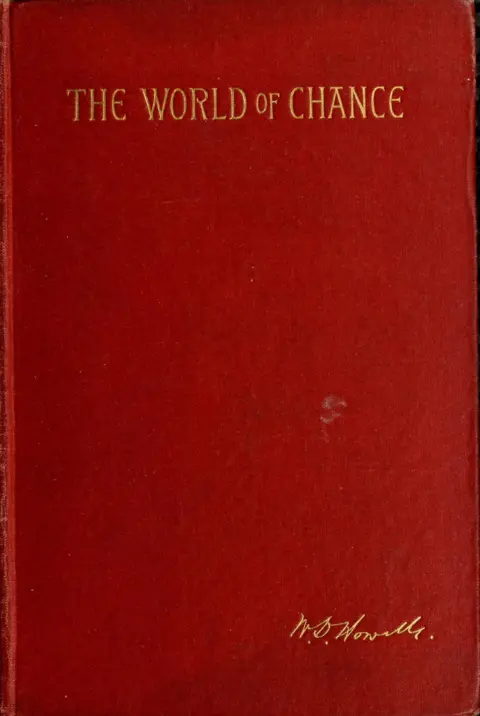
The World of Chance
William Dean Howells
THE CLASSIC COLLECTION · 1895
"Questionable Shapes" by William Dean Howells is a novel written in the early 20th century. The story opens with the protagonist, Hewson, grappling with the enigmatic experience of encountering an apparition, a phenomenon that leaves him both intrigued and deeply reflective about its implications in his life. The narrative seems to explore themes of reality versus perception and the human condition's response to the supernatural, as well as the interplay of social dynamics among a group of characters at a summer house party. At the start of the book, Hewson wakes early in June, disturbed by his encounter with the apparition, and contemplates the significance of his unusual experience against the backdrop of a summer morning filled with birdsong and natural beauty. As he prepares for breakfast, there is a growing sense of his internal conflict regarding how to share this extraordinary event with his hosts and guests without feeling the need for validation. The opening chapters detail his interactions with St. John, the host, and other guests, particularly highlighting his interactions with the mysterious Miss Hernshaw, hinting at deeper connections that may evolve as the story progresses. Despite his initial excitement about sharing his experience, he ultimately decides against it due to the potential repercussions, setting the stage for the novel's exploration of truth, identity, and interpersonal relationships in the face of extraordinary occurrences.
Introduction adapted from the source catalogue; source summaries may be automatically generated.
Free to read · English · 42,122 words · No account needed
MAKE TIME FOR A GOOD BOOK
On by default. Untick to stop anonymous reading totals. Each page counts after 10 seconds in view. How this works.
Anonymous counting is on unless you have switched it off.
Wanhope examined his cup for some dregs of coffee, and then put it down with an air of resignation. I offered to touch the bell, but, “No, don’t,” he said. “I’m better without it.” And he went on: “There was a lonely piece of woods that they had to drive through before they struck the avenue leading to their house, which was on a cheerful upland overlooking the river, and when they had got about half-way through this woods, the tramp whom Ormond had fed in the morning, slipped out of a thicket on the hillside above them, and crossed the road in front of them, and slipped out of sight among the trees on the slope below. Ormond stopped the horse, and turned to his wife with a strange kind of whisper. ‘Did you see it?’ he asked, and she answered yes, and bade him drive on. He did so, slowly looking back round the side of the buggy till a turn of the road hid the place where the tramp had crossed their track. She could not speak, she says, till they came in sight of their house. Then her heart gave a great bound, and she broke out on him, blaming him for having encouraged the tramp to lurk about, as he must have done, all day, by his foolish sentimentality in taking his breakfast out to him. ‘He saw that you were a delicate person, and now to-night he will be coming round, and--’ She says Ormond kept looking at her, while she talked, as if he did not know what she was saying, and all at once she glanced down at their feet, and discovered that her hat was gone.
“That, she owned, made her frantic, and she blazed out at him again, and accused him of having lost her hat by stopping to look at that worthless fellow, and then starting up the horse so suddenly that it had rolled out. He usually gave her as good as she sent when she let herself go in that way, and she told me she would have been glad if he had done it now, but he only looked at her in a kind of daze, and when he understood, at last, he bade her get out and go into the house--they were almost at the door,--and he would go back and find her hat himself. ‘Indeed, you’ll do nothing of the kind,’ she said she told him. ‘I shall go back with you, or you’ll be hunting up that precious vagabond and bringing him home to supper.’ Ormond said, ‘All right,’ with a kind of dreamy passivity, and he turned the old horse again, and they drove slowly back, looking for the hat in the road, right and left. She had not noticed before that it was getting late, and perhaps it was not so late as it seemed when they got into that lonely piece of woods again, and the veils of shadow began to drop round them, as if they were something falling from the trees, she said. They found the hat easily enough at the point where it must have rolled out of the buggy, and he got down and picked it up. She kept scolding him, but he did not seem to hear her. He stood dangling the hat by its ribbons from his right hand, while he rested his left on the dashboard, and looking--looking down into the wooded slope where the tramp had disappeared. A cold chill went over her, and she stopped her scolding. ‘Oh, Jim,’ she said, ‘do you see something? What do you see?’ He flung the hat from him, and ran plunging down the hillside--she covered up her face when she told me, and said she should always see him running--till the dusk among the trees hid him. She ran after him, and she heard him calling, calling joyfully, ‘Yes, I’m coming!’ and she thought he was calling back to her, but the rush of his feet kept getting farther, and then he seemed to stop with a sound like falling. He couldn’t have been much ahead of her, for it was only a moment till she stood on the edge of a boulder in the woods, looking over, and there at the bottom Ormond was lying with his face turned under him, as she expressed it; and the tramp, with a heavy stick in his hand, was standing by him, stooping over him, and staring at him. She began to scream, and it seemed to her that she flew down from the brink of the rock, and caught the tramp and clung to him, while she kept screaming ‘Murder!’ The man didn’t try to get away; he only said, over and over, ‘I didn’t touch him, lady; I didn’t touch him.’ It all happened simultaneously, like events in a dream, and while there was nobody there but herself and the tramp, and Ormond lying between them, there were some people that must have heard her from the road and come down to her. They were neighbor-folk that knew her and Ormond, and they naturally laid hold of the tramp; but he didn’t try to escape. He helped them gather poor Ormond up, and he went back to the house with them, and staid while one of them ran for the doctor. The doctor could only tell them that Ormond was dead, and that his neck must have been broken by his fall over the rock. One of the neighbors went to look at the place the next morning, and found one of the roots of a young tree growing on the rock, torn out, as if Ormond had caught his foot in it; and that had probably made his fall a headlong dive. The tramp knew nothing but that he heard shouting and running, and got up from the foot of the rock, where he was going to pass the night, when something came flying through the air, and struck at his feet. Then it scarcely stirred, and the next thing, he said, the lady was onto him, screeching and tearing. He piteously protested his innocence, which was apparent enough, at the inquest, and before, for that matter. He said Ormond was about the only man that ever treated him white, and Mrs. Ormond was remorseful for having let him get away before she could tell him that she didn’t blame him, and ask him to forgive her.”
Your reading position is saved on this browser. Take it to another device with a library code. Reading pages adapt to text, rather than matching a printed edition.
William Dean Howells
William Dean Howells
William Dean Howells
William Dean Howells
BEHIND THE BOOK
This eBook is for the use of anyone anywhere in the United States and most other parts of the world at no cost and with almost no restrictions whatsoever. You may copy it, give it away or re-use it under the terms of the Project Gutenberg License included with this eBook or online at www.gutenberg.org. If you are not located in the United States, you will have to check the laws of the country where you are located before using this eBook. Read the source licence.
The original source file, including credits and licence, is retained by this library. Request an original-format copy at no charge. Please include the book title and Project Gutenberg identifier #9458.
KEEP YOUR CURIOSITY GOING
Coulson Kernahan

Maurice Baring
Frances Wright
Cécile Tormay

Frederic Jesup Stimson

W. H. P. (William Henry Pope) Jarvis