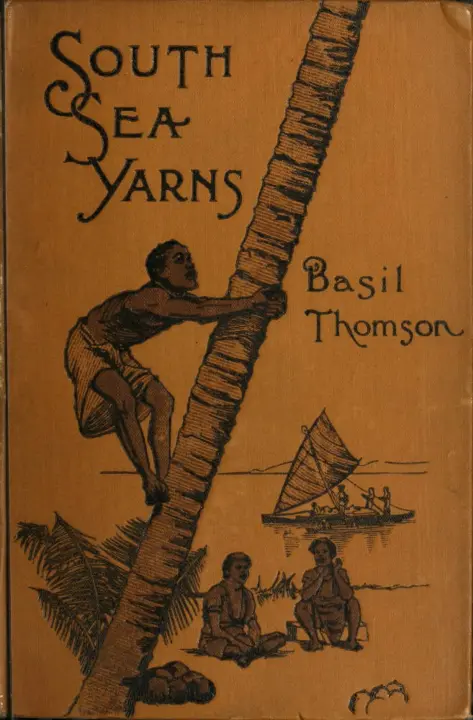
South Sea Yarns
Basil Thomson
THE CLASSIC COLLECTION · 1922
"Queer people" by Basil Thomson is a memoir of policing and intelligence written in the early 20th century. It offers an insider’s account of Scotland Yard and the Special Branch, showing how organization, legwork, and luck—not fanciful forensics—solve real cases, and how war fever and rumor can hinder sound judgment. Expect lively true-crime and espionage anecdotes: jewel thefts, confidence tricks, spy scares, political violence, and the everyday craft of detectives and “thief-catchers.”
The opening of this work moves from a brief, modest preface into a brisk demystification of detective fiction, as the narrator contrasts Sherlockian showmanship with the Yard’s methodical systems and field craft. He sketches the CID’s structure, praises “thief-catchers,” and illustrates practical ingenuity with sharp vignettes (baiting bus pickpockets, posing as a gardener, outwitting suspects in shops and on the Tube). The next chapter exposes “adolescent lying” through cases of forged poison-pen letters and a fanciful maid’s fake kidnapping and spy yarn, followed by the famous recovery of a stolen pearl necklace and raids on receivers and safe-breakers. A survey of classic swindles follows—the Spanish Prisoner letters, the American “confidence trick,” a man who “stole a row of houses,” and a bogus doctor who robs patients he pretends to examine. At the start of the war narrative, he recalls the swift neutralization of a German spy network, smooth mobilization, and then a rolling catalogue of public hysteria—Russians “seen” in Britain, pigeon and wireless scares, gun-platform myths, coded agony columns, and imagined night signals—each patiently investigated and debunked. Finally, the early Special Branch chapters trace its evolution from anarchists and suffragettes to wartime duties, note crime’s decline as offenders enlisted (including a V.C. winner), and offer quick, human portraits from the flood of letters, tourists, refugees, internment at Olympia, and the everyday oddities that crowded the first months of war.
Introduction adapted from the source catalogue; source summaries may be automatically generated.
Free to read · English · 95,430 words · No account needed
MAKE TIME FOR A GOOD BOOK
On by default. Untick to stop anonymous reading totals. Each page counts after 10 seconds in view. How this works.
Anonymous counting is on unless you have switched it off.
About the examinations in my room there was never anything in the nature of what the Americans call the ‘Third Degree,’ which, I understand, consists in startling or wearying the suspect into a confession. If they preferred not to answer questions they were detained until further inquiry could be made about them. In many cases it was the detention that influenced them. They were not sent to prison unless it was clear that their detention would have to be prolonged. There was a range of cells in the adjacent building of Cannon Row Police Station: one of these was furnished as a bed-sitting-room, and was known as the ‘extradition cell’: the others were the ordinary cells in which remand prisoners are placed after arrest. One has to put oneself into the suspect’s position in order to realise what this change of circumstances meant to him. He had been full of the excitement and interest of foreign travel, fresh from a voyage in a liner, where he was unsuspected and liked. Suddenly he found himself within four narrow walls, in silence and without the amenities of comfortable armchairs and tables. If he wished to write he might do so, but everything he wrote would be subject to scrutiny. He had, however, ample time for reflection, and now that the first move must come from his side it was not long before he would send a request for another interview. If he did not he would, in course of time, be sent for, but the period of waiting without any fixed date usually had its effect.
In the middle of October 1915 very definite evidence reached us of the extent of the German-Indian conspiracy and the length the conspirators were prepared to go. The Indian Committee in Berlin was established quite early in the War. After his expulsion from the United States Har Dayal, who had been conducting the ‘Ghadr’ (Mutiny) newspaper in California, went to Switzerland, and on the outbreak of war he, Chattopadhya, and some other Indian revolutionaries who were living in Switzerland went to Berlin. At first the Germans, feeling that they had them quite in their power, treated them with some contempt, but this attitude changed when one or two Germans who posed as Indian experts persuaded the Government to found an Indian Committee to concert measures for starting a revolution in India under a German President. They had a Press Bureau and a regular working scheme for corrupting the loyalty of Indian prisoners of war. Still, though tons of paper and lakes of ink were consumed, no headway was being made until March 1915, when an Indian land-owner named Pertabr conceived the plan of going over to the Germans in the character of an Indian prince. He had some slight claim to this self-assumed title since he was the son of a deposed ruler of a small native State. Having obtained a passport from the Indian Government on the backing of a man whose loyalty was unquestioned, he arrived in Switzerland from Marseilles and lost no time in communicating with Har Dayal, who took him to see the German Consul. Now it does not take much to deceive a German official about Oriental matters. Pertabr wore native dress, and was aloof and condescending. In fact, his haughtiness was exactly what the German Consul would have expected from a Rajah. When pressed to enter the Fatherland Pertabr declared firmly that he would not cross the German frontier until he had a promise that the Kaiser would receive him in person. This arrangement suited Har Dayal admirably, for he would become the intermediary between the two potentates and the springs of money would begin again to flow. After several journeys to and from Berlin an audience was arranged. It was characteristic of the German Consul that he besought Pertabr in all humility to say a good word for him to the All Highest when he should enter the Presence.
Your reading position is saved on this browser. Take it to another device with a library code. Reading pages adapt to text, rather than matching a printed edition.
BEHIND THE BOOK
This eBook is for the use of anyone anywhere in the United States and most other parts of the world at no cost and with almost no restrictions whatsoever. You may copy it, give it away or re-use it under the terms of the Project Gutenberg License included with this eBook or online at www.gutenberg.org. If you are not located in the United States, you will have to check the laws of the country where you are located before using this eBook. Read the source licence.
The original source file, including credits and licence, is retained by this library. Request an original-format copy at no charge. Please include the book title and Project Gutenberg identifier #77709.
KEEP YOUR CURIOSITY GOING

Herman W. Mudgett
James Holbrook

William Le Queux

Edgar Wallace
Hilaire Belloc
Marie Belloc Lowndes