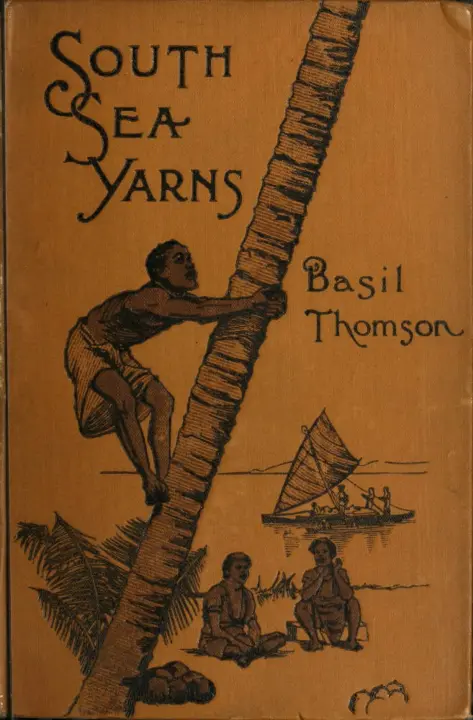
South Sea Yarns
Basil Thomson
THE CLASSIC COLLECTION · 1922
"Queer people" by Basil Thomson is a memoir of policing and intelligence written in the early 20th century. It offers an insider’s account of Scotland Yard and the Special Branch, showing how organization, legwork, and luck—not fanciful forensics—solve real cases, and how war fever and rumor can hinder sound judgment. Expect lively true-crime and espionage anecdotes: jewel thefts, confidence tricks, spy scares, political violence, and the everyday craft of detectives and “thief-catchers.”
The opening of this work moves from a brief, modest preface into a brisk demystification of detective fiction, as the narrator contrasts Sherlockian showmanship with the Yard’s methodical systems and field craft. He sketches the CID’s structure, praises “thief-catchers,” and illustrates practical ingenuity with sharp vignettes (baiting bus pickpockets, posing as a gardener, outwitting suspects in shops and on the Tube). The next chapter exposes “adolescent lying” through cases of forged poison-pen letters and a fanciful maid’s fake kidnapping and spy yarn, followed by the famous recovery of a stolen pearl necklace and raids on receivers and safe-breakers. A survey of classic swindles follows—the Spanish Prisoner letters, the American “confidence trick,” a man who “stole a row of houses,” and a bogus doctor who robs patients he pretends to examine. At the start of the war narrative, he recalls the swift neutralization of a German spy network, smooth mobilization, and then a rolling catalogue of public hysteria—Russians “seen” in Britain, pigeon and wireless scares, gun-platform myths, coded agony columns, and imagined night signals—each patiently investigated and debunked. Finally, the early Special Branch chapters trace its evolution from anarchists and suffragettes to wartime duties, note crime’s decline as offenders enlisted (including a V.C. winner), and offer quick, human portraits from the flood of letters, tourists, refugees, internment at Olympia, and the everyday oddities that crowded the first months of war.
Introduction adapted from the source catalogue; source summaries may be automatically generated.
Free to read · English · 95,430 words · No account needed
MAKE TIME FOR A GOOD BOOK
On by default. Untick to stop anonymous reading totals. Each page counts after 10 seconds in view. How this works.
Anonymous counting is on unless you have switched it off.
One of the most curious of the obsessions is the fear of anarchy if the Reds fall. There is anarchy already. Russia is the last country in the world to fall into the sort of anarchy feared by our statesmen. For centuries she has been accustomed to village councils, with which the Czarist Government interfered very little. She has them now, and all that will happen when the Communists fall, as fall they must, is that the country will break up into these little entities, each stretching out hands to its neighbours. In such conditions the last state of Russia will be better than the first.
Meanwhile, the real Government, so far as there is a Central Government at all, is the Tche-ka, the Extraordinary Commission, which has changed its name but not its nature. It is now called a political committee under the Commissary of the Interior, and in due course, when its new name becomes as much hated as its old name, it will change it again. Even Lenin himself would not be exempt from its attentions, and he knows it. This terror that walks by day and night is the real Government of Russia.
The conviction, honestly held by all classes of Germans, that the War was forced upon them by an inexorable ring of steel that hemmed them in, is not to be dismissed lightly as the figment of their military party. It was a sub-conscious impulse like that of a hive of bees before they swarm, and, like the bees, they were armed with stings. It is even now idle to point out to them that their surplus population was as free as air; the sparsely-populated regions of the earth lay open to it; it could do as so many thousands of Germans had done, and form German-speaking communities, not in German tropical colonies, which have never been successful, but in temperate zones where men can reap the fruits of their own labour; that was not their vision of a place in the sun. Nor is their conviction shaken by the argument that by their industry and their commercial enterprise abroad they were already beginning to inherit the earth. Perhaps the Great War was the first premonition of what is to be the destiny of poor humanity. Far back in the ages the millions of Asia, driven out of their own lands by drought and famine, swarmed westward and swept away the Roman Empire, but then there was land enough for all, and as a torrent pouring down a mountain cañon comes to rest in the broad waters of the lake, so the irruptions from the East spent themselves and subsided. But when there is no longer any lake, what then? In the time of Elizabeth the population of England and Wales was 5,000,000, as late as 1750 it was only 6,500,000, and in 1801, the year of the first census, under 9,000,000. Up to that date these islands were self-supporting. During the last century it has increased at a rate of more than 2,000,000 every ten years, in spite of emigration, and if we were cut off from supplies from abroad we should be starving in a few weeks. The population of the earth is now estimated at something over 1,500,000,000: at the present rate of increase it may be 3,000,000,000 in less than a century. The empty spaces of the world are rapidly filling, and when all those in which men can support themselves are filled up, posterity will have to look to itself. Nature’s old remedy, plague, and the early death of the weakly and the ailing, have been subdued, and unless the birth-rate is artificially regulated the sub-conscious swarming instinct, having no outlet, must behave as it does in the hive, and whole nations and classes will fall upon one another for the right to live. Beside such a vital struggle the Great War will seem as insignificant as the Crimea. The generation upon which this catastrophe falls will find plenty of reasons to justify the breach of Peace, and it will remain ignorant of the root cause to the end.
Your reading position is saved on this browser. Take it to another device with a library code. Reading pages adapt to text, rather than matching a printed edition.
BEHIND THE BOOK
This eBook is for the use of anyone anywhere in the United States and most other parts of the world at no cost and with almost no restrictions whatsoever. You may copy it, give it away or re-use it under the terms of the Project Gutenberg License included with this eBook or online at www.gutenberg.org. If you are not located in the United States, you will have to check the laws of the country where you are located before using this eBook. Read the source licence.
The original source file, including credits and licence, is retained by this library. Request an original-format copy at no charge. Please include the book title and Project Gutenberg identifier #77709.
KEEP YOUR CURIOSITY GOING

Herman W. Mudgett
James Holbrook

William Le Queux

Edgar Wallace
Hilaire Belloc
Marie Belloc Lowndes