THE CLASSIC COLLECTION✦Ruben and Ivy SênCLASSIC FREE BOOKS
Ruben and Ivy Sên
Louise Jordan Miln
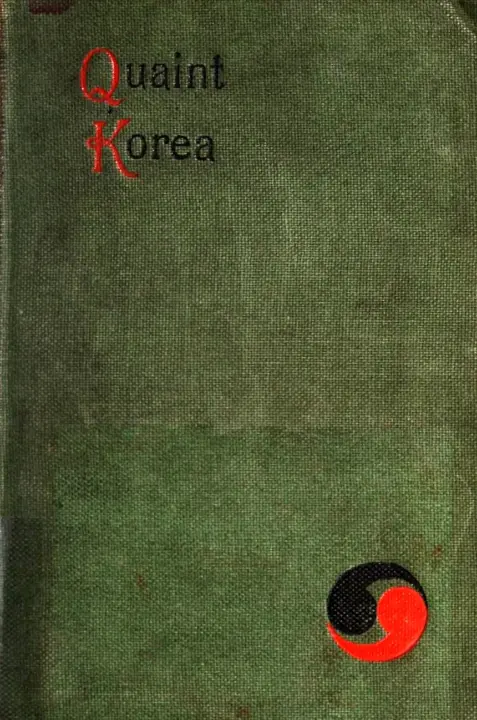
THE CLASSIC COLLECTION · 1895
"Quaint Korea" by Louise Jordan Miln is a travel narrative written in the late 19th century. The book explores the culture, customs, and daily life of Korea as observed by the author, who accompanied her husband (referred to as Mr. Q.) and their party on a journey to the kingdom during a time of pivotal change and conflict in East Asia. Through her observations, Miln offers readers insights into both the idiosyncrasies of Korean society and the political dynamics of the region, along with reflections on the nature of cultural exchange. At the start of the narrative, we are introduced to Mrs. Q., the spoiled wife of an Englishman, traveling in a Chinese junk bound for Korea, along with their companion, a Chinese mandarin, and a young man named John Stewart-Leigh. As they embark on their journey to Korea, the opening chapters provide glimpses of their awkward interactions, showcasing their linguistic barriers and cultural differences. The narrative quickly sets the stage for a detailed exploration of Korea’s distinct customs and lifestyle, richly infused with both humor and poignant reflections on the ongoing influences of Western civilization on traditional societies. The early chapters suggest that readers can expect an engaging mix of personal anecdote, cultural commentary, and historical context as Miln delves deeper into her experience in the "land of the morning calm".
Introduction adapted from the source catalogue; source summaries may be automatically generated.
Free to read · English · 68,122 words · No account needed
MAKE TIME FOR A GOOD BOOK
On by default. Untick to stop anonymous reading totals. Each page counts after 10 seconds in view. How this works.
Anonymous counting is on unless you have switched it off.
I do not mean that reason and unreason ever lose themselves in each other, though, like other rival powers, the boundary line between them may be narrower than any fraction of any hair, and quite imperceptible to human eyes.
Korean rationalism is practically identical with rationalism the world over. Korean superstitions are unique in form if not in essence. It merits at least passing notice that Reason expresses herself in one way everywhere, and that Unreason in different parts of the earth speaks in tongues as differing as fantastic.
The expression of Korean superstition is picturesque. The more picturesque a superstition is the more impregnable it is.
Korean demon-worship is positively fascinating. Superstition has not always been the power in Korea that it is now. In Korea religion and superstition have played a long game of see-saw. The Koreans outgrew their early superstitions, discarded them, and embraced a highly civilized and civilizing form of religion; then they discarded that religion. Now, the average human mind must believe in something outside of its own material ken, beyond its own demonstrating. Quod erat demonstrandum forms no part of the rituals and the creeds of most religions, so when the time came that Buddha and his coterie of well-bred and fairly rational deities had practically been banished from Korea, the Koreans fell back on their old superstitions, and to-day superstition and its ridiculous rites are more rife in Korea than in any other civilized country.
There are three classes of supernatural beings in whom the people of Korea believe—the demons who work all manner of evil, the beneficent spirits whose practice it is to do good occasionally, and who semi-occasionally combat the evil spirits, and an intermediate class of spirits who dwell, as a rule, on the mountains, and neither work good nor evil, but who, in themselves and in their lives, are the subjects of much charming folk-lore. The Korean—the Korean of the populace—the superstitious Korean attributes all his ills to demons. He, being a Korean, cannot conceive that Nature can be malignant, nor can he conceive that he is ever punished for breaking laws of whose very existence he is ignorant. So he peoples the air, the sea, and the rocks with devils of earthquake, devils of pestilence, devils of lightning, devils of hurricane, and a thousand other devils of blight and of sorrow. Having determined that they cause all his troubles, he then sets about doing the best he can to propitiate the spirits of evil. Korean demons are supposed to be very small, and I have never heard of one to whom much physical strength was attributed; and almost always when it comes to a face-to-face contest between one of them and a powerful man (and such contests occur very often in Korean myths), the demon has the worst of it. Still, the majority of the Korean populace live in unceasing terror and dread of these demons. Korean methods of circumventing them are delightful, and delightfully simple. I have already spoken of the beasts that sit on guard on many Korean roofs. They are supposed to be the most efficacious combatants of the Korean devils; but the privilege of having them is rather monopolized by royalty and by the high favourites of the royal family. On lintels of the houses of well-to-do Koreans are usually hung two oblong pieces of coloured paper upon which are drawn in black, or two oblong pieces of white paper on which are drawn in colours, terrible enough portraits of two famous old generals. One of these warriors was a Chinaman, the other was a Korean, and both are renowned in the legends of the peninsula as having waged highly successful warfare against several evil spirits of Chosön, and their portraits are supposed to protect the houses, outside of which they hang, from the invasion of the imps of mischief and of misery. Korean devils, for some unfathomable reason, are supposed to be far more powerful indoors than out, and so the Koreans are at special pains to exclude their devilships from Korean interiors. The Korean householder, who is debarred by poverty or by his own social inferiority both from using the roof-scarecrows, and from hanging counterfeit presentments of the two old warriors on his portals, fastens a strip of cloth and some wisps of rice straw outside his door. He fastens the rice straw there in the hope that the devil about to enter may be hungry, and stop to gorge himself and then go away. He fastens the bit of cloth (which must be torn from some old garment of his own), because the Koreans have the nice taste to consider their devils extremely stupid, and so believe that any devil who is confronted with a fragment of a man’s garment will mistake it for the man himself, and, in view of how often men have defeated devils, fly and trouble that house no more.
Your reading position is saved on this browser. Take it to another device with a library code. Reading pages adapt to text, rather than matching a printed edition.
Louise Jordan Miln
Louise Jordan Miln & Harold Owen & Harry M. Vernon
Louise Jordan Miln
Louise Jordan Miln
BEHIND THE BOOK
This eBook is for the use of anyone anywhere in the United States and most other parts of the world at no cost and with almost no restrictions whatsoever. You may copy it, give it away or re-use it under the terms of the Project Gutenberg License included with this eBook or online at www.gutenberg.org. If you are not located in the United States, you will have to check the laws of the country where you are located before using this eBook. Read the source licence.
The original source file, including credits and licence, is retained by this library. Request an original-format copy at no charge. Please include the book title and Project Gutenberg identifier #56623.
KEEP YOUR CURIOSITY GOING
Wilfrid Scawen Blunt
Wilfrid Scawen Blunt

E. W. (Edgar Watson) Howe
Francis Greenleaf Allinson & Anne C. E. (Anne Crosby Emery) Allinson
Cyrenus Cole

John Martineau