THE CLASSIC COLLECTION✦An outlaw’s diary: the CommuneCLASSIC FREE BOOKS
An outlaw’s diary: the Commune
Cécile Tormay
THE CLASSIC COLLECTION · 1915
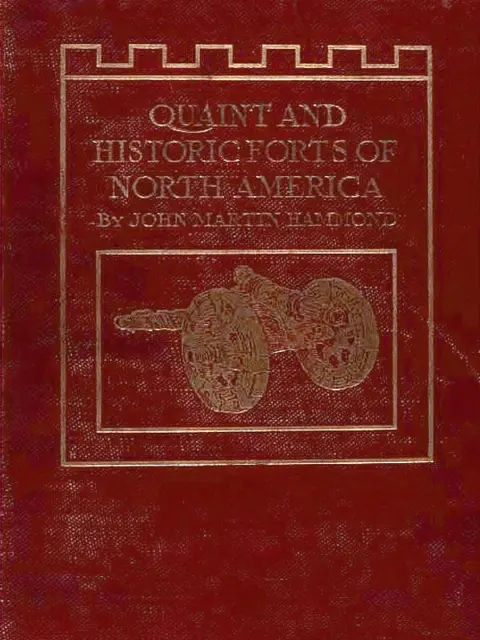
"Quaint and Historic Forts of North America" by John Martin Hammond is a historical account written in the early 20th century. This work explores the military history and significance of notable fortifications throughout North America, covering various periods of conflict and cultural interaction from the colonial era onward. The book emphasizes the unique architectures and historical events associated with these forts, enriching the reader's understanding of their roles in shaping the continent's history. The opening of this volume introduces the concept that the fortifications of North America serve as a cross-section of the continent's military past, detailing the myriad cultures that have engaged in conflict over the land. Hammond highlights the historical significance of locations like Cape Breton Island, referencing the formidable fortress of Louisburg and its role during the War of the Austrian Succession. The narrative hints at the complexities involved in the relationships between indigenous peoples, European settlers, and military endeavors, setting the tone for a detailed examination of individual forts and their stories in subsequent chapters.
Introduction adapted from the source catalogue; source summaries may be automatically generated.
Free to read · English · 75,531 words · No account needed
MAKE TIME FOR A GOOD BOOK
On by default. Untick to stop anonymous reading totals. Each page counts after 10 seconds in view. How this works.
Anonymous counting is on unless you have switched it off.
In carrying forward my work I have freely consulted historical authorities, among which I would like especially to acknowledge indebtedness to the writings of Francis Parkman, who in his many volumes has made the days of Old France in the New World a living reality; to John Fiske, “New France and New England;” to Reuben G. Thwaites, “France in America;” to various publications of the Michigan Pioneer and Historical Society; to Agnes C. Laut, “Canada;” to William Henry Withrow, “Canada;” to Randall Parrish, “Historic Illinois;” to the Hon. Peter A. Porter, “Brief History of Old Fort Niagara;” to Benson John Lossing, “Pictorial Field Book of the Revolution;” to E. G. Bourne, “Spain in America;” to Charles B. Reynolds, “Old St. Augustine;” to Loyall Farragut, “David Glasgow Farragut;” and to various books of travel and reminiscence, among which I would like to mention: S. A. Drake, “Nooks and Corners of the New England Coast” and “The Pine Tree Coast;” George Champlin Mason, “Reminiscences of Newport;” Irene A. Wright, “Cuba;” A. Hyatt Verrill, “Cuba;” Helen Throop Purdy, “San Francisco;” Ernest Peixotto, “Romantic California;” Adelaide Wilson, “Savannah, Picturesque and Beautiful;” Mrs. St. Julien Ravenel, “Charleston, the Place and the People;” and I have received valuable help in material and suggestions from various State historical societies, which have been uniformly courteous and desirous to be of service.
I wish to express gratitude to various friends and individuals who have helped me with suggestions or photographs, among whom I may mention Messrs. Henry P. Baily, Lloyd Norris, William H. Castle, Edward P. Crummer, Maurice T. Fleisher, James Prescott Martin, Edward H. Smith, and Harold Donaldson Eberlein.
September, 1915. J. M. H.
Garden View of One of Monroe’s Ante-bellum Residences 234
Fire!!! 236 Showing Shells Just Leaving Mortars, Fort Monroe, Va. This Remarkable Photograph Was Taken with Modern High Speed Apparatus by the Corps of Enlisted Specialists Stationed at This Post. (By courtesy of the War Department)
Casemates of Fort Monroe, as They Were During the Civil War 239
Fort Sumter, a Pile of Stone on a Sandy Shoal 242
The Deserted Casemates of Fort Pulaski, near Savannah, Ga. 253
Scenes of Desolation at Fort Pulaski, near Savannah, Ga.: Parade and Ramparts 256 The Battered Eastern Salient 256
Old Stone Tower at Fort Snelling, near St. Paul, Minn. 268
Ruins of the Alamo in 1845 280 From a Sketch Upon Map of the Country in the Vicinity of San Antonio de Bexar Made by J. Edmund Blake, 1st Lieutenant Topographical Engineers, U. S. A. (By courtesy of the War Department)
Fort Keogh, near Miles City, Montana 289
Fort Yuma, California 296 (By courtesy of the War Department)
Scenes at Valley Forge, Pa.: National Memorial Arch 300 Washington’s Headquarters 300
Your reading position is saved on this browser. Take it to another device with a library code. Reading pages adapt to text, rather than matching a printed edition.
BEHIND THE BOOK
This eBook is for the use of anyone anywhere in the United States and most other parts of the world at no cost and with almost no restrictions whatsoever. You may copy it, give it away or re-use it under the terms of the Project Gutenberg License included with this eBook or online at www.gutenberg.org. If you are not located in the United States, you will have to check the laws of the country where you are located before using this eBook. Read the source licence.
The original source file, including credits and licence, is retained by this library. Request an original-format copy at no charge. Please include the book title and Project Gutenberg identifier #54746.
KEEP YOUR CURIOSITY GOING
Cécile Tormay

Moritz Busch
John L. Ransom
Frances Wright
Cécile Tormay

Mabel Potter Daggett