READ · DISCOVER · ENJOYClassic literature · Always free
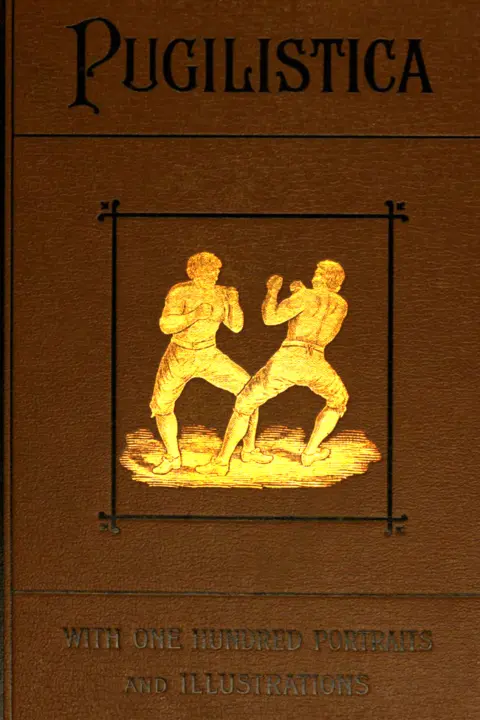
Pugilistica: The History of British Boxing, Volume 3 (of 3) Containing Lives of the Most Celebrated Pugilists; Full Reports of Their Battles from Contemporary Newspapers, With Authentic Portraits, Personal Anecdotes, and Sketches of the Principal Patrons of the Prize Ring, Forming a Complete History of the Ring from Fig and Broughton, 1719-40, to the Last Championship Battle Between King and Heenan, in December 1863 — digital edition cover

THE CLASSIC COLLECTION · 1880

Pugilistica: The History of British Boxing, Volume 3 (of 3) Containing Lives of the Most Celebrated Pugilists; Full Reports of Their Battles from Contemporary Newspapers, With Authentic Portraits, Personal Anecdotes, and Sketches of the Principal Patrons of the Prize Ring, Forming a Complete History of the Ring from Fig and Broughton, 1719-40, to the Last Championship Battle Between King and Heenan, in December 1863

"Pugilistica: The History of British Boxing, Volume 3" by Henry Downes Miles is a historical account written in the early 20th century. This volume provides a detailed examination of British boxing, focusing on significant pugilists and their battles, extending from the era of Bendigo in 1835 to the championship fight in December 1863. It explores the lives, fights, and legacies of notable boxers, capturing the evolution of the sport and its cultural significance during the time. At the start of this volume, the author introduces William Thompson, known as Bendigo, detailing his rise to prominence as a champion pugilist. The text recounts Bendigo's early victories against notable opponents, his fighting style characterized by agility and clever tactics, and the growing excitement surrounding his matches. The narrative sets the stage for exploring both the historical context of boxing in Britain and the captivating anecdotes that shaped the lives of its celebrated fighters, establishing a rich tapestry of boxing's storied past.

Introduction adapted from the source catalogue; source summaries may be automatically generated.

Start reading ↓

Free to read · English · 328,146 words · No account needed

MAKE TIME FOR A GOOD BOOK

Pugilistica: The History of British Boxing, Volume 3 (of 3) Containing Lives of the Most Celebrated Pugilists; Full Reports of Their Battles from Contemporary Newspapers, With Authentic Portraits, Personal Anecdotes, and Sketches of the Principal Patrons of the Prize Ring, Forming a Complete History of the Ring from Fig and Broughton, 1719-40, to the Last Championship Battle Between King and Heenan, in December 1863

On by default. Untick to stop anonymous reading totals. Each page counts after 10 seconds in view. How this works.

Anonymous counting is on unless you have switched it off.

Pugilistica: The History of British Boxing, Volume 3 (of 3) Containing Lives of the Most Celebrated Pugilists; Full Reports of Their Battles from Contemporary Newspapers, With Authentic Portraits, Personal Anecdotes, and Sketches of the Principal Patrons of the Prize Ring, Forming a Complete History of the Ring from Fig and Broughton, 1719-40, to the Last Championship Battle Between King and Heenan, in December 1863

As a record of times and manners, and modes of travel, we shall give a sketch of how and in what company the representative of Bell’s Life in London, then, quâ the Ring, the only sporting “oracle,” was wont to make his way to distant battlefields, ere the steam steed had rendered the mail coach, the “Highflyer,” the “Red Rover,” the “Age,” et hoc genus omne, obsolete as public conveyances:――

As “Sheffield, or within 100 miles thereof,” was the mysterious “fixture” for the big tourney, on Saturday evening, at half-past seven, we threw ourselves into the Glasgow mail, on our route to Doncaster, between which town and Selby we had the “office” the affair was to be decided. Adventures in stage-coaches have often afforded topics for amusing detail; but we confess, from the laborious duties which fall to our lot to perform, private as well as public, every week of our lives, the last day, or rather the last night, of the week is not the one we should select as that most propitious to collect materials (if such materials were wanting) for filling a column in our ensuing publication. In taking our place in the mail, therefore, we looked forward rather to the enjoyment of an occasional snooze than to the hope that we should discover any subject on which to dilate at a future period, whether as to the character of our fellow-travellers, the general appointments of the “drag,” or the peculiarities of the coachmen or guards――of the former we had four, and of the latter two, in the course of the journey――and these we will at once dismiss, by stating, at the outset, that they did their duty admirably――taking care, as “in duty bound,” to seek the usual mark of approbation by farewell hints in the common-place terms of “I leave you here, gentlemen”――in other words, “tip” and “go”――a laconic mode of address which by all travellers is well understood, however coolly appreciated when spoken at an open door on a cold frosty night, as that night of Saturday was, and at a moment when you may perhaps have been dreaming of the “joys you left behind you.” Quietness and repose being our first study, we soon placed our hat in the suspending-straps at the top of the mail, and our travelling-cap over head, and then, quietly reclining in the corner with our back to the horses, waited for the “start” from the yard of the “Bull and Mouth.” We found one old gentleman had taken his seat before us, who subsequently followed our example in taking the same side of the coach with ourselves, and was not less careful in guarding himself against the chilling influence of a hard frost. A third gentleman soon after joined us, and thus, “trio juncta in uno,” we were whirled round to the Post Office, St. Martin’s-le-Grand, whence we shortly commenced our journey at a slapping pace. On reaching Islington, a fourth passenger, of colossal size, filled up the vacant seat. Few words, if any, were spoken; and the only interruption to the monotony of the night’s travel was the frequent popping out and in of the last-mentioned gentleman to comfort his “inward man” with “drops of brandy,” with which he so perfumed our “leathern convenience” on his return that if we were as sensitive as some Frenchman of whom we have heard (who dined upon the effluvia of the good things he could not otherwise enjoy) we should certainly have been “pretty jolly” before he took his leave of us at peep of day. His departure gave occasion for the first indication that our companions were gifted with the power of speech. Their words were few, and these only had reference to the “spirited” propensities of the gentleman who had just vacated his seat. On this there could be no difference of opinion, and consequently no argument――so that we soon relapsed into the appearance at least of sleep, which we maintained with great perseverance till a brilliant sun shining through the ice-covered windows called forth a remark on the fineness of the morning. This, to our surprise, for we thought ourselves incog., was followed by a remark of recognition from the third gentleman who had entered the coach at the “Bull and Mouth,” and who, alluding to quick travelling, recalled to our mind some feats of this sort in which we had been engaged in the course of a twenty years’ connection with the Press. The ice once broken, conversation commenced, with apparent satisfaction to us all, the venerable gentleman on my right joining, and contributing as well as exacting his proportion of information on all manner of topics――public men and public measures, and the public Press, forming prominent subjects of remark, upon all of which our friend on the right seemed agreeably conversant. We soon discovered that our opposite neighbour was going to Leeds, to and from which town he was a frequent traveller; but respecting the other we could form no opinion. Regarding ourselves our secret had been divulged, and we stood forward the confessed “representative of Bell’s Life in London.” Sporting of various descriptions opened new sources of gossip, and here we found “the unknown” as much at home as ourselves. It came out, in fact, that he had been a breeder of racehorses, and a patron of the Turf for pleasure, but not for profit――that he had been steward at Newmarket, and that, in fact, he knew all the leading Turfites of the age, and was familiar with all the recent important events on the Turf. All this led us to surmise that he was “somebody,” but who, we confess, we did not attempt to speculate. We found him a most pleasant associate, and with that we were content. Upon the subject of our own trip to Doncaster we were silent, for we considered that was “nothing to nobody.” The Ring as connected with our British sports was but slightly alluded to――and against the objections that were made arising out of the late fatal issue of the combat between Swift and Brighton Bill, we argued it was a casualty purely the result of an accident, which might have occurred on any other athletic competition in which no personal animosity existed, and wound up by saying that there was one unanswerable argument even to the opponents of prizefighting, that as by them the principals were invariably considered worthless and deserving of punishment, in becoming the instrument of punishing each other, they were only fulfilling the ends of justice, without the necessity of legal interference. We referred, of course, to the recent painful exhibition of the frequent use of the knife, and the strong remarks which the increasing extent of this treacherous mode of revenge had called from the judges; but upon these points our unknown friend, as we take the liberty of calling him, did not seem disposed to break a lance, and the subject dropped. At last we reached Grantham, where our fellow-travellers forewarned us we should have an excellent breakfast, and certainly one served in better taste or in greater profusion we never enjoyed. Here we met in the same room the Quaker member for Durham (Mr. Pease), on his way to the north, between whom and “the unknown” there was a friendly recognition, but we still made no effort to lift the veil by which he was enshrouded. On again taking our seats in the mail, we were alone with the old gentleman, our Leeds friend having mounted the roof, so that we had it all to ourselves. The chat was as pleasant to us as before――new topics were broached, and the description of the localities through which we passed――the “Dukery” (a sort of concentration of ducal seats), &c.――afforded us both amusement and information. Now, for the first time, when conversation flagged, on watching the physiognomy of “the unknown,” we imagined there was a meaning smile on his countenance, which seemed to say, “This fellow does not know to whom he is talking,” and we confess we began to try back and see whether we had said anything to which exception could be taken; and more especially whether anything had dropped from us whence the intent of our journey could be collected; for we began to suspect we had been talking to a beak, who was going down expressly to spoil sport, and who was chuckling within himself at the disappointment we were sure to incur. But all was safe――we had kept our secret, and from anything that had dropped from us everything was as “right as the day;” indeed we dismissed the thought of treachery from our mind, and we are now glad we did so, for it would have been most unjustly adopted; for, although a beak of the first magnitude was in truth before us, we are persuaded he had no sinister feeling towards us or the sport we anticipated. But we have spun our yarn longer than we had intended, and will come to the dénouement at once. We now rattled into the clean and quiet town of Doncaster with the customary flourish of the horn, and reached the “Angel” safe and sound. As we had collected that our companion was going no further, we were satisfied our doubts as to his real character would soon be removed; they were, sooner than we expected; for scarcely had he stepped forth when “MY LORD!” was congratulated on his safe arrival. My lord! thought we, and following his example, our first effort on stretching our cramped limbs was by a respectful touch of our tile to acknowledge the honour we had enjoyed――an honour, by-the-bye, which confirmed us in the good old maxim, “Where ignorance is bliss ’tis folly to be wise.” An answer to a simple question soon put us in possession of the “great secret.” It was to a noble Baron who was about to preside at the Pontefract sessions we were indebted for a pleasing relief to a tedious journey; and while we acknowledge his lordship’s kindness and urbanity, permit us to add that there was not a sentiment uttered by him in our presence to which we do not heartily respond. We are sure it will be gratifying to our milling readers to hear that although the fight which has given occasion for this episode was announced to take place in the district of Pontefract, formerly represented by a milling member,[12] neither our noble companion nor any of his sessional coadjutors offered any interference.
Your reading position is saved on this browser. Take it to another device with a library code. Reading pages adapt to text, rather than matching a printed edition.

More from this author

BEHIND THE WORDS

About Henry Downes Miles

Henry Downes Miles (1806–1889). Explore Pugilistica: The History of British Boxing, Volume 3 (of 3) Containing Lives of the Most Celebrated Pugilists; Full Reports of Their Battles from Contemporary Newspapers, With Authentic Portraits, Personal Anecdotes, and Sketches of the Principal Patrons of the Prize Ring, Forming a Complete History of the Ring from Fig and Broughton, 1719-40, to the Last Championship Battle Between King and Heenan, in December 1863, Pugilistica: The History of British Boxing, Volume 2 (of 3) Containing Lives of the Most Celebrated Pugilists; Full Reports of Their Battles from Contemporary Newspapers, With Authentic Portraits, Personal Anecdotes, and Sketches of the Principal Patrons of the Prize Ring, Forming a Complete History of the Ring from Fig and Broughton, 1719-1740, to the Last Championship Battle Between King and Heenan, in December 1863, Pugilistica: The History of British Boxing, Volume 1 (of 3) Containing Lives of the Most Celebrated Pugilists; Full Reports of Their Battles from Contemporary Newspapers, With Authentic Portraits, Personal Anecdotes, and Sketches of the Principal Patrons of the Prize Ring, Forming a Complete History of the Ring from Fig and Broughton, 1719-40, to the Last Championship Battle Between King and Heenan, in December 1863 in this collection. These books span history.

Explore this author’s books →

THE READERS’ VERDICT

How did this story stay with you?

Not rated yet
Your rating for Pugilistica: The History of British Boxing, Volume 3 (of 3) Containing Lives of the Most Celebrated Pugilists; Full Reports of Their Battles from Contemporary Newspapers, With Authentic Portraits, Personal Anecdotes, and Sketches of the Principal Patrons of the Prize Ring, Forming a Complete History of the Ring from Fig and Broughton, 1719-40, to the Last Championship Battle Between King and Heenan, in December 1863

Be the first to share your verdict.

One rating per browser, which you can change or remove. A necessary browser identifier remembers your vote. How ratings work

A GOOD STORY DESERVES COMPANY

Pass this book along.

A great read is even better when it’s shared.

SEND A LITTLE INSPIRATION

Share this book

BEHIND THE BOOK

Edition & source details.

Title
Pugilistica: The History of British Boxing, Volume 3 (of 3) Containing Lives of the Most Celebrated Pugilists; Full Reports of Their Battles from Contemporary Newspapers, With Authentic Portraits, Personal Anecdotes, and Sketches of the Principal Patrons of the Prize Ring, Forming a Complete History of the Ring from Fig and Broughton, 1719-40, to the Last Championship Battle Between King and Heenan, in December 1863
Author
Henry Downes Miles
First publication (Open Library catalogue match)
1880
Digital edition publisher
Project Gutenberg
Gutenberg release date
2020-12-22
Language
English
Source edition imprint
Not stated in source catalogue
Source identifier
Project Gutenberg #64111
Contributors
No additional named contributors in source metadata

Public-domain source & licence

This eBook is for the use of anyone anywhere in the United States and most other parts of the world at no cost and with almost no restrictions whatsoever. You may copy it, give it away or re-use it under the terms of the Project Gutenberg License included with this eBook or online at www.gutenberg.org. If you are not located in the United States, you will have to check the laws of the country where you are located before using this eBook. Read the source licence.

Full source licence and obtaining an original copy

The original source file, including credits and licence, is retained by this library. Request an original-format copy at no charge. Please include the book title and Project Gutenberg identifier #64111.

the full Project Gutenberg License must appear
prominently whenever any copy of a Project Gutenberg work (any work
on which the phrase “Project Gutenberg” appears, or with which the
phrase “Project Gutenberg” is associated) is accessed, displayed,
performed, viewed, copied or distributed:

This eBook is for the use of anyone anywhere in the United States and most
other parts of the world at no cost and with almost no restrictions
whatsoever. You may copy it, give it away or re-use it under the terms
of the Project Gutenberg™ License included with this eBook or online
at www.gutenberg.org. If you
are not located in the United States, you will have to check the laws
of the country where you are located before using this eBook.

1.E.2. If an individual Project Gutenberg electronic work is
derived from texts not protected by U.S. copyright law (does not
contain a notice indicating that it is posted with permission of the
copyright holder), the work can be copied and distributed to anyone in
the United States without paying any fees or charges. If you are
redistributing or providing access to a work with the phrase “Project
Gutenberg” associated with or appearing on the work, you must comply
either with the requirements of paragraphs 1.E.1 through 1.E.7 or
obtain permission for the use of the work and the Project Gutenberg
trademark as set forth in paragraphs 1.E.8 or 1.E.9.

1.E.3. If an individual Project Gutenberg electronic work is posted
with the permission of the copyright holder, your use and distribution
must comply with both paragraphs 1.E.1 through 1.E.7 and any
additional terms imposed by the copyright holder. Additional terms
will be linked to the Project Gutenberg License for all works
posted with the permission of the copyright holder found at the
beginning of this work.

1.E.4. Do not unlink or detach or remove the full Project Gutenberg
License terms from this work, or any files containing a part of this
work or any other work associated with Project Gutenberg.

1.E.5. Do not copy, display, perform, distribute or redistribute this
electronic work, or any part of this electronic work, without
prominently displaying the sentence set forth in paragraph 1.E.1 with
active links or immediate access to the full terms of the Project
Gutenberg License.

1.E.6. You may convert to and distribute this work in any binary,
compressed, marked up, nonproprietary or proprietary form, including
any word processing or hypertext form. However, if you provide access
to or distribute copies of a Project Gutenberg work in a format
other than “Plain Vanilla ASCII” or other format used in the official
version posted on the official Project Gutenberg website
(www.gutenberg.org), you must, at no additional cost, fee or expense
to the user, provide a copy, a means of exporting a copy, or a means
of obtaining a copy upon request, of the work in its original “Plain
Vanilla ASCII” or other form. Any alternate format must include the
full Project Gutenberg License as specified in paragraph 1.E.1.

1.E.7. Do not charge a fee for access to, viewing, displaying,
performing, copying or distributing any Project Gutenberg works
unless you comply with paragraph 1.E.8 or 1.E.9.

1.E.8. You may charge a reasonable fee for copies of or providing
access to or distributing Project Gutenberg electronic works
provided that:

• You pay a royalty fee of 20% of the gross profits you derive from
the use of Project Gutenberg works calculated using the method
you already use to calculate your applicable taxes. The fee is owed
to the owner of the Project Gutenberg trademark, but he has
agreed to donate royalties under this paragraph to the Project
Gutenberg Literary Archive Foundation. Royalty payments must be paid
within 60 days following each date on which you prepare (or are
legally required to prepare) your periodic tax returns. Royalty
payments should be clearly marked as such and sent to the Project
Gutenberg Literary Archive Foundation at the address specified in
Section 4, “Information about donations to the Project Gutenberg
Literary Archive Foundation.”

• You provide a full refund of any money paid by a user who notifies
you in writing (or by e-mail) within 30 days of receipt that s/he
does not agree to the terms of the full Project Gutenberg™
License. You must require such a user to return or destroy all
copies of the works possessed in a physical medium and discontinue
all use of and all access to other copies of Project Gutenberg™
works.

• You provide, in accordance with paragraph 1.F.3, a full refund of
any money paid for a work or a replacement copy, if a defect in the
electronic work is discovered and reported to you within 90 days of
receipt of the work.

• You comply with all other terms of this agreement for free
distribution of Project Gutenberg™ works.


1.E.9. If you wish to charge a fee or distribute a Project
Gutenberg™ electronic work or group of works on different terms than
are set forth in this agreement, you must obtain permission in writing
from the Project Gutenberg Literary Archive Foundation, the manager of
the Project Gutenberg™ trademark. Contact the Foundation as set
forth in Section 3 below.

1.F.

1.F.1. Project Gutenberg volunteers and employees expend considerable
effort to identify, do copyright research on, transcribe and proofread
works not protected by U.S. copyright law in creating the Project
Gutenberg™ collection. Despite these efforts, Project Gutenberg™
electronic works, and the medium on which they may be stored, may
contain “Defects,” such as, but not limited to, incomplete, inaccurate
or corrupt data, transcription errors, a copyright or other
intellectual property infringement, a defective or damaged disk or
other medium, a computer virus, or computer codes that damage or
cannot be read by your equipment.

1.F.2. LIMITED WARRANTY, DISCLAIMER OF DAMAGES - Except for the “Right
of Replacement or Refund” described in paragraph 1.F.3, the Project
Gutenberg Literary Archive Foundation, the owner of the Project
Gutenberg™ trademark, and any other party distributing a Project
Gutenberg™ electronic work under this agreement, disclaim all
liability to you for damages, costs and expenses, including legal
fees. YOU AGREE THAT YOU HAVE NO REMEDIES FOR NEGLIGENCE, STRICT
LIABILITY, BREACH OF WARRANTY OR BREACH OF CONTRACT EXCEPT THOSE
PROVIDED IN PARAGRAPH 1.F.3. YOU AGREE THAT THE FOUNDATION, THE
TRADEMARK OWNER, AND ANY DISTRIBUTOR UNDER THIS AGREEMENT WILL NOT BE
LIABLE TO YOU FOR ACTUAL, DIRECT, INDIRECT, CONSEQUENTIAL, PUNITIVE OR
INCIDENTAL DAMAGES EVEN IF YOU GIVE NOTICE OF THE POSSIBILITY OF SUCH
DAMAGE.

1.F.3. LIMITED RIGHT OF REPLACEMENT OR REFUND - If you discover a
defect in this electronic work within 90 days of receiving it, you can
receive a refund of the money (if any) you paid for it by sending a
written explanation to the person you received the work from. If you
received the work on a physical medium, you must return the medium
with your written explanation. The person or entity that provided you
with the defective work may elect to provide a replacement copy in
lieu of a refund. If you received the work electronically, the person
or entity providing it to you may choose to give you a second
opportunity to receive the work electronically in lieu of a refund. If
the second copy is also defective, you may demand a refund in writing
without further opportunities to fix the problem.

1.F.4. Except for the limited right of replacement or refund set forth
in paragraph 1.F.3, this work is provided to you ‘AS-IS’, WITH NO
OTHER WARRANTIES OF ANY KIND, EXPRESS OR IMPLIED, INCLUDING BUT NOT
LIMITED TO WARRANTIES OF MERCHANTABILITY OR FITNESS FOR ANY PURPOSE.

1.F.5. Some states do not allow disclaimers of certain implied
warranties or the exclusion or limitation of certain types of
damages. If any disclaimer or limitation set forth in this agreement
violates the law of the state applicable to this agreement, the
agreement shall be interpreted to make the maximum disclaimer or
limitation permitted by the applicable state law. The invalidity or
unenforceability of any provision of this agreement shall not void the
remaining provisions.

1.F.6. INDEMNITY - You agree to indemnify and hold the Foundation, the
trademark owner, any agent or employee of the Foundation, anyone
providing copies of Project Gutenberg™ electronic works in
accordance with this agreement, and any volunteers associated with the
production, promotion and distribution of Project Gutenberg™
electronic works, harmless from all liability, costs and expenses,
including legal fees, that arise directly or indirectly from any of
the following which you do or cause to occur: (a) distribution of this
or any Project Gutenberg work, (b) alteration, modification, or
additions or deletions to any Project Gutenberg work, and (c) any
Defect you cause.

Section 2. Information about the Mission of Project Gutenberg

Project Gutenberg is synonymous with the free distribution of
electronic works in formats readable by the widest variety of
computers including obsolete, old, middle-aged and new computers. It
exists because of the efforts of hundreds of volunteers and donations
from people in all walks of life.

Volunteers and financial support to provide volunteers with the
assistance they need are critical to reaching Project Gutenberg’s
goals and ensuring that the Project Gutenberg collection will
remain freely available for generations to come. In 2001, the Project
Gutenberg Literary Archive Foundation was created to provide a secure
and permanent future for Project Gutenberg and future
generations. To learn more about the Project Gutenberg Literary
Archive Foundation and how your efforts and donations can help, see
Sections 3 and 4 and the Foundation information page at www.gutenberg.org.

Section 3. Information about the Project Gutenberg Literary Archive Foundation

The Project Gutenberg Literary Archive Foundation is a non-profit
501(c)(3) educational corporation organized under the laws of the
state of Mississippi and granted tax exempt status by the Internal
Revenue Service. The Foundation’s EIN or federal tax identification
number is 64-6221541. Contributions to the Project Gutenberg Literary
Archive Foundation are tax deductible to the full extent permitted by
U.S. federal laws and your state’s laws.

The Foundation’s business office is located at 41 Watchung Plaza #516,
Montclair NJ 07042, USA, +1 (862) 621-9288. Email contact links and up
to date contact information can be found at the Foundation’s website
and official page at www.gutenberg.org/contact

Section 4. Information about Donations to the Project Gutenberg
Literary Archive Foundation

Project Gutenberg™ depends upon and cannot survive without widespread
public support and donations to carry out its mission of
increasing the number of public domain and licensed works that can be
freely distributed in machine-readable form accessible by the widest
array of equipment including outdated equipment. Many small donations
($1 to $5,000) are particularly important to maintaining tax exempt
status with the IRS.

The Foundation is committed to complying with the laws regulating
charities and charitable donations in all 50 states of the United
States. Compliance requirements are not uniform and it takes a
considerable effort, much paperwork and many fees to meet and keep up
with these requirements. We do not solicit donations in locations
where we have not received written confirmation of compliance. To SEND
DONATIONS or determine the status of compliance for any particular state
visit www.gutenberg.org/donate.

While we cannot and do not solicit contributions from states where we
have not met the solicitation requirements, we know of no prohibition
against accepting unsolicited donations from donors in such states who
approach us with offers to donate.

International donations are gratefully accepted, but we cannot make
any statements concerning tax treatment of donations received from
outside the United States. U.S. laws alone swamp our small staff.

Please check the Project Gutenberg web pages for current donation
methods and addresses. Donations are accepted in a number of other
ways including checks, online payments and credit card donations. To
donate, please visit: www.gutenberg.org/donate.

Section 5. General Information About Project Gutenberg electronic works

Professor Michael S. Hart was the originator of the Project
Gutenberg concept of a library of electronic works that could be
freely shared with anyone. For forty years, he produced and
distributed Project Gutenberg eBooks with only a loose network of
volunteer support.

Project Gutenberg eBooks are often created from several printed
editions, all of which are confirmed as not protected by copyright in
the U.S. unless a copyright notice is included. Thus, we do not
necessarily keep eBooks in compliance with any particular paper
edition.

Most people start at our website which has the main PG search
facility: www.gutenberg.org.

This website includes information about Project Gutenberg,
including how to make donations to the Project Gutenberg Literary
Archive Foundation, how to help produce our new eBooks, and how to
subscribe to our email newsletter to hear about new eBooks.


KEEP YOUR CURIOSITY GOING

Your next chapter awaits.

Your privacy choices

Reading is always free. You can change these settings at any time.

Book banners link to our books on simonward.net. They do not use advertising cookies or tracking.

Privacy & cookie policy · Reading data and privacy controls

