
Letters of Marque
Rudyard Kipling
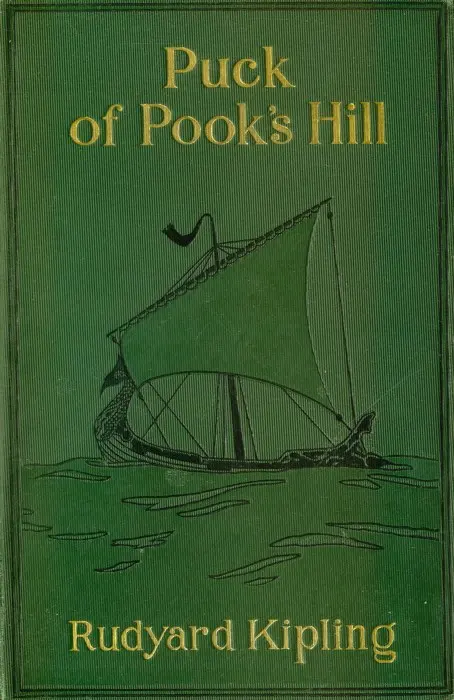
THE CLASSIC COLLECTION · 1905
"Puck of Pook's Hill" by Rudyard Kipling is a fantasy book published in 1906, containing short stories set across different periods of English history. When two children living in Sussex encounter the ancient elf Puck, he summons figures from England's past—Roman soldiers, Norman knights, Danish seafarers—to share their tales. Each story reveals fragments of history, from Hadrian's Wall to the Norman Conquest, blending authentic historical detail with magical elements. Together, these episodes trace England's formation through centuries of conquest, survival, and transformation.
Introduction adapted from the source catalogue; source summaries may be automatically generated.
Free to read · English · 59,945 words · No account needed
MAKE TIME FOR A GOOD BOOK
On by default. Untick to stop anonymous reading totals. Each page counts after 10 seconds in view. How this works.
Anonymous counting is on unless you have switched it off.
‘I am in good health,’ Parnesius answered. ‘See! I have tried to bend the bow of Ulysses, but——’ He held up his thumb.
‘I’m sorry. You must have pulled off too soon,’ said Dan. ‘Puck said you were telling Una a story.’
‘Continue, O Parnesius,’ said Puck, who had perched himself on a dead branch above them. ‘I will be chorus. Has he puzzled you much, Una?’
‘Not a bit, except—I didn’t know where Ak—Ak something was,’ she answered.
‘Oh, Aquae Solis. That’s Bath, where the buns come from. Let the hero tell
his own tale.’
Parnesius pretended to thrust his spear at Puck’s legs, but Puck reached down, caught at the horse-tail plume, and pulled off the tall helmet.
‘Thanks, jester,’ said Parnesius, shaking his curly dark head. ‘That is cooler. Now hang it up for me....
‘I was telling your sister how I joined the Army,’ he said to Dan.
‘Did you have to pass an Exam?’ Dan asked, eagerly.
‘No. I went to my Father, and said I should like to enter the Dacian Horse (I had seen some at Aquae Solis); but he said I had better begin service in a regular Legion from Rome. Now, like many of our youngsters, I was not too fond of anything Roman. The Roman-born officers and magistrates looked down on us British-born as though we were barbarians. I told my Father so.
‘“I know they do,” he said; “but remember, after all, we are the people of the Old Stock, and our duty is to the Empire.”
‘“To which Empire?’” I asked. “We split the Eagle before I was born.”
‘“What thieves’ talk is that?” said my Father. He hated slang.
‘“Well, Sir,” I said, “we’ve one Emperor in Rome, and I don’t know how many Emperors the outlying Provinces have set up from time to time. Which am I to follow?”
‘“Gratian,” said he. “At least he’s a sportsman.”
‘“He’s all that,” I said. “Hasn’t he turned himself into a raw-beef-eating Scythian?”
‘“Where did you hear of it?” said the Pater.
‘“At Aquae Solis,” I said. It was perfectly true. This precious Emperor Gratian of ours had a bodyguard of fur-cloaked Scythians, and he was so crazy about them that he dressed like them. In Rome of all places in the world! It was as bad as if my own Father had painted himself blue!
Your reading position is saved on this browser. Take it to another device with a library code. Reading pages adapt to text, rather than matching a printed edition.
Rudyard Kipling

Rudyard Kipling
Rudyard Kipling

Rudyard Kipling
BEHIND THE BOOK
This eBook is for the use of anyone anywhere in the United States and most other parts of the world at no cost and with almost no restrictions whatsoever. You may copy it, give it away or re-use it under the terms of the Project Gutenberg License included with this eBook or online at www.gutenberg.org. If you are not located in the United States, you will have to check the laws of the country where you are located before using this eBook. Read the source licence.
The original source file, including credits and licence, is retained by this library. Request an original-format copy at no charge. Please include the book title and Project Gutenberg identifier #26027.
KEEP YOUR CURIOSITY GOING
Cécile Tormay

Moritz Busch
Coulson Kernahan
John L. Ransom

Maurice Baring
Frances Wright