
Last letters from the living dead man
David Patterson (Spirit) Hatch
THE CLASSIC COLLECTION · 1853
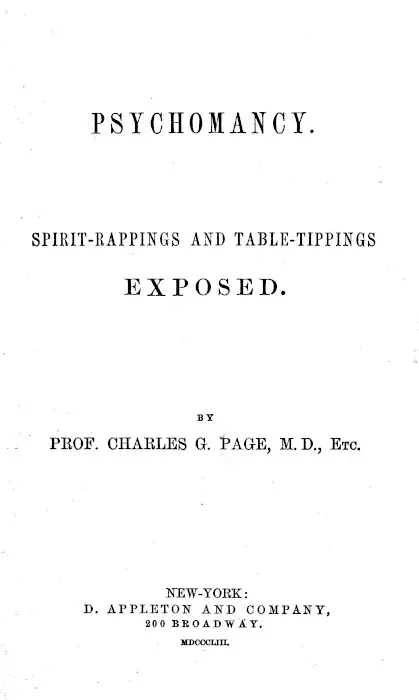
"Psychomancy: Spirit-Rappings and Table-Tippings Exposed" by Charles Grafton Page is a critical treatise written in the mid-19th century. The work delves into the phenomena of spirit communications and table movements, dismissed by the author as illusions rooted in human deception rather than genuine supernatural occurrences. Page argues against the credulity of society in regard to these practices, asserting they are little more than frauds perpetuated by charlatans for profit. The opening of the text sets a provocative tone, as Page challenges the widespread belief in spirit-rappings and table-tippings. He provides vivid descriptions of his own investigations into these practices, denouncing them as mere tricks executed by fraudsters, particularly the Fox sisters, who were among the first to popularize spiritualism in America. Through a series of experiments and observations, he strives to uncover the mechanics behind these phenomena, consistently attributing their origins to human agency rather than otherworldly forces. Page's writing is impassioned, urging readers to critically evaluate such miraculous claims through the lens of logic and science.
Introduction adapted from the source catalogue; source summaries may be automatically generated.
Free to read · English · 18,631 words · No account needed
MAKE TIME FOR A GOOD BOOK
On by default. Untick to stop anonymous reading totals. Each page counts after 10 seconds in view. How this works.
Anonymous counting is on unless you have switched it off.
"Such were the obstacles arising from the vanity of philosophers and the imperfection of their science, which suspended the strength of their appeal to reason and common sense, against the condemning of wretches to a cruel death, on account of crimes, which the nature of things rendered in modern times impossible."
Thus learned men seeking to unravel mysteries, for want of sagacity and full knowledge, may become the apologists of sorcery and witchcraft. Bacon was obliged to be a philosopher for the whole enlightened world; but, in our day, so vast has each branch of science become, that any one of them would be full enough for a Bacon's grasp, and philosophers hardly dare to venture outside of their own boundaries, lest they become, or be considered philosophists. We hear men of science abused because they take such obstinate, inexorable positions against these "fooleries." This they are bound to do. Familiar with the laws of nature, all real phenomena are alike marvellous to their minds, and those which claim to be miraculous, supernatural, and, par excellence, the MARVELLOUS, they repudiate summarily as absurdities, knowing that if they cannot disabuse the popular mind, they can prove their irrationality to their own entire satisfaction, at least. Formerly fortune-tellers were sometimes styled Philomaths, but we think that as fortune-telling has degenerated into such disrepute, the name is unworthily applied, and we propose to transfer it to that class of learned writers of the present day, who seek to trace these tricks of raps and tips to the direct agency of the devil, or evil or good spirits;--supposing these spirits to make the sounds or movements, and to give the communications;--and to that class specially who attribute these phenomena to electricity, magnetism, or to the action of some power or fluid hitherto unknown; in short, to all, who look upon these things as any thing else than impostures and illusions. These are the philomaths of the present day, and while they thus stand in the way of advancement in true knowledge, they are, in effect, fostering error, superstition, and sorcery. We boast in our day of the enlightenment of the masses, the spread of education and the diffusion of knowledge; but for all this, necromancy is not dead nor stifled; and is now like a baleful poison running rife through our land, upon the most preposterous foundations and pretexts. Spirits, rapping upon doors, floors, and tables, upsetting tables and swinging them about the room? Spirits, do you say? Has a "spirit flesh and blood?" Has a spirit bones, muscles, fingers, heels, toes, and sticks? DO SPIRITS WEAR PETTICOATS and long dresses? A "new fluid," says another philomath. A new fluid, forsooth? None other than that old fluid of credulity or gullibity, if we may be allowed the latter term. An "old fluid," says another. "Electricity or magnetism in some shape." This is insufferable. Since the first discoveries in electricity and magnetism, these agents have had to take the paternity of every rare and inexplicable phenomenon. This is much more the case now than when Sir Walter Scott wrote his letters on witchcraft, though he says that the divining-rod, and other remarkable and misconceived phenomena, were assigned to the agency of electricity and magnetism. At the present times these subtle agents are the common scape-goats for mesmeric, electro-biological, psychological, and every other kind of phenomenon, the cause of which eludes the senses, and the new-fangled farce of "rappings and tippings" must fain take advantage of the same subterfuge in order to make its way to popular credence. Unfortunately, in this case an accurate knowledge of the laws of electricity is possessed by comparatively few persons; and the electric fluid, or power of magnetism, becomes a very clever instrument in the hands of charlatans and empirics, through which to enforce upon the popular mind the reality of their tricks and impostures. To one who has an adequate knowledge of the laws of electricity and magnetism, it is more than amusing to see with what pedantic gravity these latter philomaths descant upon electricity and magnetism, contorting and butchering their established laws all the while, to explain some vile juggle, or unravel the psychomancy of rappers and tippers; and also to see with what avidity their inflated arguments are gulped by gaping crowds, who apparently are unwilling or unable to swallow a single naked truth. It is often said that "men love to be deceived." This is true to some extent, and it is sometimes the case that a quack will draw crowds around him where a truly learned man could not get a foothold. The truth however is mighty, and will prevail, and the power of learning always has been, and will be felt, though it may be somewhat slow to assert and maintain its supremacy. In verity, there is not one property, condition, or law of electricity or magnetism, so far as they have been established by experiment and science, that would explain rappings and tippings without doing violence to philosophy. A few years ago, a medical friend and brother came to our house late at night, in considerable trepidation, and wished us to go and see a woman who was bewitched in an extraordinary manner. At intervals she would be seized with convulsions, and while the fit was on her she pulled pins out of the hands, arms, and legs of bystanders, and tossing the pins into her mouth, swallowed them. We remonstrated with him, but though highly intelligent, and excelling in his profession, our friend the Doctor would not give it up. He had seen it, believed it, but could not account for it, and came to us specially to ascertain if "ELECTRICITY had not something to do with it." Knowing that the witches of old had a special fancy for pins, and fully prepared to see nothing more than a dexterous feat of legerdemain, we consented to go, late as it was, and as soon as the pretty little elf, who was lying upon a pallet upon the floor, had become convulsed, and pulled a pin from our person, and swallowed it, we discovered the quomodò, and the next day, with a little practice, we were able to go into very fair convulsions, and could draw out pins and swallow them as skilfully as the witch herself. Our good friend, the doctor, had not even noticed that the convulsive movements were all confined to the voluntary actions upon the muscles, so engrossed was he with the idea of the supernatural character of this performance. It is remarkable to notice how the scrutinizing powers of the most astute, fail as soon as they entertain the remotest idea of the supernatural in these cases. This girl was visited by hundreds of respectable and intelligent persons in our community, and notwithstanding a publication which was made exposing the trick, but few were able to discover it for themselves, and the greater portion believed it to be a genuine performance, and alms were freely given in sympathy for her unfortunate condition. Our sympathies were enlisted for those whom she bewitched, and we must give the enchantress credit for more shrewdness than her customers, and we believe she reaped quite a rich harvest for her skill in legerdemain. We cite this case to show what violence is done to science to account for modern sorceries. Remember, we are called on to decide if electricity played any part in this extraordinary exhibition.
Your reading position is saved on this browser. Take it to another device with a library code. Reading pages adapt to text, rather than matching a printed edition.
BEHIND THE BOOK
This eBook is for the use of anyone anywhere in the United States and most other parts of the world at no cost and with almost no restrictions whatsoever. You may copy it, give it away or re-use it under the terms of the Project Gutenberg License included with this eBook or online at www.gutenberg.org. If you are not located in the United States, you will have to check the laws of the country where you are located before using this eBook. Read the source licence.
The original source file, including credits and licence, is retained by this library. Request an original-format copy at no charge. Please include the book title and Project Gutenberg identifier #61807.
KEEP YOUR CURIOSITY GOING
David Patterson (Spirit) Hatch

David Patterson (Spirit) Hatch

David Patterson (Spirit) Hatch
Cécile Tormay

Moritz Busch
Coulson Kernahan