READ · DISCOVER · ENJOYClassic literature · Always free
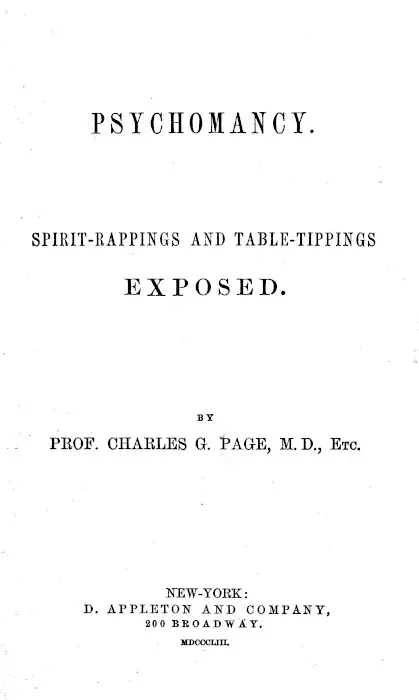
Psychomancy: Spirit-Rappings and Table-Tippings Exposed — digital edition cover

THE CLASSIC COLLECTION · 1853

Psychomancy: Spirit-Rappings and Table-Tippings Exposed

"Psychomancy: Spirit-Rappings and Table-Tippings Exposed" by Charles Grafton Page is a critical treatise written in the mid-19th century. The work delves into the phenomena of spirit communications and table movements, dismissed by the author as illusions rooted in human deception rather than genuine supernatural occurrences. Page argues against the credulity of society in regard to these practices, asserting they are little more than frauds perpetuated by charlatans for profit. The opening of the text sets a provocative tone, as Page challenges the widespread belief in spirit-rappings and table-tippings. He provides vivid descriptions of his own investigations into these practices, denouncing them as mere tricks executed by fraudsters, particularly the Fox sisters, who were among the first to popularize spiritualism in America. Through a series of experiments and observations, he strives to uncover the mechanics behind these phenomena, consistently attributing their origins to human agency rather than otherworldly forces. Page's writing is impassioned, urging readers to critically evaluate such miraculous claims through the lens of logic and science.

Introduction adapted from the source catalogue; source summaries may be automatically generated.

Start reading ↓

Free to read · English · 18,631 words · No account needed

MAKE TIME FOR A GOOD BOOK

Psychomancy: Spirit-Rappings and Table-Tippings Exposed

On by default. Untick to stop anonymous reading totals. Each page counts after 10 seconds in view. How this works.

Anonymous counting is on unless you have switched it off.

Psychomancy: Spirit-Rappings and Table-Tippings Exposed

Our readers are now ready to ask if we have discovered the machinery or instrumentality by which these girls make the sounds. In answer, we say that our investigation is conclusive that these sounds are entirely at the control of these girls, and that we have placed them in situations where they could not rap at all. And if, after all this, we have invented several modes by which the rappings can be made as successfully as by them, we think we have discovered enough. During each of our two visits, we noticed, by very cautious and careful inspection, one interesting and significant fact--that each rap was attended with a slight movement of the person of the rapper, and that a very distinct motion of the dress was visible about the right hypogastric region. While watching this point the girl noticed us, and immediately rose, went to the window, and dropped the curtain to darken the room, which was on the north side of the building, and full dark enough before. When she sat down she drew her shawl over this part of her person. This was on the first visit. On the second visit, we were soon discovered watching this movement again, and she rose and procured a shawl with which she covered her person as before. We do not pretend to decide that this movement had any direct connection with the instrument by which she rapped upon the floor; if so, it was very clumsy and awkward, for we have devised a mode of rapping that involves no such motion, and which we will shortly explain. It may have been that this movement was connected with the device for rapping upon the table. We are of opinion that when they rapped upon the table, it was upon the under side of the table-top and not about their feet. They did not, and evidently could not, rap upon the table without sitting closely up to the table. If this conjecture, as to the rap under the table-top, is right, the movement we saw is easily accounted for. Be it so, or be it not, we have invented a contrivance which raps upon the under side of the table-top, and which involves precisely the motion we discovered. It requires but little exercise of ingenuity to contrive means of producing these sounds. It has been stated that a relative of these girls has made a public statement under oath, that they produce the raps with their toes, in a peculiar manner acquired by long practice. The public papers tell us that electro-magnetism has been employed to carry out this fraud. The snapping of the joints has been resorted to by another; and indeed we can easily imagine a variety of ways in which these sounds are, or may be produced. The Fox girls rapped upon neither of these plans. The sound was machine-like, and too loud for a sound that could be made by striking the naked or unarmed toe upon the floor, and entirely too loud for, and differing in character from, the snapping of the joints, and as to electro-magnetism, it was entirely out of the question in this case. The Fox girls visit the houses of strangers and rap always with the same ease every where. The raps are never remote from their persons but always directly about their feet, unless it be when they are sitting at the table, as we have before said, when the rap appears to be on the under side of the table-top, although we would not undertake to decide fully upon this latter point, as they would not allow us to choose our position so as to judge of the true direction of the sound; for as soon as my coadjutor looked under the table, the spirits decamped and we had no rapping. There are certain circumstances, under which no ear, however skilful and practised, can judge correctly of the position or distance where certain sounds originate. Such a case is exemplified in the common speaking tubes used in public houses and elsewhere. When you place your ear near the tube, the voice appears to be uttered close to the ear, though the person speaking may be at a great distance. The Invisible Lady is another instance, for a full account of which, see Brewster's work on Natural Magic. But the most remarkable illustration of this case is exhibited in the following manner. If you take an iron rod ten, twenty, fifty, or one hundred feet in length and strike it at one end, the blow is heard by a person having his ear close at the other end precisely as if the blow was struck near his ear. This illusion is more remarkable if the listener cannot hear the original blow through the medium of the air. To make the whole experiment very imposing, suppose an iron rod, three-fourths of an inch in diameter, projecting three or four feet through the floor of a large hall, and that this projecting part is a continuation of a rod passing beneath the floor of the room, and concealed entirely from observation and terminating out of doors, or in a distant apartment. Whenever a blow is struck upon the remote and concealed end, the sound not being heard except through the medium of the rod, appears to every person present, precisely as if it issued from the projecting end within the hall. With proper pre-concertion and ceremonial preparation, such a contrivance as this would far exceed, in mysterious character, the shallow trickery of these feet-rappers. From this experiment, which we have tried with entire success with a rod only twenty feet in length, we see how closely we must look to all the attendant circumstances and possibilities of the case, before we can conclude strictly upon the position of the origin of sounds, where their origin is out of sight. We know that the rapping was always about their heels when these girls sat in chairs, stood upon the floor, or in chairs, or stood in the wardrobe, or rapped upon the door. For this part of the performance we had abundant opportunities for examination, and if these girls will stand upon the floor and allow us to examine their feet, at the time of the rapping, we defy them and their spirits to produce the rappings without a full exposure. It is worthy of note that witches have always been far more numerous than wizards. There are reasons for such disparity in numbers, but this rapping business is particularly the province of females. There are no male rappers unless it be of late, since they have resorted to confederacy, or electrical or mechanical tricks. There are no men-rappers who rap upon such an extensive scale as the Fox girls. The latter are not confined to a certain table, a certain room, or certain spots in a room, or a certain house. They carry their "Rattle-traps" about with them, and go from house to house, and their "familiar spirits" are very sociable, unceremonious, and accommodating. If they will but adopt the Bloomer costume, our word for it, the spirits would signify their disapprobation by departing at once. Relying upon their sex they trust the courtesy of their visitors as sufficient protection against the examination of even their feet, and therefore they make bold to wear unusually long dresses the better to conceal their movements and rapping apparatus. When the girl stood upon tumblers, she did not venture to rap till, by gradual stooping, she brought her dress down so as to cover her feet and touch the floor. There are then special reasons why this kind of witchery should be played off by females. The Fox style of rapping CANNOT be performed by men, or in the male attire. We do not attribute to woman more or greater proneness, or power to deceive than to man; but when woman undertakes to deceive, she is generally more successful. She is less suspected, has fewer motives, runs greater risk, and incurs greater loss in the event of disclosures, and with the blandishments of person and sex, she silences opposition, smothers inquiry, defies and escapes inspection, and lastly takes captive the head with the heart. Possessed of greater susceptibilities and easily impressed; she is more readily carried away by new and strange fascinations, and in times of certain remarkable developements of sympathetic witchcrafts, she is the first to be imposed upon and most apt to impose upon herself. This characteristic is well illustrated in the case of the jerks, a species of witch mania which prevailed in this country so extensively many years ago, in which women figured so largely. Sympathetic action is potential with both sexes, but especially with women does it overpower sense, reason and volition, giving rise to temporary insanity. We are however uncharitable enough to believe that, in many cases, upon these occasions the surrendry of the judgment and bewilderment of the imagination is not altogether involuntary, and that the whole operation of being bewitched might be arrested at a certain stage of its progress by an effort to resist, except perhaps in conditions of extreme hysteria and nervous prostration, or irritability. We have seen a young lady of the very highest respectability at a table-tipping, tugging away at the table to make it move, and all the while endeavoring to conceal her exertions, and declaring, when interrogated, that she did "not make the slightest effort." Can it be that she had become so infatuated as to forget that she was, or to persuade herself that she was not, deceiving, and yet all the while to be so assiduous and adroit in accomplishing her object? Charity says yes. Well! after all, there is something in the feat of deceiving and blinding reverend and grave Senators, Judges and Priests, well calculated to whet the pride, stimulate the cunning, and foster the love of power in a young Miss, especially when her arts are practised upon some doings not embraced in the criminal code nor amenable to law. There are probably--paradoxical as it may seem--cases of honest deception. The desire to accomplish something great, something exceeding the common course of familiar phenomena, may be so strong as to beget an entire perversion of all truthfulness, a self sanctioning of error, artfulness, and imposture, oblivion of conscience, an enthusiastic profession of faith and spirited advocacy of the new developments, a bending of every thing to conceal the fraud, and withal a remarkable preservation of the appearance of sincerity, and an air of ingenuousness so well put on as to appear natural, which go very far to inveigle those who may witness the performances.

Your reading position is saved on this browser. Take it to another device with a library code. Reading pages adapt to text, rather than matching a printed edition.

BEHIND THE WORDS

About Charles Grafton Page

Charles Grafton Page (1812–1868). Explore Psychomancy: Spirit-Rappings and Table-Tippings Exposed in this collection. These books span history, philosophy, religion & spirituality.

Explore this author’s books →

THE READERS’ VERDICT

How did this story stay with you?

Not rated yet
Your rating for Psychomancy: Spirit-Rappings and Table-Tippings Exposed

Be the first to share your verdict.

One rating per browser, which you can change or remove. A necessary browser identifier remembers your vote. How ratings work

A GOOD STORY DESERVES COMPANY

Pass this book along.

A great read is even better when it’s shared.

SEND A LITTLE INSPIRATION

Share this book

BEHIND THE BOOK

Edition & source details.

Title
Psychomancy: Spirit-Rappings and Table-Tippings Exposed
Author
Charles Grafton Page
First publication (Open Library catalogue match)
1853
Digital edition publisher
Project Gutenberg
Gutenberg release date
2020-04-11
Language
English
Source edition imprint
Not stated in source catalogue
Source identifier
Project Gutenberg #61807
Contributors
No additional named contributors in source metadata

Public-domain source & licence

This eBook is for the use of anyone anywhere in the United States and most other parts of the world at no cost and with almost no restrictions whatsoever. You may copy it, give it away or re-use it under the terms of the Project Gutenberg License included with this eBook or online at www.gutenberg.org. If you are not located in the United States, you will have to check the laws of the country where you are located before using this eBook. Read the source licence.

Full source licence and obtaining an original copy

The original source file, including credits and licence, is retained by this library. Request an original-format copy at no charge. Please include the book title and Project Gutenberg identifier #61807.

the full Project Gutenberg License must appear
prominently whenever any copy of a Project Gutenberg work (any work
on which the phrase “Project Gutenberg” appears, or with which the
phrase “Project Gutenberg” is associated) is accessed, displayed,
performed, viewed, copied or distributed:

This eBook is for the use of anyone anywhere in the United States and most
other parts of the world at no cost and with almost no restrictions
whatsoever. You may copy it, give it away or re-use it under the terms
of the Project Gutenberg™ License included with this eBook or online
at www.gutenberg.org. If you
are not located in the United States, you will have to check the laws
of the country where you are located before using this eBook.

1.E.2. If an individual Project Gutenberg electronic work is
derived from texts not protected by U.S. copyright law (does not
contain a notice indicating that it is posted with permission of the
copyright holder), the work can be copied and distributed to anyone in
the United States without paying any fees or charges. If you are
redistributing or providing access to a work with the phrase “Project
Gutenberg” associated with or appearing on the work, you must comply
either with the requirements of paragraphs 1.E.1 through 1.E.7 or
obtain permission for the use of the work and the Project Gutenberg
trademark as set forth in paragraphs 1.E.8 or 1.E.9.

1.E.3. If an individual Project Gutenberg electronic work is posted
with the permission of the copyright holder, your use and distribution
must comply with both paragraphs 1.E.1 through 1.E.7 and any
additional terms imposed by the copyright holder. Additional terms
will be linked to the Project Gutenberg License for all works
posted with the permission of the copyright holder found at the
beginning of this work.

1.E.4. Do not unlink or detach or remove the full Project Gutenberg
License terms from this work, or any files containing a part of this
work or any other work associated with Project Gutenberg.

1.E.5. Do not copy, display, perform, distribute or redistribute this
electronic work, or any part of this electronic work, without
prominently displaying the sentence set forth in paragraph 1.E.1 with
active links or immediate access to the full terms of the Project
Gutenberg License.

1.E.6. You may convert to and distribute this work in any binary,
compressed, marked up, nonproprietary or proprietary form, including
any word processing or hypertext form. However, if you provide access
to or distribute copies of a Project Gutenberg work in a format
other than “Plain Vanilla ASCII” or other format used in the official
version posted on the official Project Gutenberg website
(www.gutenberg.org), you must, at no additional cost, fee or expense
to the user, provide a copy, a means of exporting a copy, or a means
of obtaining a copy upon request, of the work in its original “Plain
Vanilla ASCII” or other form. Any alternate format must include the
full Project Gutenberg License as specified in paragraph 1.E.1.

1.E.7. Do not charge a fee for access to, viewing, displaying,
performing, copying or distributing any Project Gutenberg works
unless you comply with paragraph 1.E.8 or 1.E.9.

1.E.8. You may charge a reasonable fee for copies of or providing
access to or distributing Project Gutenberg electronic works
provided that:

• You pay a royalty fee of 20% of the gross profits you derive from
the use of Project Gutenberg works calculated using the method
you already use to calculate your applicable taxes. The fee is owed
to the owner of the Project Gutenberg trademark, but he has
agreed to donate royalties under this paragraph to the Project
Gutenberg Literary Archive Foundation. Royalty payments must be paid
within 60 days following each date on which you prepare (or are
legally required to prepare) your periodic tax returns. Royalty
payments should be clearly marked as such and sent to the Project
Gutenberg Literary Archive Foundation at the address specified in
Section 4, “Information about donations to the Project Gutenberg
Literary Archive Foundation.”

• You provide a full refund of any money paid by a user who notifies
you in writing (or by e-mail) within 30 days of receipt that s/he
does not agree to the terms of the full Project Gutenberg™
License. You must require such a user to return or destroy all
copies of the works possessed in a physical medium and discontinue
all use of and all access to other copies of Project Gutenberg™
works.

• You provide, in accordance with paragraph 1.F.3, a full refund of
any money paid for a work or a replacement copy, if a defect in the
electronic work is discovered and reported to you within 90 days of
receipt of the work.

• You comply with all other terms of this agreement for free
distribution of Project Gutenberg™ works.


1.E.9. If you wish to charge a fee or distribute a Project
Gutenberg™ electronic work or group of works on different terms than
are set forth in this agreement, you must obtain permission in writing
from the Project Gutenberg Literary Archive Foundation, the manager of
the Project Gutenberg™ trademark. Contact the Foundation as set
forth in Section 3 below.

1.F.

1.F.1. Project Gutenberg volunteers and employees expend considerable
effort to identify, do copyright research on, transcribe and proofread
works not protected by U.S. copyright law in creating the Project
Gutenberg™ collection. Despite these efforts, Project Gutenberg™
electronic works, and the medium on which they may be stored, may
contain “Defects,” such as, but not limited to, incomplete, inaccurate
or corrupt data, transcription errors, a copyright or other
intellectual property infringement, a defective or damaged disk or
other medium, a computer virus, or computer codes that damage or
cannot be read by your equipment.

1.F.2. LIMITED WARRANTY, DISCLAIMER OF DAMAGES - Except for the “Right
of Replacement or Refund” described in paragraph 1.F.3, the Project
Gutenberg Literary Archive Foundation, the owner of the Project
Gutenberg™ trademark, and any other party distributing a Project
Gutenberg™ electronic work under this agreement, disclaim all
liability to you for damages, costs and expenses, including legal
fees. YOU AGREE THAT YOU HAVE NO REMEDIES FOR NEGLIGENCE, STRICT
LIABILITY, BREACH OF WARRANTY OR BREACH OF CONTRACT EXCEPT THOSE
PROVIDED IN PARAGRAPH 1.F.3. YOU AGREE THAT THE FOUNDATION, THE
TRADEMARK OWNER, AND ANY DISTRIBUTOR UNDER THIS AGREEMENT WILL NOT BE
LIABLE TO YOU FOR ACTUAL, DIRECT, INDIRECT, CONSEQUENTIAL, PUNITIVE OR
INCIDENTAL DAMAGES EVEN IF YOU GIVE NOTICE OF THE POSSIBILITY OF SUCH
DAMAGE.

1.F.3. LIMITED RIGHT OF REPLACEMENT OR REFUND - If you discover a
defect in this electronic work within 90 days of receiving it, you can
receive a refund of the money (if any) you paid for it by sending a
written explanation to the person you received the work from. If you
received the work on a physical medium, you must return the medium
with your written explanation. The person or entity that provided you
with the defective work may elect to provide a replacement copy in
lieu of a refund. If you received the work electronically, the person
or entity providing it to you may choose to give you a second
opportunity to receive the work electronically in lieu of a refund. If
the second copy is also defective, you may demand a refund in writing
without further opportunities to fix the problem.

1.F.4. Except for the limited right of replacement or refund set forth
in paragraph 1.F.3, this work is provided to you ‘AS-IS’, WITH NO
OTHER WARRANTIES OF ANY KIND, EXPRESS OR IMPLIED, INCLUDING BUT NOT
LIMITED TO WARRANTIES OF MERCHANTABILITY OR FITNESS FOR ANY PURPOSE.

1.F.5. Some states do not allow disclaimers of certain implied
warranties or the exclusion or limitation of certain types of
damages. If any disclaimer or limitation set forth in this agreement
violates the law of the state applicable to this agreement, the
agreement shall be interpreted to make the maximum disclaimer or
limitation permitted by the applicable state law. The invalidity or
unenforceability of any provision of this agreement shall not void the
remaining provisions.

1.F.6. INDEMNITY - You agree to indemnify and hold the Foundation, the
trademark owner, any agent or employee of the Foundation, anyone
providing copies of Project Gutenberg™ electronic works in
accordance with this agreement, and any volunteers associated with the
production, promotion and distribution of Project Gutenberg™
electronic works, harmless from all liability, costs and expenses,
including legal fees, that arise directly or indirectly from any of
the following which you do or cause to occur: (a) distribution of this
or any Project Gutenberg work, (b) alteration, modification, or
additions or deletions to any Project Gutenberg work, and (c) any
Defect you cause.

Section 2. Information about the Mission of Project Gutenberg

Project Gutenberg is synonymous with the free distribution of
electronic works in formats readable by the widest variety of
computers including obsolete, old, middle-aged and new computers. It
exists because of the efforts of hundreds of volunteers and donations
from people in all walks of life.

Volunteers and financial support to provide volunteers with the
assistance they need are critical to reaching Project Gutenberg’s
goals and ensuring that the Project Gutenberg collection will
remain freely available for generations to come. In 2001, the Project
Gutenberg Literary Archive Foundation was created to provide a secure
and permanent future for Project Gutenberg and future
generations. To learn more about the Project Gutenberg Literary
Archive Foundation and how your efforts and donations can help, see
Sections 3 and 4 and the Foundation information page at www.gutenberg.org.

Section 3. Information about the Project Gutenberg Literary Archive Foundation

The Project Gutenberg Literary Archive Foundation is a non-profit
501(c)(3) educational corporation organized under the laws of the
state of Mississippi and granted tax exempt status by the Internal
Revenue Service. The Foundation’s EIN or federal tax identification
number is 64-6221541. Contributions to the Project Gutenberg Literary
Archive Foundation are tax deductible to the full extent permitted by
U.S. federal laws and your state’s laws.

The Foundation’s business office is located at 41 Watchung Plaza #516,
Montclair NJ 07042, USA, +1 (862) 621-9288. Email contact links and up
to date contact information can be found at the Foundation’s website
and official page at www.gutenberg.org/contact

Section 4. Information about Donations to the Project Gutenberg
Literary Archive Foundation

Project Gutenberg™ depends upon and cannot survive without widespread
public support and donations to carry out its mission of
increasing the number of public domain and licensed works that can be
freely distributed in machine-readable form accessible by the widest
array of equipment including outdated equipment. Many small donations
($1 to $5,000) are particularly important to maintaining tax exempt
status with the IRS.

The Foundation is committed to complying with the laws regulating
charities and charitable donations in all 50 states of the United
States. Compliance requirements are not uniform and it takes a
considerable effort, much paperwork and many fees to meet and keep up
with these requirements. We do not solicit donations in locations
where we have not received written confirmation of compliance. To SEND
DONATIONS or determine the status of compliance for any particular state
visit www.gutenberg.org/donate.

While we cannot and do not solicit contributions from states where we
have not met the solicitation requirements, we know of no prohibition
against accepting unsolicited donations from donors in such states who
approach us with offers to donate.

International donations are gratefully accepted, but we cannot make
any statements concerning tax treatment of donations received from
outside the United States. U.S. laws alone swamp our small staff.

Please check the Project Gutenberg web pages for current donation
methods and addresses. Donations are accepted in a number of other
ways including checks, online payments and credit card donations. To
donate, please visit: www.gutenberg.org/donate.

Section 5. General Information About Project Gutenberg electronic works

Professor Michael S. Hart was the originator of the Project
Gutenberg concept of a library of electronic works that could be
freely shared with anyone. For forty years, he produced and
distributed Project Gutenberg eBooks with only a loose network of
volunteer support.

Project Gutenberg eBooks are often created from several printed
editions, all of which are confirmed as not protected by copyright in
the U.S. unless a copyright notice is included. Thus, we do not
necessarily keep eBooks in compliance with any particular paper
edition.

Most people start at our website which has the main PG search
facility: www.gutenberg.org.

This website includes information about Project Gutenberg,
including how to make donations to the Project Gutenberg Literary
Archive Foundation, how to help produce our new eBooks, and how to
subscribe to our email newsletter to hear about new eBooks.


KEEP YOUR CURIOSITY GOING

Your next chapter awaits.