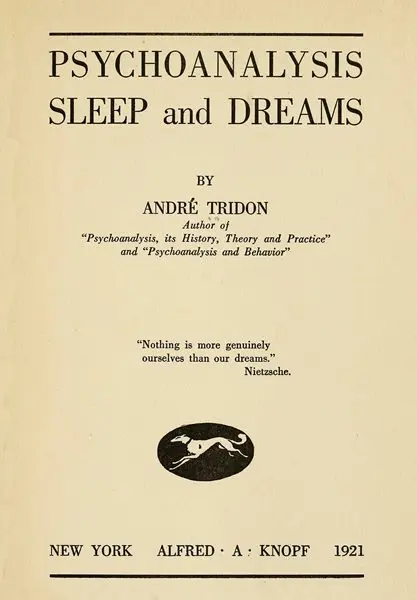
Psychoanalysis, Sleep and Dreams
André Tridon

THE CLASSIC COLLECTION · 1922
"Psychoanalysis and Love" by André Tridon is a scientific publication written in the early 20th century. The book examines love from a psychoanalytical perspective, delving into its involuntary nature, the choice of a mate, and the psychological factors underlying romantic relationships. It integrates principles from various branches of science, particularly focusing on the interactions of psychological and biological processes that shape human affection and attachment. The opening of "Psychoanalysis and Love" introduces the complex nature of love, emphasizing its involuntary character and how it operates outside the realm of conscious choice. Tridon contrasts this with animal mating behaviors, illustrating the complications that arise due to the civilized restrictions imposed on human interactions. He further discusses the traditional associations of the heart with emotion, asserting that love should be understood through a scientific lens rather than the romanticized notions often presented in literature. The material raises essential questions about the dynamics of emotional experiences in modern society, setting the stage for an in-depth exploration of love's physiological, psychological, and sociological dimensions in the subsequent chapters.
Introduction adapted from the source catalogue; source summaries may be automatically generated.
Free to read · English · 63,582 words · No account needed
MAKE TIME FOR A GOOD BOOK
On by default. Untick to stop anonymous reading totals. Each page counts after 10 seconds in view. How this works.
Anonymous counting is on unless you have switched it off.
=Fear of Pregnancy.= Unfortunately, civilisation has surrounded motherhood with so many complications, social, ethical, financial, sentimental, etc., that in very few women, indeed, is that biological process an unmixed pleasure, dissociated from all pain and anxiety.
Vomiting, which expresses the female's disgust for her condition, or her mate or the offspring; cramplike tensions, expressing her worries about her appearance, her anxious thought of financial or social consequences; anxiety states, affecting the adrenals, which discolor her face (pregnancy mask), make pregnancy hideous in many cases.
Even the process of parturition seems to have become more painful and dangerous with advancing civilisation.
Any one who has seen, for instance, Mexican women barely interrupting their labor in the fields to give birth to a child, and resuming their tasks an hour later, must realise that autosuggestion has much to do with the physical disability of the civilised woman in child bed.
In spite of the complexities of modern life, the female organism which is not affected by fear complexes, must expect a pleasure premium from pregnancy, lactation and other duties of motherhood. This would supply us with an organic basis for the mother's attachment to her offspring which is observable almost in every animal species.
That a number of women may be found who hate their children owing to the suffering to which unwelcome motherhood and difficult parturition have subjected them, is easily understandable. In fact we face a vicious circle. The unwelcome pregnancy will be an unpleasant one, followed almost unavoidably by painful delivery, etc.
=When Mother Love is Lacking= or when a mother hates a very young child, the psychologist must look for morbid unconscious influences which analysis should remove as soon as possible.
Stekel, the Viennese analyst, tells of a woman who was very fond of three of her daughters but, for some mysterious reason, detested the fourth one. Analysis revealed that she imagined she saw every one of her husband's faults reproduced and magnified in the unfortunate child.
She also imagined that she loved her husband very deeply.
The year when the unloved child was conceived, however, she had fallen in love with another man, a young poet. She remained "technically faithful" to her husband, altho, when in his arms, it was always the poet to whom she was giving herself.
She hoped sentimentally that the forthcoming child would look like her platonic lover but the little girl reproduced with striking faithfulness her father's features.
Unwilling to accept her dislike of her husband, the romantic mother had transferred it to the child who served as a scapegoat in various ways.
=Frigid Wives.= We often observe a great craving for motherhood in
frigid wives.
Your reading position is saved on this browser. Take it to another device with a library code. Reading pages adapt to text, rather than matching a printed edition.
André Tridon
BEHIND THE BOOK
This eBook is for the use of anyone anywhere in the United States and most other parts of the world at no cost and with almost no restrictions whatsoever. You may copy it, give it away or re-use it under the terms of the Project Gutenberg License included with this eBook or online at www.gutenberg.org. If you are not located in the United States, you will have to check the laws of the country where you are located before using this eBook. Read the source licence.
The original source file, including credits and licence, is retained by this library. Request an original-format copy at no charge. Please include the book title and Project Gutenberg identifier #61124.
KEEP YOUR CURIOSITY GOING

David Patterson (Spirit) Hatch
Coulson Kernahan

Ralph Waldo Emerson
Frances Wright

Edwin Abbott Abbott

Joseph Droz